
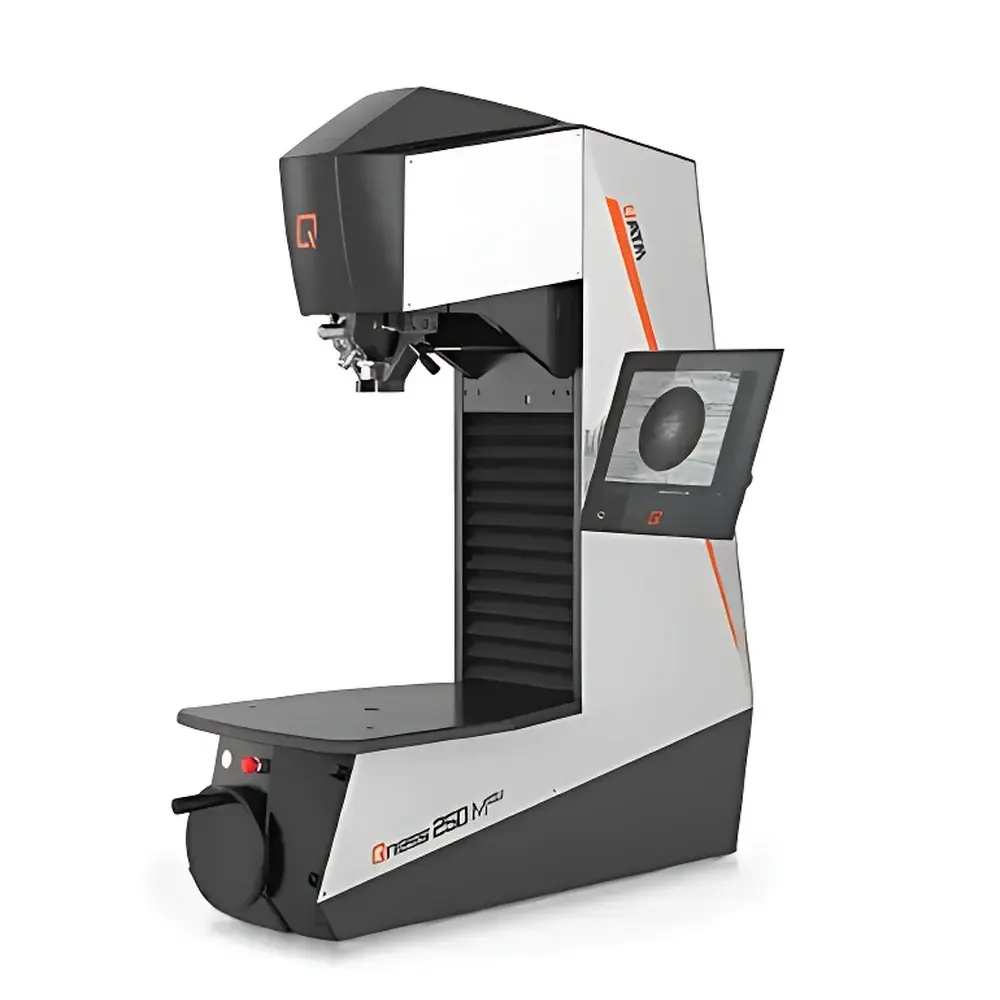
QATM QNESS 250 / 750 / 3000 M EVO Macro Hardness Tester for Large Components
| Brand | QATM |
|---|---|
| Origin | Austria |
| Model | QNESS 250 M EVO / QNESS 750 M EVO / QNESS 3000 M EVO |
| Testing Force Range | QNESS 250 M EVO: 1–250 kgf (9.81–2450 N) |
| QNESS 750 M EVO | 0.3–750 kgf (2.94–7358 N) |
| QNESS 3000 M EVO | 0.3–3000 kgf (2.94–29430 N) |
| Max Test Height | 510 mm |
| Throat Depth | 320 mm |
| Anvil Dimensions | 584 × 450 mm |
| Weight | 490 kg |
| Imaging | 5 MP industrial Ethernet camera, up to 270 fps |
| Turret | 2-position standard or 8-position optional |
| Software | Qpix T2 (optional Qpix CONTROL 2 M) |
| OS | Windows 10 IoT |
| Storage | 128 GB SSD |
| Power Supply | 230 V ~1/N/PE or 110 V ~1/N/PE |
| Max Power Consumption | ~480 W |
Overview
The QATM QNESS 250 / 750 / 3000 M EVO is a fully engineered macro hardness testing system designed for high-precision mechanical property evaluation of large-scale industrial components. Built on a rigid cast-iron base and optimized for structural stability, the M EVO series implements classical indentation hardness principles—namely Brinell, Vickers, Rockwell, Knoop, and plastic hardness testing—under precisely controlled static load application. Its defining architectural feature is the manually operated, low-friction rotational handwheel mechanism that positions the test head along a vertically aligned column, enabling smooth, backlash-free movement across the full 510 mm test height range. This mechanical design eliminates motorized complexity while ensuring repeatability and long-term calibration integrity—critical for laboratories operating under ISO/IEC 17025, ASTM E10, E384, E18, and ISO 6506–6507 compliance frameworks. The system’s open-throat geometry (320 mm depth) and oversized anvil (584 × 450 mm) accommodate forgings, castings, heavy-duty gears, turbine discs, rail sections, and welded assemblies without requiring part sectioning or repositioning.
Key Features
- Modular force capacity: Three platform variants—QNESS 250 M EVO (1–250 kgf), QNESS 750 M EVO (0.3–750 kgf), and QNESS 3000 M EVO (0.3–3000 kgf)—enable scalable testing from thin case-hardened layers to bulk structural steel.
- Manual precision positioning: Ergonomically designed front-mounted handwheel delivers tactile control over test head vertical travel with minimal operator effort, eliminating servo-induced vibration and preserving indenter alignment stability.
- Industrial-grade optical imaging: Integrated 5-megapixel Ethernet camera supports real-time image acquisition at up to 270 frames per second, compatible with automated measurement algorithms in Qpix T2 software.
- Multi-objective turret configuration: Standard 2-position turret accommodates dual indenters (e.g., diamond pyramid + tungsten carbide ball); optional 8-position turret enables unattended multi-method sequencing (Brinell/Vickers/Rockwell/Knoop).
- Robust mechanical architecture: 490 kg mass, vibration-damped base, and hardened linear guides ensure thermal and mechanical stability during extended test cycles—even in non-climate-controlled production floor environments.
- Comprehensive accessory ecosystem: Includes cross-laser alignment aids, anti-collision protection modules, V-groove fixtures, custom anvil inserts, and barcode/QR code readers for LIMS-integrated sample traceability.
Sample Compatibility & Compliance
The QNESS M EVO series accommodates specimens of unrestricted weight, provided they fit within the 510 mm maximum test height and 320 mm throat depth envelope. Its large anvil surface (584 × 450 mm) supports flat, curved, or irregularly shaped parts—including cylindrical shafts, flanged joints, and thick-section weldments—without auxiliary support structures. All models comply with international hardness testing standards including ASTM E10 (Brinell), ASTM E384 (Knoop & micro-Vickers), ASTM E18 (Rockwell), ISO 6506 (Brinell), ISO 6507 (Vickers), ISO 6508 (Rockwell), and ISO 4545 (Knoop). The electronic force control system meets Class 1 accuracy requirements per ISO 6506-2 and ASTM E10-22 Annex A1. Optional Qpix CONTROL 2 M software provides full audit trail functionality compliant with FDA 21 CFR Part 11 and EU Annex 11 for regulated quality control environments.
Software & Data Management
Qpix T2 serves as the primary user interface—delivering intuitive touchscreen operation via the integrated 12″ capacitive display. It supports automated hardness calculation, statistical reporting (mean, SD, min/max, histogram), and customizable report templates exportable to PDF, CSV, or XML. For regulated industries, Qpix CONTROL 2 M adds role-based access control, electronic signatures, instrument calibration history logging, and tamper-proof audit trails with timestamped operator actions. Data exchange is facilitated through four USB ports, dual Gigabit Ethernet interfaces (one dedicated to camera streaming), and optional OPC UA or MODBUS TCP gateways for MES/SCADA integration. All systems ship with Windows 10 IoT Enterprise and a 128 GB industrial SSD optimized for write endurance under continuous data logging.
Applications
- Heavy manufacturing QA/QC: hardness verification of forged crankshafts, pressure vessel heads, and offshore pipeline girth welds.
- Aerospace component certification: case depth validation on landing gear axles and turbine blade root sections using Knoop or low-force Vickers.
- Railway infrastructure: bulk hardness profiling of rail heads and switch points per EN 13674-1.
- Energy sector: material qualification of nuclear reactor vessel cladding and steam turbine rotors.
- Research & development labs: comparative studies of heat treatment response across alloy families (e.g., AISI 4140, Inconel 718, Ti-6Al-4V).
- Third-party testing laboratories: accredited hardness services supporting ISO/IEC 17025 scope expansion for macro-scale metallic materials.
FAQ
What hardness methods does the QNESS M EVO support?
Brinell, Vickers, Rockwell (A, B, C, D, E, F, G, H, K scales), Knoop, and plastic hardness testing (e.g., Shore D)—all implemented via interchangeable indenters and calibrated force application.
Is the system suitable for on-site use in production workshops?
Yes—the manual positioning mechanism, robust cast-iron construction, and absence of sensitive servo drives make it highly tolerant of ambient vibration and temperature fluctuation typical in shop-floor environments.
Can the QNESS M EVO be integrated into an existing LIMS or MES?
Yes—via native Ethernet connectivity, OPC UA drivers (optional), and structured data export formats (CSV, XML, PDF), enabling bidirectional communication with laboratory information management systems and enterprise manufacturing execution platforms.
Does the system require periodic recalibration by a certified service provider?
Annual verification against traceable reference blocks is recommended per ISO/IEC 17025 and ASTM E10/E18; however, built-in self-diagnostic routines and force sensor linearity checks allow in-house performance monitoring between formal calibrations.
What optical magnification options are available for indenter impression analysis?
Standard lenses include XLED 1, XLED 2, XLED 5, and fixed magnifications of 5×, 10×, 20×, 50×, and 100×, delivering field-of-view ranges from 0.113 × 0.084 mm (at 100×) to 7.98 × 5.97 mm (at XLED 1).



