
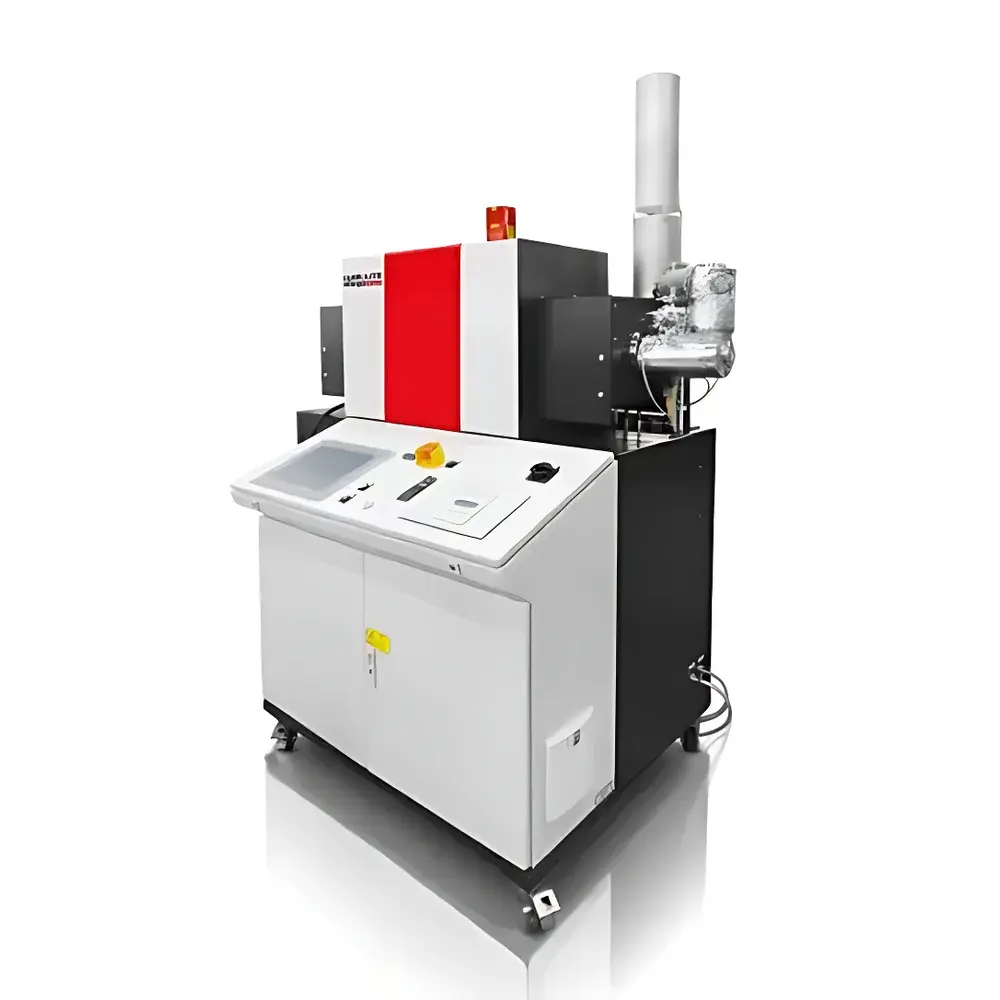
Carbolite Gero HTRH-H2 Hydrogen-Compatible High-Temperature Tube Furnace
| Brand | Carbolite Gero |
|---|---|
| Origin | Germany |
| Model | HTRH-H2 |
| Maximum Temperature | 1600 °C |
| Gas Compatibility | 100% H₂ (certified) |
| Safety Certification | SIL2-compliant |
| Cooling | Water-cooled ceramic tube ends with leak-tight flanges |
| Purge System | Automated inert gas (N₂ or Ar) pre-purge via mass flow controllers |
| Exhaust Treatment | Heated catalytic tail-gas burner (propane/air-driven) |
| Control Interface | Industrial-grade touchscreen HMI with audit-trail-capable data logging |
| Compliance | Designed to meet EN 13445, PED 2014/68/EU, ATEX Directive 2014/34/EU (Zone 1), and IEC 61508 for functional safety |
Overview
The Carbolite Gero HTRH-H2 is a rigorously engineered hydrogen-compatible high-temperature tube furnace designed for controlled thermal processing under pure hydrogen atmospheres up to 1600 °C. Unlike standard tube furnaces retrofitted for H₂ service, the HTRH-H2 is purpose-built from the ground up to satisfy stringent international safety and operational requirements for hydrogen handling—including ISO/IEC 80079-36, EN 15634-1, and the European Pressure Equipment Directive. Its core architecture integrates dual-safety-layer engineering: first, a fully sealed, water-cooled ceramic tube assembly with welded-in flanges and helium-leak-tested joints; second, an integrated functional safety system certified to SIL2 per IEC 61508. The furnace operates on the principle of resistive heating via silicon carbide (SiC) or molybdenum disilicide (MoSi₂) heating elements, housed within a multi-zone insulated hot zone to ensure axial temperature uniformity ±5 °C over 300 mm. Crucially, it is not a modified general-purpose furnace—it is a dedicated hydrogen process platform meeting the same safety rigor applied in industrial catalyst reduction, metal powder sintering, and advanced ceramic synthesis.
Key Features
- SIL2-certified safety architecture with redundant hydrogen detection: dual-point H₂ sensors mounted at top and rear of furnace housing, triggering immediate inert gas purge and thermal shutdown upon threshold detection (100 ppm lower explosive limit alarm, 500 ppm emergency shutdown)
- Automated, programmable inert gas purge sequence prior to H₂ introduction—controlled by calibrated mass flow controllers (MFCs) with real-time validation of O₂ residual ≤50 ppm
- Heated catalytic tail-gas combustion unit operating at ≥300 °C to prevent condensate formation and ensure complete oxidation of H₂ and organic volatiles (e.g., binder pyrolysis products from MIM/CIM feedstocks)
- Water-cooled ceramic end flanges with integrated thermocouple ports and pressure-rated sealing (up to 2 bar gauge), enabling stable operation under dynamic H₂ flow and thermal cycling
- Full-featured touchscreen HMI with embedded data logger compliant with FDA 21 CFR Part 11 (electronic signatures, audit trail, user role management)
- Modular hot zone design supporting interchangeable tube materials: high-purity quartz (≤1100 °C), recrystallized alumina (≤1600 °C), or molybdenum (inert/vacuum only); all tubes qualified for H₂ service per ASTM E2914
Sample Compatibility & Compliance
The HTRH-H2 accommodates a broad range of sample geometries and chemistries relevant to advanced materials R&D and production QA/QC. It supports crucibles and boats made from graphite, alumina, zirconia, or molybdenum—compatible with reducing, inert, or mixed-atmosphere processes. All internal components contacting H₂ are passivated or electropolished to minimize catalytic surface reactions. The system complies with GLP and GMP documentation standards through its built-in electronic recordkeeping, including timestamped event logs for purge cycles, temperature ramps, gas flows, fault states, and operator interventions. Third-party verification reports (TÜV or DEKRA) for ATEX Zone 1 classification and PED 2014/68/EU conformity are supplied with each unit. Optional integration with external vacuum systems (e.g., turbomolecular pumps) enables hybrid H₂/vacuum protocols per ISO 14644 cleanroom-compatible installation guidelines.
Software & Data Management
The furnace runs on Carbolite Gero’s proprietary ProcessMaster™ control firmware, accessible via a 7-inch capacitive touchscreen with IP65-rated enclosure. The interface supports up to 20 programmable ramp-soak profiles, each with independent gas sequencing logic (e.g., “hold at 400 °C under N₂ → switch to H₂ at 50 sccm → ramp to 1400 °C”). All operational data—including thermocouple readings, MFC setpoints/actuals, H₂ sensor outputs, and safety state transitions—are logged at 1-second intervals to internal secure storage (16 GB) and exportable via USB or Ethernet (Modbus TCP). Audit trails include user ID, timestamp, parameter change, and reason code—fully traceable for regulatory submissions. Optional cloud synchronization (via encrypted TLS 1.3) enables remote monitoring and centralized fleet management across multi-site laboratories.
Applications
The HTRH-H2 serves as a reference-grade tool for thermal processes demanding strict redox control and explosion-proof integrity. Key applications include: catalytic material activation (e.g., Ni, Co, Fe-based Fischer–Tropsch precursors); hydrogen reduction of metal oxides (WO₃ → W, CuO → Cu); sintering of tungsten carbide and titanium alloys under stoichiometric H₂; debinding and sintering of MIM/CIM green parts; annealing of silicon carbide wafers; synthesis of transition metal hydrides; and thermal desorption spectroscopy (TDS) sample preparation. Its validated performance makes it suitable for ASTM C1171 (ceramic matrix composites), ISO 2738 (metal powder sintering), and USP (pharmaceutical excipient thermal stability) workflows.
FAQ
Is the HTRH-H2 certified for use with 100% hydrogen at full 1600 °C?
Yes—the entire hot zone, gas train, and exhaust system are type-tested and certified for continuous operation at 1600 °C under 100% H₂ at atmospheric pressure.
Can the furnace be integrated into an existing lab automation framework?
Yes—Modbus TCP, RS485, and optional OPC UA interfaces enable seamless integration with LIMS, MES, or SCADA platforms.
What maintenance is required for the tail-gas burner?
The catalytic burner requires annual inspection of the propane/air mixing nozzle and catalyst bed integrity; no consumables are replaced under normal operation.
Does the system support rapid cooling under H₂?
Rapid cooling is available as an option using forced inert gas quenching (N₂ or Ar) with flow-controlled ramp rates up to −150 °C/min—H₂ must be purged before initiating quench.
Are calibration certificates included?
Each unit ships with factory-verified calibration reports for all thermocouples (Type S, traceable to NIST), MFCs (±1% FS), and H₂ sensors (per ISO 17025-accredited lab).



