
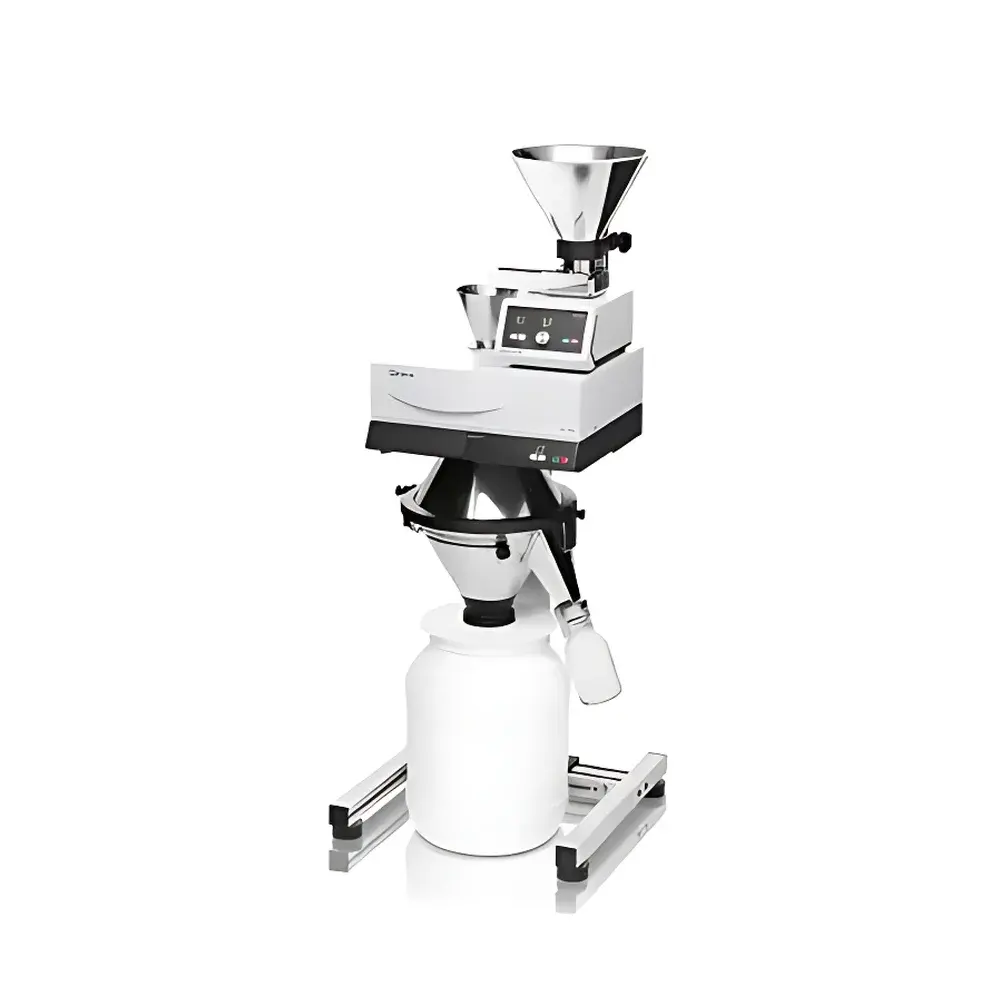
Retsch PT200 Rotating Tube Sample Divider
| Brand | Retsch |
|---|---|
| Origin | Germany |
| Model | PT200 |
| Sample Inlet Size | ≤ 10 mm |
| Rotation Speed | 50 rpm |
| Dividing Ports | 1–3 (configurable) |
| Split Ratio Range | 1:5 to 1:26 per port |
| Slit Width Adjustment | 0–159 mm (1-port), 0–110 mm (2-port), 0–53 mm (3-port) |
| Time Setting | Digital, 1–60 min or continuous |
| Container Capacity | 250 mL / 500 mL (collection), 30 L (waste) |
| Power Supply | 100–240 V, 50/60 Hz |
| Dimensions (W×H×D) | 520 × 1050 × 551 mm (base unit) |
| Weight | ~46 kg (incl. DR 100) |
| Compliance | CE, DIN 51701 |
Overview
The Retsch PT200 Rotating Tube Sample Divider is a precision-engineered laboratory instrument designed for the representative and reproducible subdivision of bulk granular and powdered materials. Based on the rotating tube principle—where sample material flows continuously through a horizontally rotating cylindrical tube equipped with adjustable radial slits—the PT200 ensures statistically valid sub-sampling by achieving homogeneous distribution across multiple outlets via controlled gravitational flow and rotational dynamics. This method eliminates segregation bias inherent in static or gravity-fed dividers, making it especially suitable for heterogeneous particulate matrices such as cement clinker, mineral ores, agricultural grains, pharmaceutical excipients, and construction aggregates. The device operates in strict accordance with DIN 51701, the German standard governing mechanical sample division for granular solids, and supports compliance-critical workflows in quality control laboratories subject to ISO/IEC 17025, GLP, and GMP frameworks.
Key Features
- Modular configuration supporting 1, 2, or 3 independent sample outlets—enabling simultaneous generation of replicate subsamples for parallel analysis or archiving.
- Infinitely variable slit width adjustment (0–159 mm for single-port; down to 0–53 mm for triple-port mode), permitting precise control over mass split ratio without mechanical reconfiguration.
- Digital timer with programmable cycle durations (1, 3, 5, 10–60 minutes) or continuous operation mode, ensuring process repeatability across batch runs.
- Quick-release outlet cones and standardized collection vessels (250 mL and 500 mL options) facilitate rapid changeover between sample types and minimize cross-contamination risk.
- Integrated compatibility with the Retsch DR 100 vibratory feeder for automated, dust-controlled feeding—critical when handling fine, cohesive, or electrostatically sensitive powders.
- Robust stainless-steel construction and CE-certified electrical architecture ensure operational safety, long-term stability, and suitability for regulated environments including pharmaceutical QC and environmental testing labs.
Sample Compatibility & Compliance
The PT200 accepts free-flowing, non-dusty bulk solids with maximum particle size ≤ 10 mm. It is validated for use with fragile, friable, and abrasive materials—including roasted coffee beans, ceramic granules, metal powders, fertilizers, seeds, and slag—without inducing attrition or segregation artifacts. Its design conforms to DIN 51701 for mechanical sample division and supports traceability requirements under ISO 13320 (particle size analysis standards) and ASTM D6938 (soil sampling procedures). When deployed within validated analytical workflows, the PT200 contributes to data integrity aligned with FDA 21 CFR Part 11 expectations for electronic records, particularly when paired with audit-trail-capable LIMS integration.
Software & Data Management
While the PT200 operates as a stand-alone electromechanical system without embedded firmware or touchscreen interface, its digital timer and fixed-speed motor provide deterministic, repeatable operation parameters that are fully documentable in laboratory notebooks or electronic batch records. All operational settings—including duration, port configuration, and slit width—are manually recorded and verifiable during internal audits. For laboratories requiring enhanced traceability, the PT200 can be integrated into broader instrument networks via external PLC-based control systems or time-stamped video monitoring synchronized with analytical instrumentation (e.g., laser diffraction particle analyzers or XRF spectrometers). No proprietary software is required, minimizing validation burden in regulated settings.
Applications
The PT200 serves as a foundational sample preparation tool across diverse sectors: in agriculture, it enables representative subsampling of grain lots prior to moisture or mycotoxin testing; in cement production, it supports homogenization of clinker and fly ash before Blaine surface area determination; in environmental labs, it prepares heterogeneous soil composites for heavy metal extraction protocols; in food manufacturing, it ensures consistent portioning of flour, sugar, or nut blends for rheological or compositional assays. Its ability to maintain particle size distribution integrity during division makes it indispensable for feedstock qualification in additive manufacturing (metal AM powder certification) and battery cathode material processing.
FAQ
What standards does the PT200 comply with?
The PT200 conforms to DIN 51701 for mechanical sample division and carries CE marking for electromagnetic compatibility and low-voltage safety.
Can the PT200 handle moist or slightly agglomerated samples?
It is intended for dry, free-flowing materials only. For damp or cohesive samples, pre-drying or de-agglomeration using a Retsch GM 200 grinder or RS 200 sieve shaker is recommended prior to division.
Is calibration required for routine use?
No formal calibration is mandated, but periodic verification of slit width accuracy using certified gauge blocks and validation of split ratio consistency via gravimetric checks are recommended as part of laboratory quality assurance programs.
How does the PT200 compare to rotary cone or riffle-type dividers?
Unlike static riffle dividers, the PT200’s rotating tube mechanism minimizes particle segregation by maintaining dynamic flow equilibrium, resulting in higher statistical fidelity—especially for wide-size-distribution samples.
Can the PT200 be used in cleanroom environments?
Yes, provided appropriate containment (e.g., glovebox integration or local exhaust ventilation) is implemented; its sealed drive train and absence of lubricants contacting the sample path support ISO Class 7–8 cleanroom compatibility.



