
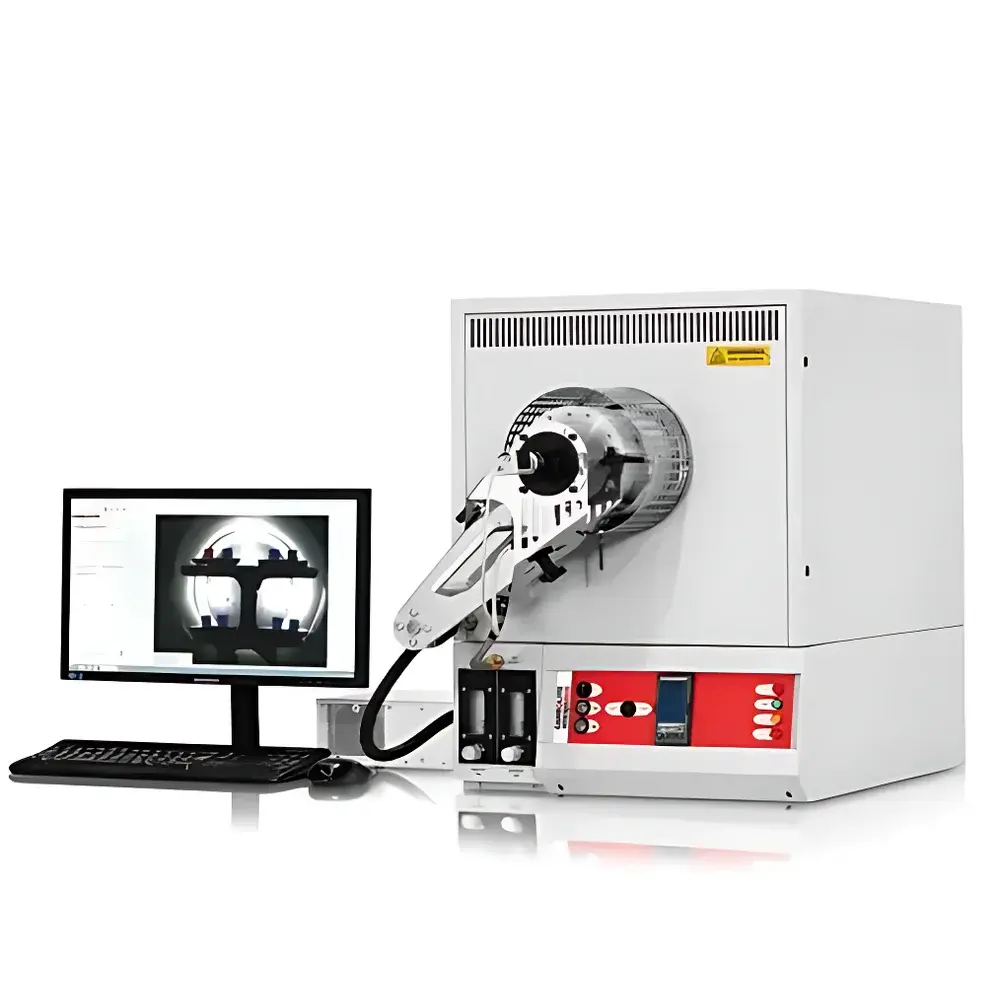
Carbolite Gero CAF G5 Ash Fusibility Tester
| Brand | Carbolite Gero |
|---|---|
| Origin | Germany |
| Model | CAF G5 |
| Instrument Type | Box-type Muffle Furnace |
| Max Temperature | 1600 °C |
| Temperature Precision | ±3 °C above 800 °C |
| Ramp Rate | 7 °C/min |
| Heating Elements | Six silicon carbide rods |
| Work Tube ID | 79 mm |
| Tube Material | RCA (refractory ceramic alloy) |
| Max Sample Load (Auto) | 6 samples |
| Max Sample Load (Manual) | 8 samples |
| Image Resolution | 1280 × 1024 pixels |
| Gas Options | N₂/CO₂ (purge), O₂/air (oxidizing), CO+CO₂ or H₂+CO₂ (reducing) |
| Power Supply | 380–415 V, 50/60 Hz, two-phase, 25 A/phase or 220–240 V, 50/60 Hz, single-phase, 50 A |
| Max Power Consumption | 7 kW |
| Dimensions (H×W×D) | 790 × 505 × 970 mm |
| Weight | 84 kg |
| Overtemperature Protection | Digital with high-alarm relay |
| Compliance | ISO 540:2008, ASTM D1857/D1857M–04(2010), DIN 51730:2007-09, DD CEN/TS 15370-1:2006, PD CEN/TR 15404:2010 |
Overview
The Carbolite Gero CAF G5 Ash Fusibility Tester is a purpose-built, standards-compliant thermal analysis system engineered for the precise determination of ash fusion temperatures in coal, coke, biomass, and solid recovered fuels (SRF). It operates on the principle of controlled-atmosphere high-temperature observation: samples are heated inside a refractory work tube under programmable oxidizing, reducing, or inert gas environments while high-resolution digital imaging captures morphological changes—deformation, softening, hemispherical, and fluid states—in real time. Designed to meet the stringent thermal and metrological requirements of ISO 540:2008 and ASTM D1857, the CAF G5 delivers reproducible, auditable results essential for fuel quality assessment, combustion optimization, slagging/fouling prediction, and regulatory compliance in energy and waste-to-energy sectors.
Key Features
- Integrated embedded computer running Windows IoT Enterprise, enabling standalone operation without external PCs and supporting future firmware upgrades.
- Digital multi-PID temperature control with gain scheduling and multi-offset compensation ensures stable ramping (7 °C/min) and tight precision (±3 °C above 800 °C) across the full 25–1600 °C range.
- High-fidelity imaging system captures up to one frame per 1 °C temperature increment (configurable from 1–20 °C steps); automatic analysis intervals capped at 5 °C for robust feature detection.
- Refractory ceramic alloy (RCA) work tube (79 mm ID) with optional integrated illumination for enhanced contrast during low-temperature initial deformation (IST) analysis of biomass and SRF.
- Fail-safe gas management system including CO alarm and interlocked purge/oxidizing/reducing gas switching—fully compliant with laboratory safety protocols and GLP audit requirements.
- Lightweight insulation architecture enables rapid cooldown, permitting up to three full test cycles—including heating, dwell, imaging, and cooling—within a single working day.
- Solid-state power relays and dual-voltage compatibility (380–415 V two-phase or 220–240 V single-phase) ensure reliable operation in diverse facility infrastructures.
Sample Compatibility & Compliance
The CAF G5 accommodates heterogeneous feedstock matrices: bituminous and anthracite coals, metallurgical coke, woody and herbaceous biomass (e.g., straw, pellets), and heterogeneous SRF streams containing plastics, paper, and biogenic fractions. Its validated methodology supports all standard ash fusibility endpoints: for coal/coke—Deformation Temperature (DT), Softening Temperature (ST), Hemispherical Temperature (HT), and Flow Temperature (FT); for biomass/SRF—the Initial Shrinkage Temperature (IST) in addition to DT, HT, and FT. The system is certified to BS ISO 540:2008, ASTM D1857/D1857M–04(2010), DIN 51730:2007-09, DD CEN/TS 15370-1:2006 (biomass), and PD CEN/TR 15404:2010 (SRF), ensuring data integrity for ISO/IEC 17025-accredited laboratories and regulatory submissions to EPA, EU ETS, and national fuel certification bodies.
Software & Data Management
The embedded CAF G5 software provides both automated and manual analysis modes. Default templates preconfigure gas sequences, ramp profiles, and endpoint criteria per material class (coal, biomass, SRF), minimizing operator input error. Each test generates a timestamped image sequence linked to thermocouple readings and gas flow logs. Software-based grid overlay allows pixel-level dimensional scaling for accurate geometric classification of ash shapes. All raw images, metadata, and analysis reports are stored locally with optional network export. Audit trails—including user login, parameter edits, and result approvals—are retained in accordance with FDA 21 CFR Part 11 and EU Annex 11 requirements for electronic records and signatures.
Applications
- Fuel procurement QA/QC: Verifying supplier ash fusion specifications prior to bulk delivery.
- Combustion R&D: Correlating ash behavior with boiler design parameters (e.g., furnace exit gas temperature, slag tap configuration).
- Co-firing optimization: Assessing interaction effects between coal and biomass ash in blended firing trials.
- Waste-derived fuel qualification: Supporting EN 15359 classification of SRF based on ash melting characteristics.
- Emissions modeling: Providing input data for predictive slagging indices (e.g., base-to-acid ratio, silica-alumina index).
- Academic research: Enabling kinetic studies of ash phase transformations via synchronized thermal–optical–gas data acquisition.
FAQ
What gas atmospheres does the CAF G5 support, and how are they controlled?
The system supports inert (N₂ or CO₂), oxidizing (O₂ or air), and reducing (CO + CO₂ or H₂ + CO₂) atmospheres via solenoid-valve-managed, pressure-regulated gas lines. Gas switching is fully automated and interlocked with temperature and safety systems.
Can the CAF G5 analyze more than one sample simultaneously?
Yes—up to six samples in fully automated mode; eight when using manual endpoint identification. Each sample is processed sequentially within a single run to maintain thermal and atmospheric consistency.
Is remote monitoring or data export possible?
All test data—including images, temperature logs, gas flow timestamps, and analysis reports—are stored on the embedded Windows IoT Enterprise platform and can be exported via USB or network share in CSV, PNG, and PDF formats.
How does the system ensure measurement traceability and regulatory compliance?
Temperature calibration is traceable to NIST-equivalent standards; image capture and analysis algorithms are version-controlled and documented per ISO/IEC 17025 clause 7.7; full electronic audit trails satisfy FDA 21 CFR Part 11 and EU Annex 11 requirements.
What maintenance is required for long-term operational reliability?
Scheduled replacement of silicon carbide heating elements (typically >5,000 hours at 1300 °C), periodic verification of thermocouple accuracy, and annual inspection of gas seals and exhaust ducting are recommended per the manufacturer’s service protocol.



