
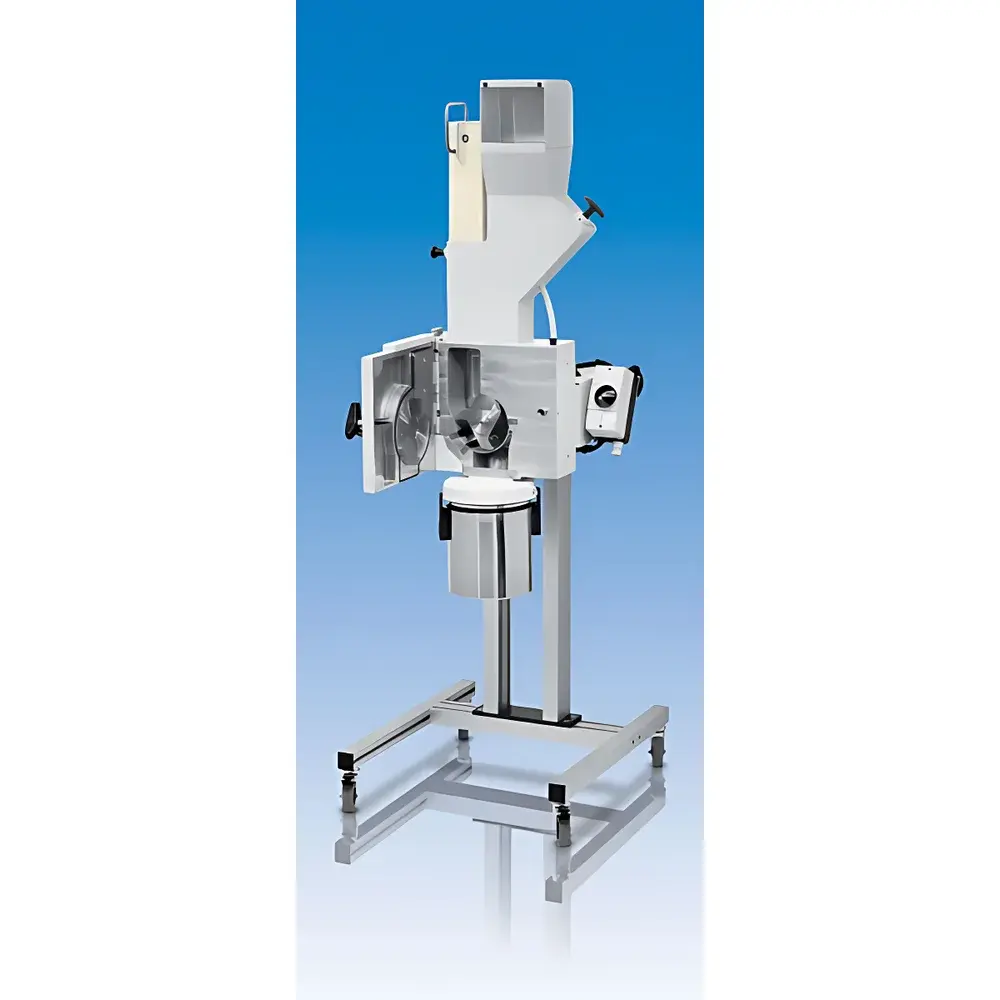
Retsch SM100 Cutting Mill
| Brand | Retsch |
|---|---|
| Origin | Germany |
| Model | SM100 |
| Sample Type | Hard, fibrous, elastic, medium-hard materials |
| Feed Size | ≤ 60 × 80 mm |
| Final Particle Size | 0.25–20 mm |
| Batch Capacity | 5–30 L |
| Rotor Speed | 1390 rpm (50 Hz) / 1690 rpm (60 Hz) |
| Motor Power | 1500 W |
| Dimensions (W×H×D) | 560 × 1510 × 700 mm (with stand & standard hopper) |
| Weight | ~68 kg |
| Compliance | CE certified |
| Screening Options | Replaceable bottom sieve (sieve aperture defines final particle size) |
| Dust Control | Integrated low-dust design with optional filter bag or ring sieve collection |
Overview
The Retsch SM100 Cutting Mill is a high-performance, CE-certified laboratory cutting mill engineered for reproducible, low-heat comminution of heterogeneous, fibrous, and tough organic or synthetic materials. Operating on the principle of controlled shear and parallel cutting—rather than impact or compression—the instrument utilizes a rotating rotor equipped with three hardened steel cutting knives that interact precisely with four fixed cutting edges mounted on the grinding chamber wall. This geometry ensures consistent material reduction through clean shearing action, minimizing thermal degradation and particle agglomeration. The residence time within the grinding chamber is inherently short; particles exit only once their dimension falls below the selected sieve aperture, enabling precise endpoint control without overgrinding. Designed for 50/60 Hz power networks, the motor delivers stable 1500 W output and rotates the rotor at 1390 rpm (50 Hz) or 1690 rpm (60 Hz), supporting throughput rates of 0.2–50 kg/h depending on sample density, moisture content, and toughness. Its robust stainless-steel construction and modular feed system make it suitable for routine QC, preparative sample homogenization, and method development in regulated environments.
Key Features
- Parallel-cutting mechanism with three interchangeable hardened-steel rotor knives and four fixed counter-cutting edges for uniform, low-heat size reduction
- Adjustable final particle size via interchangeable bottom sieves—aperture range supports target outputs from 0.25 mm to 20 mm
- Three optional feed hoppers (standard, wide-mouth, and funnel-type) to accommodate variable sample geometries and flow characteristics
- Low-dust operation enabled by integrated airflow management and compatibility with filter bags or ring-sieve collection systems
- Thermally optimized grinding chamber design limits temperature rise during extended operation—critical for heat-sensitive botanicals, polymers, and pharmaceutical excipients
- Tool-free rotor access and quick-release sieve housing facilitate rapid cleaning, maintenance, and cross-contamination prevention between batches
- CE-compliant electrical architecture with dual-voltage capability (single-phase and three-phase AC input) for global laboratory deployment
Sample Compatibility & Compliance
The SM100 demonstrates broad compatibility across soft to medium-hard, elastic, and highly fibrous matrices—including plant stems, cereal grains, herbal raw materials, paperboard, synthetic textiles, animal feed pellets, lignocellulosic biomass (e.g., straw, sawdust), and low-rank coals such as lignite and brown coal. It is not intended for abrasive minerals, metals, or highly viscous/wet samples (>15% moisture). All mechanical and electrical components comply with EU Machinery Directive 2006/42/EC and Low Voltage Directive 2014/35/EU. The unit carries full CE marking and conforms to EN 61000-6-2 (immunity) and EN 61000-6-4 (emission) standards. While not intrinsically rated for ATEX zones, its dust-controlled configuration supports safe handling of combustible organic powders under appropriate local safety protocols.
Software & Data Management
The SM100 operates as a standalone electromechanical instrument without embedded digital control or data logging. However, its deterministic mechanical behavior—fixed rotor speed, calibrated sieve geometry, and repeatable feed geometry—enables full traceability when integrated into documented laboratory workflows. Users may record operational parameters (e.g., sieve ID, feed mass, run duration, ambient temperature) manually or via LIMS-compatible entry forms. For GLP/GMP-aligned labs, the device supports audit-ready documentation when paired with standardized SOPs covering calibration verification (rotor speed confirmation via tachometer), preventive maintenance logs (knife wear inspection, sieve integrity checks), and cleaning validation records. Optional accessories—including certified reference materials for particle size verification and NIST-traceable sieve calibration kits—further strengthen metrological traceability.
Applications
- Preparatory milling of botanical samples prior to NIR, HPLC, or elemental analysis (e.g., leaves, roots, bark, seeds)
- Homogenization of feed formulations and agricultural commodities for nutritional profiling and mycotoxin testing
- Size reduction of polymer scraps and composite laminates for FTIR identification and thermal analysis (TGA/DSC)
- Routine comminution of paper, cardboard, and cellulose-based packaging waste for recycling process characterization
- Particle size conditioning of lignocellulosic feedstocks prior to enzymatic hydrolysis or pyrolysis studies
- Standardized grinding of herbal medicines and traditional remedies in pharmacognosy and quality control laboratories
FAQ
What types of materials are unsuitable for processing in the SM100?
Materials with high moisture content (>15%), extreme abrasiveness (e.g., quartz sand, alumina), metallic components, or thermoplastic behavior above 60 °C are not recommended. Adhesive or oily substances may clog the sieve and impair throughput.
Can the SM100 be used in regulated pharmaceutical environments?
Yes—provided it is operated under validated SOPs, with documented maintenance, cleaning, and performance verification. While the instrument lacks built-in electronic audit trails, its mechanical repeatability supports compliance with ICH Q5, USP , and ISO 17025 requirements when integrated into a broader quality system.
How often should the cutting knives be replaced?
Knife service life depends on cumulative throughput and material hardness. Under typical use with plant or feed samples, replacement is advised every 200–500 operating hours or upon visible edge rounding, chipping, or increased energy consumption.
Is external dust extraction required?
Not mandatory—but strongly recommended for prolonged operation or high-volume batches. The SM100’s low-dust design minimizes airborne release, yet connection to a central lab vacuum or cyclonic separator improves operator safety and chamber cleanliness, especially with fine or allergenic materials.
Does Retsch provide application support or method development assistance?
Yes—Retsch’s global Application Laboratories offer free feasibility testing, sieve selection guidance, and parameter optimization reports based on user-submitted sample material. Method transfer documentation and comparative particle size distribution (PSD) data can be generated upon request.



