
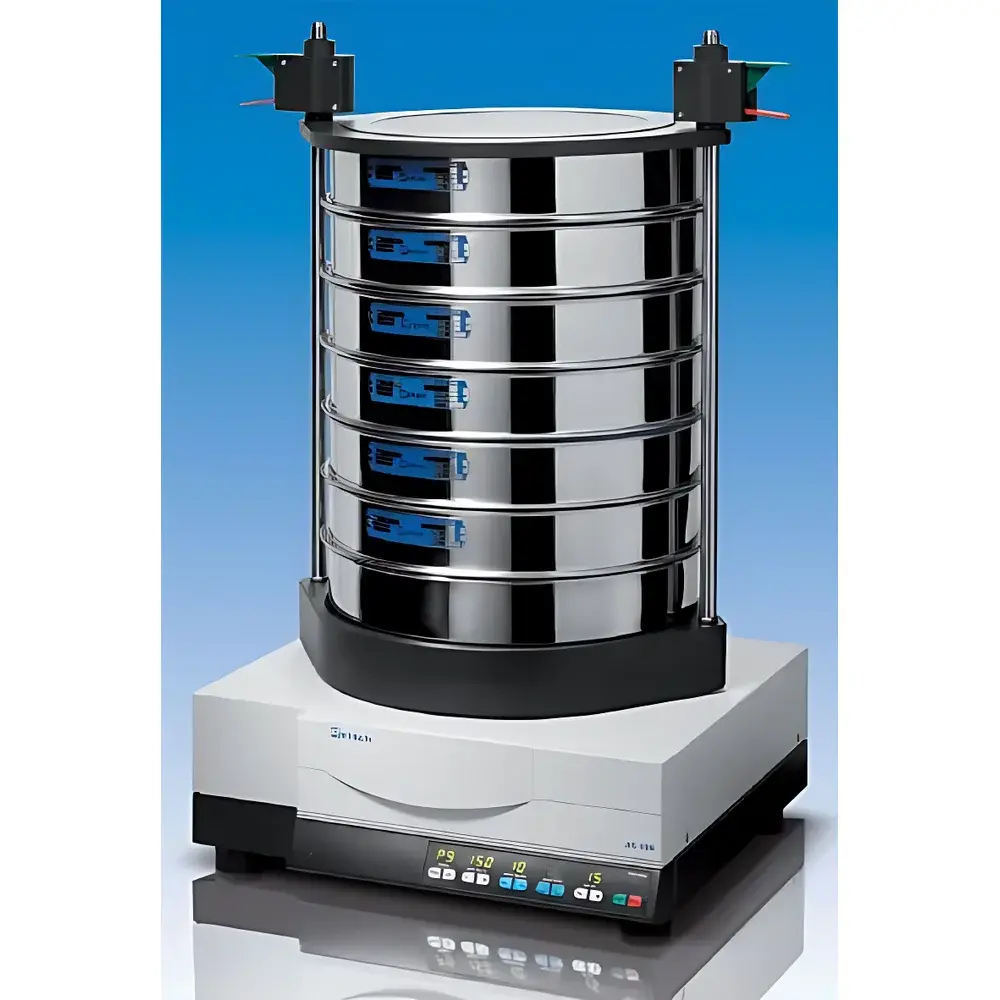
Retsch AS400 Control Sieve Shaker
| Brand | Retsch |
|---|---|
| Origin | Germany |
| Model | AS400 Control |
| Screening Motion | Horizontal Circular (DIN 53 477) |
| Speed Range | 50–300 rpm (electronically controlled, continuously adjustable) |
| Display | Digital speed & time readout |
| Motor Power | 125 W |
| Max. Sample Load | 5 kg |
| Max. Sieve Stack Mass | 15 kg |
| Max. Number of Sieves | 17 |
| Sieve Diameter Compatibility | 100 mm / 150 mm / 200 mm / 203 mm (8") / 305 mm (12") / 400 mm |
| Sieve Stack Height | up to ~450 mm |
| Measurement Range | 45 µm – 63 mm |
| Acceleration at Sieve Base | 0.04–1.51 g |
| Time Setting Range | 1–99 min (digital) |
| Intermittent Drive Interval | 1–99 s |
| Programmable Methods | Up to 9 stored protocols |
| Calibration | Traceable, certifiable |
| Compliance | CE-marked, compliant with DIN 53 477, ISO 2591-1, ASTM E11 |
| Interface | Parallel port |
| Dimensions (W × H × D) | 540 × 260 × 507 mm |
| Net Weight | ~70 kg |
Overview
The Retsch AS400 Control Sieve Shaker is a precision-engineered mechanical sieve shaker designed for standardized dry particle size analysis in quality control, R&D, and production environments. It operates on the principle of horizontal circular motion—strictly conforming to DIN 53 477, ISO 2591-1, and ASTM E11 standards—which ensures reproducible and comparable results across laboratories worldwide. Unlike vertical or tapping shakers, the AS400 Control generates uniform lateral displacement of the sieve stack via an eccentric drive mechanism, minimizing particle segregation and promoting efficient stratification of granular material across mesh openings. Its 125 W maintenance-free induction motor delivers consistent torque across the full speed range (50–300 rpm), enabling precise adaptation to diverse sample rheologies—from cohesive fine powders to free-flowing coarse aggregates. The instrument is not suitable for wet sieving; its design is optimized exclusively for dry, free-flowing or moderately cohesive particulate materials requiring reliable fractionation between 45 µm and 63 mm.
Key Features
- Horizontally rotating sieve motion compliant with DIN 53 477, ensuring regulatory alignment in materials testing labs.
- Digitally controlled, continuously adjustable rotational speed (50–300 rpm) with real-time display—enabling method optimization per sample density, moisture content, and particle shape.
- Robust mechanical architecture supporting up to 17 sieves and a maximum stack mass of 15 kg, maintaining stable amplitude and acceleration (0.04–1.51 g) even under full load.
- Ergonomic front-access design with low-noise operation (<65 dB(A)) and zero-maintenance drive system—eliminating belt wear, lubrication requirements, or frequency-dependent instability.
- Integrated parallel interface for external data logging or integration into LIMS environments; no reliance on mains frequency for speed stability.
- Onboard memory stores up to nine complete sieve protocols—including speed, duration, intermittent interval, and start/stop logic—for rapid recall and operator-independent execution.
- Traceable calibration capability with documentation support for GLP/GMP audits and ISO/IEC 17025-accredited testing facilities.
Sample Compatibility & Compliance
The AS400 Control accommodates a broad spectrum of dry, non-agglomerating or lightly agglomerated particulates. Validated applications include foundry sands, cementitious blends, agricultural seeds, metal and ceramic powders, mineral ores, pharmaceutical granules (post-drying), fertilizers, foodstuffs (e.g., flour, coffee grounds), and construction aggregates. It supports standard sieve diameters from 100 mm to 400 mm (including 8″ and 12″ formats), accommodating both laboratory-scale and industrial-grade analytical needs. All operational parameters align with internationally recognized test standards: DIN 53 477 (horizontal circular motion specification), ISO 2591-1 (sieving methods for particle size analysis), and ASTM E11 (specification for wire cloth and sieves). CE marking confirms conformity with EU Machinery Directive 2006/42/EC and Electromagnetic Compatibility Directive 2014/30/EU.
Software & Data Management
While the AS400 Control operates as a standalone hardware platform with intuitive front-panel controls, its parallel port enables direct connection to PCs running custom or third-party acquisition software. Users may log time-stamped speed, duration, and cycle count data for traceability. Though no proprietary software is bundled, the device supports integration with validated laboratory information management systems (LIMS) and electronic lab notebooks (ELN) when paired with compliant serial-to-parallel adapters. All parameter settings—including nine programmable methods—are retained in non-volatile memory. For regulated environments, audit trails can be generated externally; the instrument itself provides timestamped digital displays for speed and elapsed time, satisfying basic FDA 21 CFR Part 11 record-keeping prerequisites when combined with appropriate procedural controls.
Applications
This shaker is routinely deployed in QC laboratories across mining, building materials, chemicals, food processing, and powder metallurgy sectors. Typical use cases include: verifying compliance of silica sand against foundry grain size specifications (ASTM D3663); grading limestone fillers for asphalt binder compatibility; assessing particle size distribution of spray-dried catalyst precursors; monitoring consistency of milled spices or instant beverages; and validating sieve integrity during routine calibration checks. Its high mass capacity and stable motion profile make it particularly suited for multi-layer sieve stacks used in cumulative distribution analysis (e.g., Rosin-Rammler or log-normal fitting), where inter-sieve clogging must be minimized and mass recovery >99.5% is required.
FAQ
Is the AS400 Control suitable for wet sieving?
No. It is engineered exclusively for dry sieving applications. Wet sieving requires sealed enclosures, liquid handling components, and corrosion-resistant materials not present in this model.
Can I use ASTM E11-compliant sieves with this instrument?
Yes. All standard wire cloth sieves meeting ASTM E11, ISO 3310-1, or DIN 4188 specifications—regardless of diameter (100–400 mm)—are fully compatible.
Does the unit include calibration certification?
The AS400 Control is supplied with CE marking and factory verification of motion parameters. A formal calibration certificate (e.g., DAkkS or UKAS-accredited) may be ordered separately upon installation.
What is the recommended maintenance schedule?
None is required. The brushless induction motor and eccentric drive mechanism are sealed and lubrication-free, designed for continuous operation over 20,000 hours without service intervention.
How does the intermittent drive function improve sieving efficiency?
The 1–99 s pause intervals allow settled fines to re-suspend and re-engage with the sieve surface, enhancing separation resolution—particularly for dense or electrostatically charged powders prone to blinding.



