
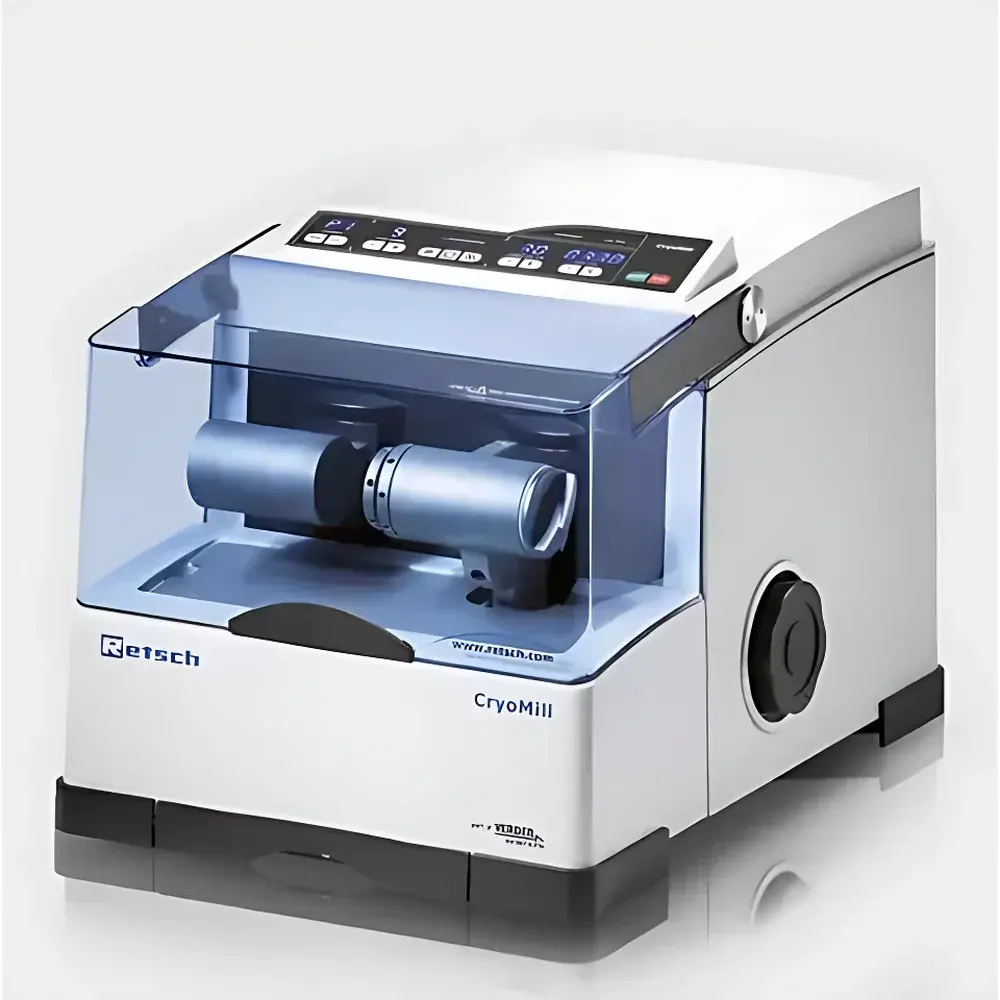
Retsch Cryomill Automatic Cryogenic Ball Mill
| Brand | Retsch |
|---|---|
| Origin | Germany |
| Model | Cryomill |
| Instrument Type | Cryogenic Ball Mill |
| Sample Compatibility | Frozen and temperature-sensitive materials |
| Feed Size | ≤ 8 mm |
| Final Particle Size | < 5 µm |
| Batch Capacity | Up to 1 × 50 mL |
| Operating Temperature Range | Down to –196 °C (liquid nitrogen cooled) |
| Grinding Mechanism | Radial vibration with high-energy ball impact and simultaneous friction |
| Compliance | Designed for GLP/GMP environments |
Overview
The Retsch Cryomill is an automated cryogenic ball mill engineered for the reproducible, high-energy comminution of temperature-sensitive, elastic, fibrous, or thermolabile samples. Unlike conventional mills operating at ambient conditions, the Cryomill integrates a fully automated liquid nitrogen dosing system that maintains sample integrity by suppressing thermal degradation, recrystallization, and polymer relaxation during grinding. Its core principle relies on radial high-frequency vibration of sealed grinding jars mounted on a horizontal axis—causing grinding balls to accelerate along the inner arc surface and impact the sample with kinetic energy exceeding 30 m/s². This dual-action mechanism combines impact fracture and shear-induced particle refinement under sustained sub-zero conditions, enabling consistent sub-5 µm particle size distributions without manual pre-freezing or external cryostat integration.
Key Features
- Fully automated liquid nitrogen supply system with programmable dosing intervals and real-time temperature monitoring via integrated Pt100 sensor
- Digital parameter control interface supporting customizable grinding cycles—including duration, frequency (3–30 Hz), pause intervals, and LN₂ volume per cycle
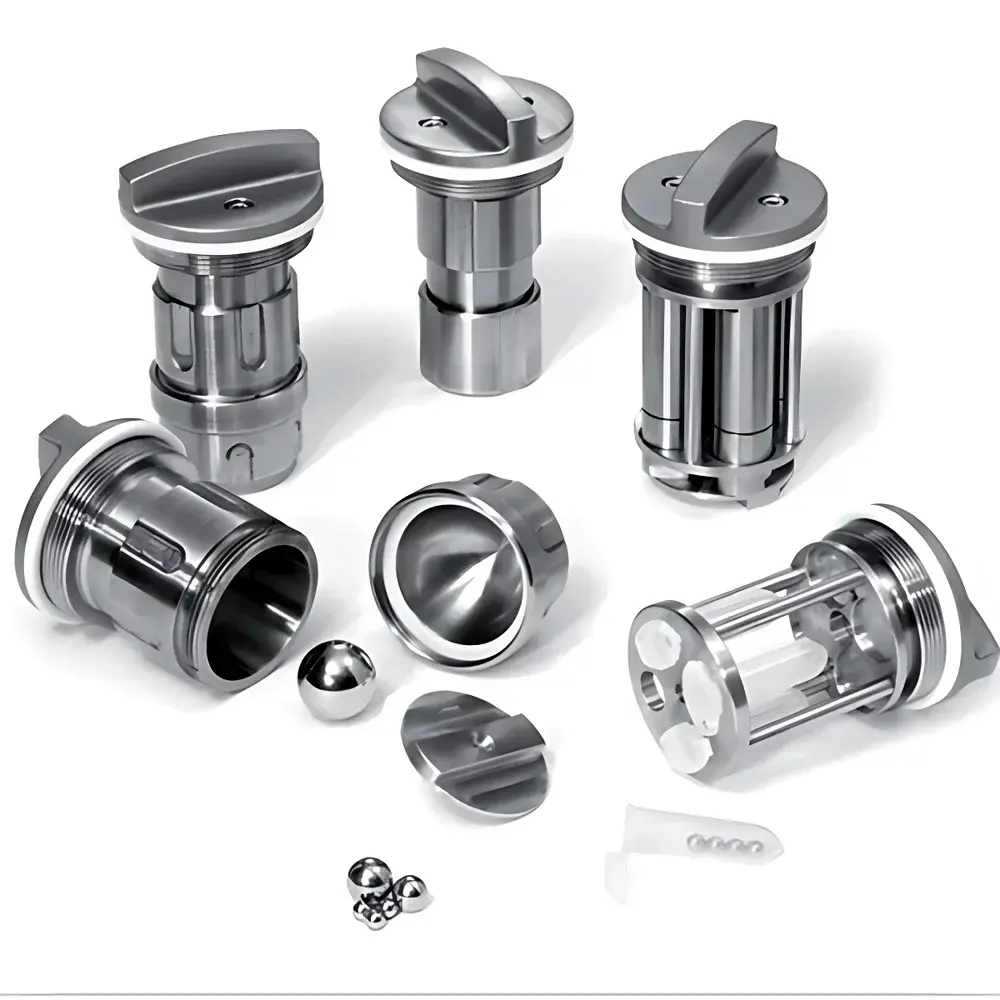
- Hermetically sealed grinding jars available in stainless steel, tungsten carbide, and hardened chrome steel (5, 25, 35, and 50 mL volumes) with pressure-relief safety valves
- Vibration-driven grinding architecture eliminating mechanical transmission losses and ensuring uniform energy distribution across all jar positions
- Integrated safety interlocks preventing operation with open chamber doors or unsecured jars; automatic emergency shutdown upon temperature or pressure deviation
- Minimal maintenance design with wear-resistant bearing assemblies and corrosion-resistant housing compliant with IP54 environmental rating
Sample Compatibility & Compliance
The Cryomill accommodates a broad spectrum of challenging matrices: biological tissues (e.g., muscle, liver, plant roots), polymers (PE, PTFE, elastomers), pharmaceutical excipients, rubber compounds, and composite materials prone to softening or agglomeration above –40 °C. It meets essential regulatory expectations for analytical sample preparation workflows—supporting traceability through timestamped parameter logs, user-access-controlled method storage, and electronic signature capability when paired with Retsch’s optional software suite. While not certified as a medical device, its construction adheres to ISO 9001 manufacturing standards and incorporates design elements aligned with ASTM E2917 (standard practice for validation of analytical instruments) and USP <1118> (cryogenic grinding of pharmaceuticals). The system is routinely deployed in QC labs operating under GLP and GMP frameworks where documentation of grinding conditions (temperature history, energy input, cycle consistency) is mandatory for batch release documentation.
Software & Data Management
Retsch’s RETSCH Control software (v3.2+) provides full remote configuration, real-time process visualization, and post-run report generation. Each grinding run generates a structured XML log containing start/stop timestamps, actual LN₂ consumption, measured jar temperature profiles, vibration amplitude data, and operator ID. These records are exportable in CSV or PDF formats and support integration into LIMS platforms via standard ODBC drivers. Optional 21 CFR Part 11 compliance packages include role-based access control, electronic signatures, and immutable audit trails—ensuring data integrity for regulated industries including pharmaceuticals, biotechnology, and forensic toxicology laboratories.
Applications
- Preparation of homogenized tissue powders for proteomics, metabolomics, and nucleic acid extraction
- Particle size reduction of heat-sensitive APIs prior to dissolution testing or solid-state characterization (XRD, DSC)
- Disruption of microbial cell walls for intracellular enzyme recovery without denaturation
- Production of ultrafine polymer blends for rheological or mechanical property evaluation
- Homogenization of heterogeneous geological or environmental samples (soils, sediments, sludges) prior to elemental analysis (ICP-MS/OES)
- Generation of reference materials with certified particle size distributions for instrument calibration
FAQ
What types of samples require cryogenic grinding?
Samples exhibiting thermal softening (e.g., rubber, waxes), structural collapse above –50 °C (e.g., collagen-rich tissues), or chemical instability at room temperature (e.g., certain alkaloids, peroxides) benefit from cryogenic milling.
Can the Cryomill be used for wet grinding?
No—the Cryomill is designed exclusively for dry and cryogenic grinding; solvent introduction risks jar over-pressurization and compromises temperature stability.
How is final particle size verified?
Particle size distribution is typically confirmed using laser diffraction (e.g., Mastersizer 3000) or scanning electron microscopy (SEM) after sieving or dispersion in inert media.
Is liquid nitrogen consumption monitored automatically?
Yes—the system records total LN₂ volume dispensed per cycle and triggers low-level alerts; consumption ranges from 0.8–2.5 L per 30-minute run depending on jar size and material thermal mass.
What maintenance is required for long-term reliability?
Routine inspection of sealing gaskets, periodic recalibration of the Pt100 temperature sensor (annually), and verification of vibration amplitude using laser vibrometry every 500 operating hours.



