
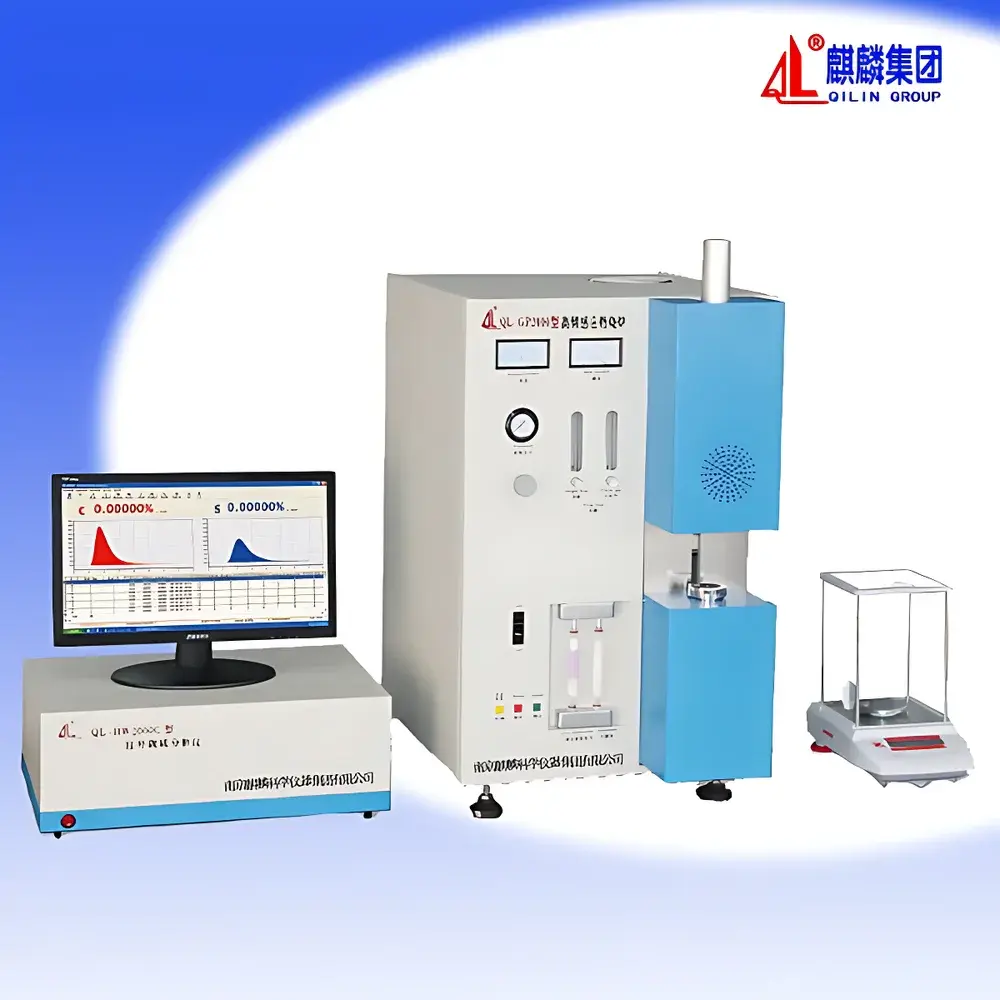
QL-HW2000C High-Frequency Infrared Carbon-Sulfur Analyzer
| Brand | Qilin (QL) |
|---|---|
| Origin | Jiangsu, China |
| Model | HW2000C |
| Measurement Principle | Non-Dispersive Infrared (NDIR) Absorption |
| Heating System | 2.5 kVA High-Frequency Induction Furnace (20 MHz) |
| Carbon Range | 0.0001–25.0000 wt% (extendable to 99.999%) |
| Sulfur Range | 0.0001–15.0000 wt% (extendable to 99.999%) |
| Sensitivity | 0.1 ppm (C/S) |
| Analysis Time | 20–1000 s (typical: 35 s) |
| Compliance | GB/T 20123–2006, ISO 15350:2000 |
| Sample Mass (steel standard) | 0.5 g nominal |
| Optical Path | Gold-Coated Absorption Cell |
| Detection Wavelengths | CO₂ @ 4.26 µm, SO₂ @ 7.4 µm |
| Modulation Frequency | 64 Hz |
| Detector Type | High-Stability Pyroelectric Sensor |
| Filtering | Narrow-Band Interference Filters |
| Dust Filtration | 0.4 µm Sintered Metal Filter |
| Power Supply | Industrial-Grade Linear Module |
Overview
The QL-HW2000C High-Frequency Infrared Carbon-Sulfur Analyzer is a dual-element combustion-based elemental analyzer engineered for precise, routine quantification of total carbon and sulfur in solid inorganic and metallurgical samples. It operates on the fundamental principle of non-dispersive infrared (NDIR) absorption spectroscopy: upon high-frequency induction combustion (20 MHz, 2.5 kVA), sample carbon and sulfur are fully oxidized to CO₂ and SO₂ gases, respectively. These diatomic polar molecules exhibit characteristic vibrational-rotational absorption bands in the mid-infrared region. The instrument employs wavelength-specific detection at 4.26 µm (CO₂) and 7.4 µm (SO₂) using thermally stable platinum-coated infrared sources, gold-plated absorption cells, and narrow-band interference filters. Signal modulation at 64 Hz—achieved via precision stepper motor-driven chopper—enables synchronous detection, effectively rejecting ambient thermal noise and electromagnetic interference from the high-frequency furnace. The resulting photonic signal is converted by pyroelectric detectors into proportional analog voltages, digitized via a 24-bit ADS1224 ADC, and processed using real-time integration and linearization algorithms embedded in the dual-CPU architecture (Atmega162 lower-level controller + Windows XP host). This architecture ensures trace-level sensitivity (0.1 ppm C/S), wide dynamic range (0.0001–99.999 wt%), and robust performance under continuous 24-hour operation.
Key Features
- High-frequency induction furnace with digitally regulated 2.5 kVA output power and 20 MHz operating frequency, enabling complete combustion of refractory alloys, cast irons, and high-carbon steels
- Dual-wavelength NDIR detection system with independently optimized optical paths for CO₂ (4.26 µm) and SO₂ (7.4 µm), minimizing cross-sensitivity and spectral overlap
- Gold-coated, temperature-stabilized absorption cell with integrated thermal management, ensuring long-term baseline stability and reproducibility
- 0.4 µm sintered metal dust filter and active furnace head heating—designed to maximize sulfur recovery and suppress SO₃ formation in high-sulfur matrices
- Automated leak-checking, over-current/over-time protection, and real-time gas flow regulation via high-accuracy mass flow controllers
- Fiber-optic isolation (Agilent 1521/2521) between furnace and detector modules, eliminating RF coupling and ensuring electromagnetic compatibility in shared lab environments
- Modular dual-CPU architecture with USB 2.0 host interface and industrial-grade linear power supply for low-noise signal acquisition
Sample Compatibility & Compliance
The QL-HW2000C is validated for analysis of ferrous and non-ferrous metals—including carbon steels, stainless steels, tool steels, cast iron, aluminum alloys, copper alloys, and nickel-based superalloys—as well as inorganic matrices such as cement, limestone, catalysts, foundry core sands, coke, and mineral ores. Its combustion protocol meets the procedural requirements of GB/T 20123–2006 and ISO 15350:2000 for determination of total carbon and sulfur in steel and iron. While not pre-certified for FDA 21 CFR Part 11 or GLP/GMP environments out-of-the-box, the system supports audit-ready data handling when deployed with properly configured network storage and user-access controls. All calibration, blank correction, and drift compensation routines are fully traceable within the software’s metadata logging framework.
Software & Data Management
The analyzer runs on a Windows XP–based Delphi-developed application featuring modular channel management, allowing unlimited user-defined carbon and sulfur calibration curves. Each analysis captures 20 real-time data points per second, generating high-resolution release profiles for both elements. Raw spectral integrals, peak areas, and background-subtracted signals are stored in an encrypted Microsoft Access database with full relational indexing—enabling queries by operator ID, sample ID, timestamp, batch number, or analytical channel. Software tools include curve fitting (linear, quadratic, cubic), statistical outlier detection (Grubbs’ test), multi-point blank subtraction, and comparative overlay of historical release profiles. Reporting supports customizable templates for laboratory and regulatory submission formats, with optional digital signature fields for QA sign-off. System diagnostics include automated seal integrity verification of the combustion chamber and IR cell.
Applications
This instrument serves quality control laboratories in steel mills, foundries, and third-party testing facilities where rapid turnaround and method ruggedness are critical. Typical use cases include incoming raw material verification (e.g., scrap metal grading), process control during alloy melting (monitoring decarburization or desulfurization efficiency), final product certification (ASTM A751 compliance reporting), and failure analysis of brittle fracture specimens linked to interstitial carbon or segregated sulfur. Its extended upper range (up to 99.999 wt%) also supports specialized applications in carbide production, graphite electrode manufacturing, and coal ash characterization—where conventional wet-chemical or LECO-style analyzers may saturate or require dilution.
FAQ
What standards does the QL-HW2000C comply with?
It conforms to GB/T 20123–2006 and ISO 15350:2000 for carbon and sulfur determination in metallic materials.
Can the instrument analyze non-metallic samples such as cement or catalysts?
Yes—provided appropriate fluxes (e.g., tungsten/tin mixtures) and combustion parameters are selected to ensure complete oxidation and minimize matrix effects.
Is the software compatible with modern Windows OS versions?
The native software is designed for Windows XP; migration to Windows 10/11 requires virtualization or OEM-supported updated firmware and driver packages.
How is sulfur recovery optimized for high-sulfur steels?
Via integrated furnace head heating (to ~1100 °C), which prevents SO₂ adsorption and promotes quantitative SO₂ release, combined with a heated 0.4 µm metal filter to retain particulates without condensing sulfur species.
What maintenance intervals are recommended for the infrared detection module?
The gold-coated cell and pyroelectric detector require no routine recalibration; annual verification against NIST-traceable CO₂/SO₂ standards is advised, alongside bi-weekly cleaning of optical windows using spectroscopic-grade methanol.




