
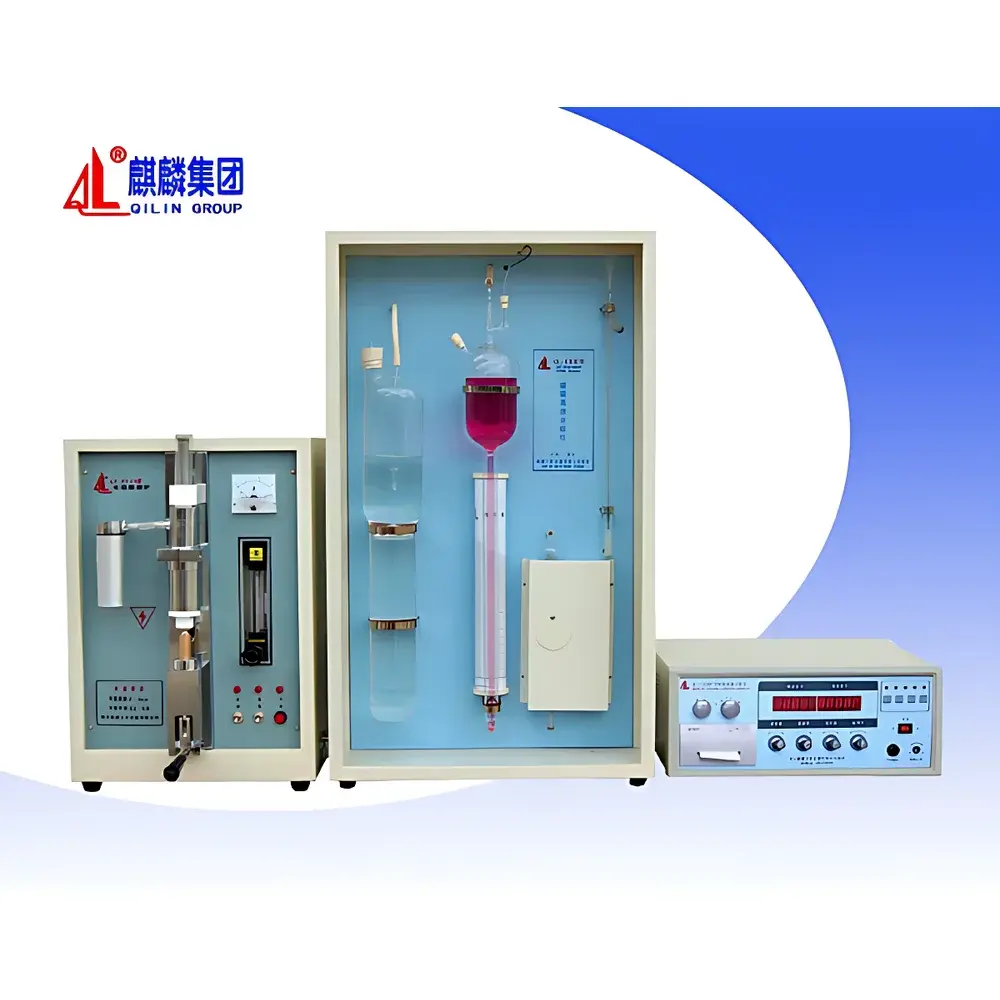
Nanjing Qilin QL-CS20D Fully Automated High-Speed Carbon-Sulfur Analyzer
| Brand | Qilin (QL) |
|---|---|
| Origin | Jiangsu, China |
| Model | QL-CS20D |
| Measurement Principle | Gas Volumetric Method (C), Iodometric Titration (S) |
| Heating System | Arc Furnace |
| Carbon Range | 0.02–6.00 wt% |
| Sulfur Range | 0.005–0.300 wt% |
| Sample Mass Options | 0.25 g / 0.5 g / 1.0 g |
| Analysis Time | 65 s (single absorption) or 85 s (dual absorption) with DL1A arc furnace |
| Compliance | GB/T 223.69–1997 (C), GB/T 223.68–1997 (S) |
| Readout | Direct digital display of mass fraction (%) with thermal printer output |
| Operating Environment | 0–40 °C, 90.658–106.658 kPa |
Overview
The Nanjing Qilin QL-CS20D Fully Automated High-Speed Carbon-Sulfur Analyzer is a dedicated elemental combustion analyzer engineered for rapid, reproducible quantification of total carbon and sulfur in solid metallic and inorganic matrices. It operates on two complementary classical wet-chemical principles: gas volumetric determination for carbon—based on CO₂ displacement volume measurement under controlled pressure differential—and iodometric titration for sulfur—relying on stoichiometric oxidation of SO₂ to sulfate followed by redox titration with standardized iodine solution. The system integrates seamlessly with the DL1A high-energy arc furnace, enabling complete sample combustion at temperatures exceeding 3,000 °C in an oxygen-rich atmosphere. This ensures quantitative liberation of carbon as CO₂ and sulfur as SO₂ from refractory phases including carbides, sulfides, and silicates commonly found in steels, cast irons, ferroalloys, non-ferrous metals, cement clinkers, ores, and heterogeneous catalyst supports.
Key Features
- Gas volumetric carbon determination using high-stability differential pressure transducers, eliminating mechanical burette drift and enabling direct digital readout of carbon content in wt% without manual calibration interpolation.
- Automated iodometric titration for sulfur analysis with solenoid-driven reagent delivery and endpoint detection via potentiometric signal stabilization—removing operator-dependent endpoint judgment and electrode fouling risks.
- Three programmable sample mass modes (0.25 g, 0.5 g, 1.0 g) with automatic range-switching logic; each mode maps directly to pre-validated concentration sub-ranges, ensuring optimal signal-to-noise ratio across the full analytical span.
- Isolated capacitive-touch keypad interface with EMI-hardened circuitry, minimizing electrical interference during arc ignition and electrochemical measurement phases—critical for long-term operational stability in shared laboratory environments.
- Dual-absorption protocol selection (single or double SO₂ absorption in H₂O₂ solution) allows method optimization for low-sulfur matrices (e.g., ultra-low-carbon steels) or high-sulfur samples (e.g., pyritic ores), improving precision at both extremes of the 0.005–0.300 wt% range.
- Integrated thermal printer provides permanent, timestamped hardcopy output of raw absorbance values, calculated concentrations, and instrument status flags—supporting audit-ready documentation per GLP requirements.
Sample Compatibility & Compliance
The QL-CS20D is validated for use with homogeneous solid samples requiring minimal preparation: drill chips, milled powders, or pressed pellets with particle size <100 µm. It accommodates ferrous alloys (carbon steels, stainless steels, tool steels), cast irons (gray, ductile, malleable), nickel- and cobalt-based superalloys, aluminum and copper alloys, limestone and dolomite fluxes, Portland cement, hematite/magnetite ores, and supported metal oxide catalysts (e.g., Ni/Mo/Al₂O₃). All measurements comply with Chinese national standards GB/T 223.69–1997 (carbon) and GB/T 223.68–1997 (sulfur), which align with ISO 4935:1989 (steel—determination of carbon) and ISO 4936:1989 (steel—determination of sulfur) in methodology and uncertainty reporting. While not 21 CFR Part 11 compliant out-of-the-box, its deterministic analog signal chain and immutable print-log output support retrospective data integrity verification during regulatory audits.
Software & Data Management
The QL-CS20D employs embedded real-time firmware (no external PC dependency) with a 16-bit microcontroller core managing sensor acquisition, titration kinetics, pressure compensation, and stoichiometric conversion algorithms. Data are stored in non-volatile memory for up to 500 analyses with full traceability: sample ID (user-entered alphanumeric tag), mass (g), absorption mode, measured pressure delta (kPa), titrant volume (mL), calculated C/S %, and analysis timestamp. Export is limited to printed reports; however, the standardized ASCII-formatted thermal output enables OCR-based ingestion into LIMS or Excel via third-party scanning workflows. No proprietary drivers or cloud connectivity are implemented—ensuring electromagnetic compatibility in high-power metallurgical labs and simplifying validation under ISO/IEC 17025 Clause 5.9.
Applications
This analyzer serves quality control laboratories in primary metal production (blast furnace hot metal monitoring), foundry process control (melt composition verification prior to casting), scrap sorting facilities (rapid grade identification), cement manufacturing (raw mix homogeneity assessment), and mineral processing plants (ore grade certification). Its 65-second single-cycle throughput meets ASTM E1019 time constraints for routine screening, while dual-absorption mode satisfies ISO 11583 precision requirements (<0.002 wt% RSD for sulfur in certified reference materials). Research applications include kinetic studies of desulfurization reactions in ladle metallurgy and carbon loss profiling during sintering of powder metallurgy compacts.
FAQ
What sample preparation is required before analysis?
Samples must be clean, dry, and free of oil or cutting fluid residues. Drill chips or lathe turnings are preferred; if milling is necessary, use carbide tools and avoid lubricants. Particle size should be ≤100 µm for uniform combustion.
Can the QL-CS20D analyze coated or surface-treated materials?
No—surface contamination (e.g., galvanizing, phosphating, paint) introduces uncontrolled carbon/sulfur contributions. Only bulk composition is measurable; representative subsampling after removal of coatings is mandatory.
Is calibration required between every sample?
No. Calibration is performed daily using certified reference materials (CRMs) traceable to NIM (China National Institute of Metrology); drift correction is applied automatically via built-in zero-reference cycles during idle periods.
What maintenance intervals are recommended?
Daily: ash removal from arc furnace crucible; weekly: replacement of CO₂ absorber (NaOH-asbestos) and SO₂ absorber (H₂O₂ + starch indicator); quarterly: pressure sensor zero-check and titration pump tubing inspection.
Does the system support GLP-compliant electronic records?
It generates auditable paper records meeting ALCOA+ principles (Attributable, Legible, Contemporaneous, Original, Accurate); for fully electronic records, integration with a validated LIMS via optical character recognition of printed outputs is advised.






