
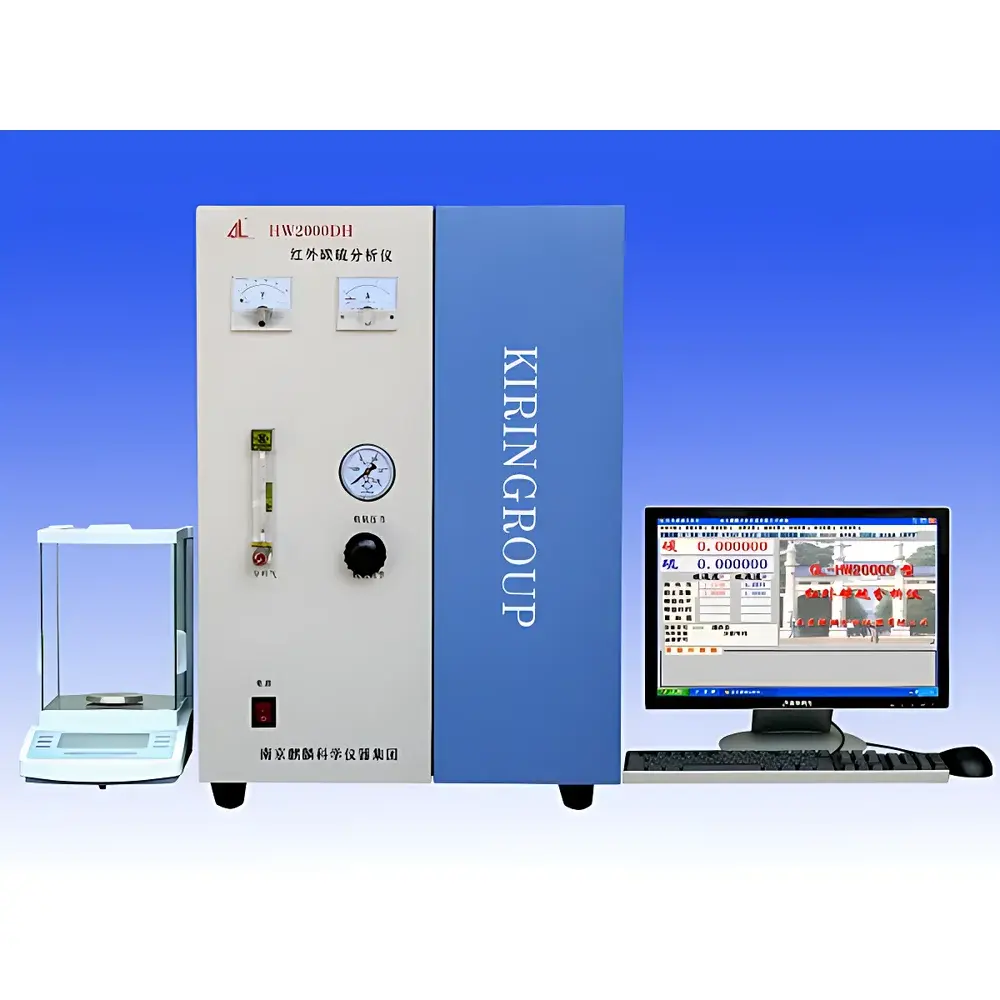
QL Instrument HW2000DH Infrared Carbon-Sulfur Analyzer
| Brand | QL Instrument |
|---|---|
| Origin | Jiangsu, China |
| Model | HW2000DH |
| Measurement Principle | Infrared Absorption |
| Heating System | High-Frequency Induction Furnace |
| Carbon Range | ω(C) 0.0010–10.00% |
| Sulfur Range | ω(S) 0.0005–0.500% |
| Precision (C) | RSD ≤ 0.5% |
| Analysis Time | Adjustable 20–60 s (typical 35 s) |
| Sample Weighing | Analytical Balance (0.0001 g resolution) |
| Operating Environment | 10–30 °C, RH < 75% |
| Compliance | Meets GB/T 223.69–1997 (C) and GB/T 223.68–1997 (S) |
Overview
The QL Instrument HW2000DH Infrared Carbon-Sulfur Analyzer is a high-performance elemental analyzer engineered for precise, routine quantification of total carbon and sulfur in solid metallic and inorganic samples. It operates on the principle of non-dispersive infrared (NDIR) absorption spectroscopy: following complete combustion in a high-frequency induction furnace, the evolved CO₂ and SO₂ gases pass through dedicated optical cells where their characteristic infrared absorbance at specific wavelengths (4.26 µm for CO₂, 7.35 µm for SO₂) is measured photometrically. This method delivers high selectivity, minimal spectral interference, and direct correlation to mass concentration—enabling trace-level detection with robust reproducibility across diverse metallurgical matrices including ferrous alloys, stainless steels, cast irons, nickel-based superalloys, and refractory metals.
Key Features
- High-frequency induction furnace (≥2.5 kW output) ensuring rapid, complete, and consistent sample combustion—eliminating electrode erosion and arc instability associated with traditional arc furnaces.
- Dual-channel NDIR detection system with temperature-stabilized detectors and sealed reference cells, delivering long-term baseline stability and minimizing drift over extended operation.
- Integrated analytical balance (0.0001 g resolution) enabling indefinite sample mass input; software automatically normalizes results to reported weight, supporting both fixed- and variable-mass protocols.
- Modular gas handling path with dual-stage desiccant traps (anhydrous magnesium perchlorate and copper sulfate), automatic pressure regulation, and flow-controlled manifold—ensuring optimal gas conditioning prior to detection.
- Rugged industrial chassis with EMI-shielded electronics enclosure and passive thermal management—designed for continuous use in QC laboratories with ambient fluctuations between 10–30 °C and relative humidity below 75%.
- Embedded microprocessor control with real-time diagnostic monitoring of furnace current, gas flow, detector voltage, and cell temperature—facilitating predictive maintenance and root-cause troubleshooting.
Sample Compatibility & Compliance
The HW2000DH accommodates solid samples up to 1.0 g in mass, including drill chips, turnings, pressed pellets, and certified reference materials (CRMs) traceable to NIST or IRMM standards. It supports analysis of low-carbon steels (e.g., interstitial-free grades), high-sulfur tool steels, and ultra-low-carbon specialty alloys. Method validation conforms to national standard methodologies GB/T 223.69–1997 (carbon) and GB/T 223.68–1997 (sulfur), with documented performance meeting RSD ≤ 0.5% for carbon across the full 0.0010–10.00% range. While not pre-certified to ISO 15350 or ASTM E1019, the instrument’s architecture—including stable optical path, calibrated gas standards, and audit-ready data logging—supports laboratory-developed validation per ISO/IEC 17025 requirements and internal GLP/GMP documentation practices.
Software & Data Management
The proprietary QL-CS v4.2 acquisition and analysis software runs on Windows OS and provides full control over furnace parameters (power ramp, hold time), gas flow sequencing, and integration window settings. All raw absorbance signals, calibration curves, sample metadata, and operator logs are stored in encrypted SQLite databases with configurable backup intervals. Audit trail functionality records timestamped entries for method edits, calibration events, user logins, and result approvals—supporting compliance with FDA 21 CFR Part 11 when deployed with validated electronic signatures and role-based access controls. Export options include CSV, PDF reports (with embedded spectra), and LIMS-compatible XML formats compliant with ASTM E1382 data exchange conventions.
Applications
This analyzer is routinely deployed in incoming raw material inspection, melt shop process control, final product certification, and failure analysis laboratories. Typical use cases include: verification of carbon specification in austenitic stainless steels (e.g., 304, 316); sulfur content monitoring in bearing steels (e.g., 52100) to prevent hot shortness; quality assurance of titanium alloys (e.g., Ti-6Al-4V) where residual C/S impurities affect ductility and weldability; and regulatory testing of scrap metal streams for RoHS-compliant recycling. Its 35-second typical cycle time enables throughput of ≥120 samples per 8-hour shift under standard operating conditions.
FAQ
What sample preparation is required prior to analysis?
Minimal preparation is needed: samples must be clean, dry, and free of oil or coolant residues. Drill chips or lathe turnings are preferred; powders require pressing into pellets using a hydraulic press and binder (e.g., tungsten oxide).
Can the instrument analyze non-metallic samples such as ceramics or graphite?
Yes—with appropriate crucible selection (e.g., ceramic or quartz) and optimized combustion parameters; however, matrix-specific calibration using CRMs is mandatory due to potential catalytic effects or incomplete oxidation.
Is external calibration gas required for daily operation?
No—calibration is performed using solid certified reference materials (CRMs) traceable to national standards; periodic verification with certified gas mixtures (e.g., 1% CO₂ in N₂, 100 ppm SO₂ in air) is recommended quarterly for detector linearity assessment.
How is carryover between high- and low-concentration samples managed?
The system includes an automated post-analysis purge sequence with high-purity oxygen and a dedicated catalyst bed (cobalt oxide) that oxidizes residual carbonaceous deposits, reducing carryover to <0.0002% C between extremes.
Does the software support multi-instrument network deployment?
Yes—QL-CS v4.2 supports centralized database hosting via SQL Server, enabling concurrent access from up to 16 client workstations with synchronized method libraries and shared CRM databases.





