
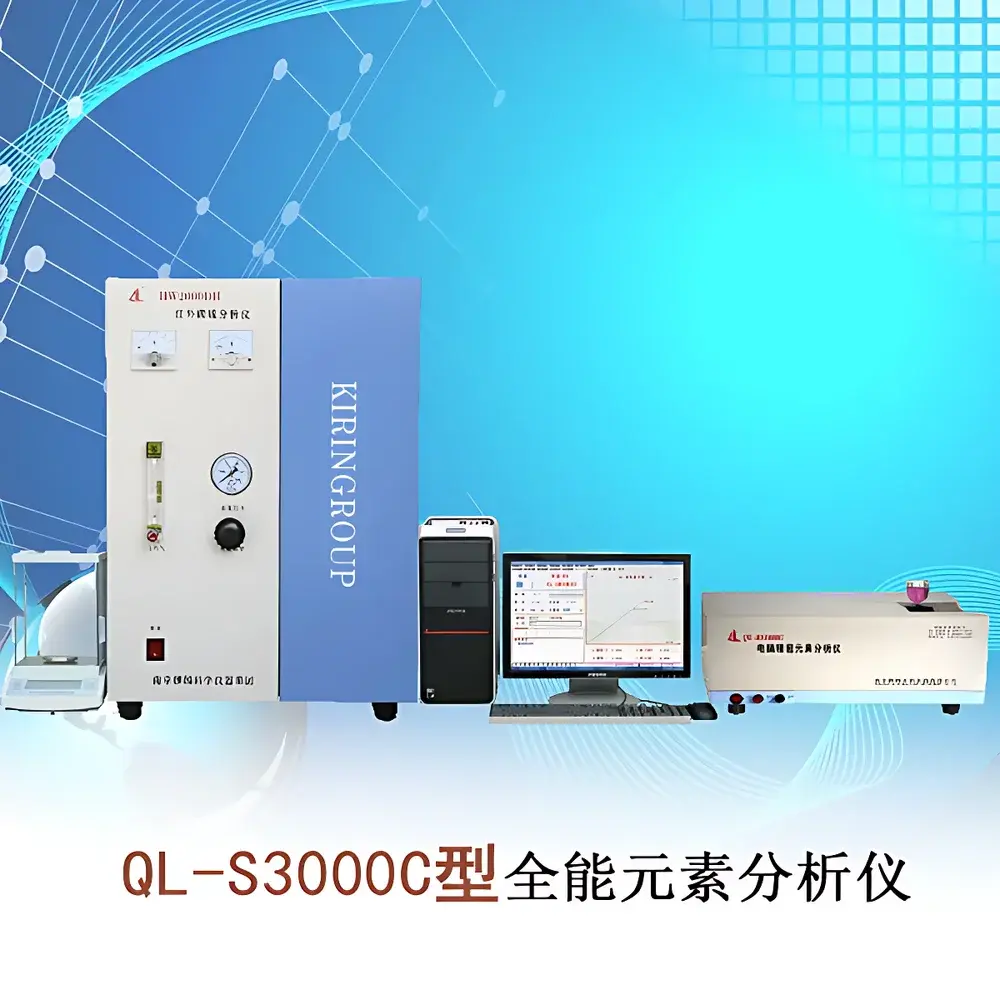
QL-S3000C Qilin High-Frequency Infrared Carbon-Sulfur & Colorimetric Multi-Element Analyzer
| Brand | Qilin (QL) |
|---|---|
| Origin | Jiangsu, China |
| Model | QL-S3000C |
| Measurement Principle | Non-Dispersive Infrared (NDIR) Absorption for C/S |
| Heating System | High-Frequency Induction Furnace (2.5 kVA peak power) |
| Detection Sensitivity | C/S: 0.1 ppm |
| Analysis Time | C/S: 25–60 s (adjustable) |
| Other Elements | 5–8 s per element |
| Measurement Ranges | C: 0.001–10.0000 wt% |
| S | 0.0005–0.5000 wt% |
| Mn | 0.10–65.00 wt% |
| Si | 0.10–75.00 wt% |
| P | 0.005–1.000 wt% |
| Cu | 0.02–85.00 wt% |
| Cr | 0.01–45.0 wt% |
| Mo | 0.10–6.00 wt% |
| Mg | 0.01–0.100 wt% |
| Ni | 0.01–50.0 wt% |
| Rare Earths | 0.01–0.100 wt% |
| Precision | Compliant with GB/T 20123–2006 (C/S), GB/T 223.69–1997 (C), GB/T 223.68–1997 (S), and GB/T 222–2006 (other elements) |
| Sample Weighing Accuracy | 0.0001 g (integrated analytical balance interface) |
Overview
The QL-S3000C is a benchtop high-frequency infrared carbon-sulfur and photometric multi-element analyzer engineered for precise, routine quantitative analysis of metallic alloys and raw materials in foundry, metallurgical, and quality control laboratories. It combines dual detection methodologies—non-dispersive infrared (NDIR) absorption for carbon and sulfur quantification, and solid-state photometric colorimetry for up to 11 additional elements including manganese, silicon, phosphorus, chromium, nickel, molybdenum, copper, magnesium, and rare earths. The instrument utilizes a high-frequency induction furnace (2.5 kVA peak power) to fully combust solid metal samples under controlled oxygen flow, converting carbon and sulfur into CO₂ and SO₂ gases, which are then measured via temperature-compensated NDIR cells with narrow-band optical filters. Simultaneously, acid-digested solutions from the same sample batch are introduced into the colorimetric module, where catalyzed chromogenic reactions generate absorbance signals proportional to elemental concentrations. This hybrid architecture eliminates cross-method calibration drift and ensures traceability across both combustion and wet-chemistry domains.
Key Features
- Integrated high-frequency induction furnace with ceramic crucible handling system and real-time temperature monitoring for consistent combustion efficiency across ferrous and non-ferrous matrices.
- Dual-path NDIR detection module featuring imported Swiss aerospace-grade synchronous motors (rated for >100,000 hours MTBF) and high-stability pyroelectric detectors with <0.1 ppm detection limit for carbon and sulfur.
- Narrow-band interference filters (German-engineered optics) suppress spectral overlap—particularly critical for accurate sulfur measurement in high-carbon steels.
- Modular photometric subsystem using cold-light LED sources, precision optical filters, and calibrated photodiodes; supports automatic zero-point and full-scale self-calibration without manual intervention.
- Embedded microcontroller architecture with real-time pressure, temperature, and gas-flow compensation algorithms—ensuring repeatability within ±0.5% RSD across daily operation.
- Single-software platform enabling synchronized method setup, data acquisition, curve-fitting (multi-point polynomial regression), and audit-ready reporting compliant with GLP documentation requirements.
Sample Compatibility & Compliance
The QL-S3000C is validated for solid metallic samples—including carbon steels, stainless steels, cast irons, aluminum alloys, copper-based alloys, and titanium grades—with mass ranges from 0.1 to 1.0 g. Sample preparation follows standardized dissolution protocols per ISO 11572 and ASTM E1019 for combustion analysis, while colorimetric modules align with ISO 6429 (Mn), ISO 4829-1 (Si), and ISO 6430 (P). Analytical performance meets or exceeds national standards GB/T 20123–2006 (carbon-sulfur), GB/T 223.69–1997 (carbon), GB/T 223.68–1997 (sulfur), and GB/T 222–2006 (general compositional tolerances). The system supports 21 CFR Part 11–ready electronic signatures when deployed with optional secure user authentication and audit trail logging.
Software & Data Management
The proprietary QL-Analyze v4.2 software provides a unified interface for method configuration, real-time signal visualization, dynamic baseline correction, and multi-element report generation. All calibration curves are stored with metadata (date, operator ID, standard lot number, environmental conditions). Data export supports CSV, XML, and LIMS-compatible ASTM E1382 formats. Built-in statistical tools calculate %RSD, confidence intervals, and control chart parameters (X-bar/R) per ASTM E2554. Raw spectra and time-resolved detector outputs are retained for forensic reprocessing. Audit trails record all user actions—including method edits, result overrides, and calibration events—with immutable timestamps and operator attribution.
Applications
- Routine QC/QA in steel mills and alloy producers for incoming raw material verification and final product certification.
- Research laboratories performing compositional mapping of experimental high-entropy alloys and specialty tool steels.
- Third-party testing labs requiring simultaneous C/S + major/minor element reporting for ISO/IEC 17025 accreditation.
- Foundry process optimization through rapid feedback on melt chemistry—enabling real-time adjustments to deoxidation and alloying practices.
- Scrap metal sorting support via rapid identification of residual elements (e.g., Cu, Cr, Ni) affecting recyclability grades.
FAQ
What sample forms are compatible with the QL-S3000C?
Solid chips, turnings, or drilled shavings from metallic materials; minimum particle size ≤0.5 mm. Powders require binder-assisted pelletization per ASTM E1019 Annex A3.
Does the system support automated sample loading?
No—manual crucible placement is required; however, optional robotic sample introduction modules (QL-AutoLoad Pro) are available as field-upgradable accessories.
How is calibration traceability maintained?
Certified reference materials (CRMs) from NIST, BCS, or IRMM are used for initial calibration; periodic verification employs in-house secondary standards traceable to national metrology institutes.
Can the instrument be integrated into an existing LIMS?
Yes—via TCP/IP or RS-232 serial protocol using ASTM E1382-compliant message structures; API documentation and driver packages are provided with purchase.
What maintenance intervals are recommended?
Daily: desiccant replacement and dust filter inspection. Quarterly: optical path cleaning and furnace liner assessment. Annually: NDIR cell recalibration and photometer lamp intensity verification.





