
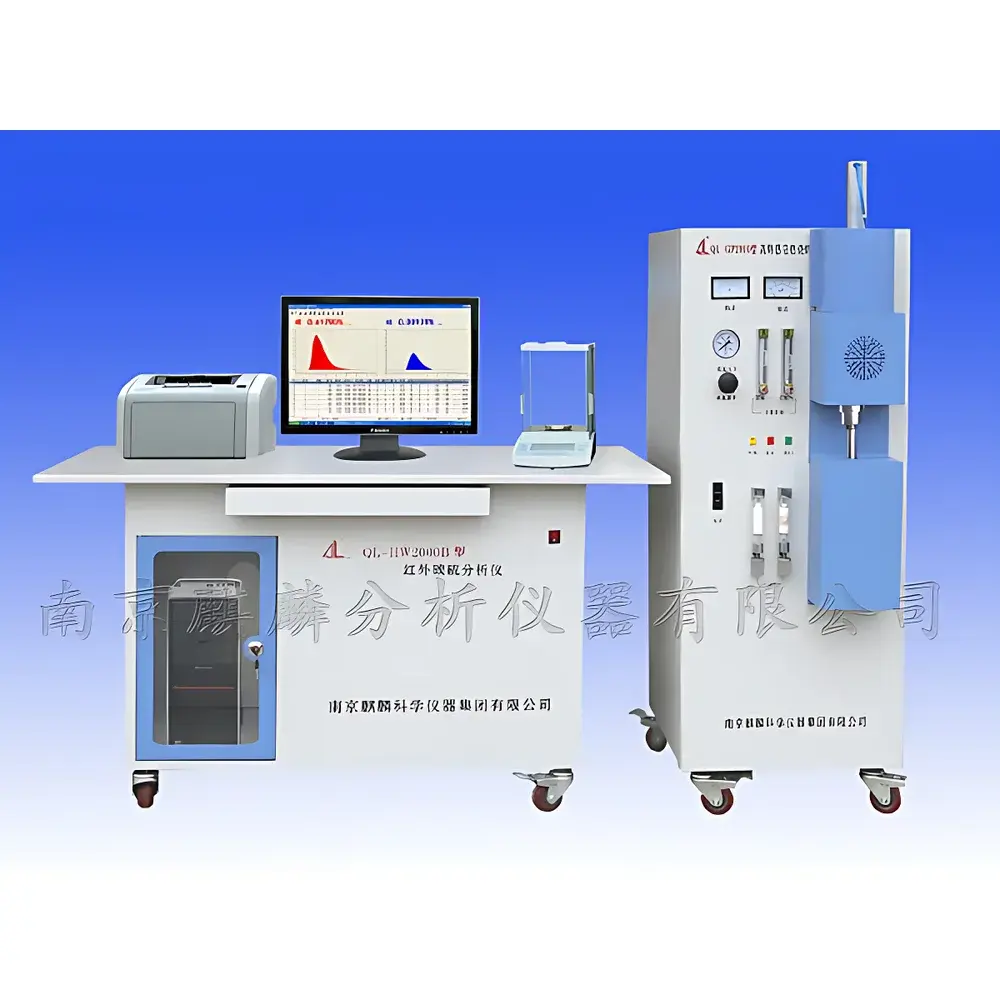
QL-HW2000B High-Frequency Infrared Carbon-Sulfur Analyzer
| Brand | Qilin (QL) |
|---|---|
| Origin | Jiangsu, China |
| Model | HW2000B |
| Measurement Principle | Non-Dispersive Infrared (NDIR) Absorption |
| Heating System | 2.5 kVA High-Frequency Induction Furnace (18–20 MHz) |
| Carbon Range | 0.00001–10.0000 wt% (extendable to 99.999 wt%) |
| Sulfur Range | 0.00001–0.5000 wt% (extendable to 99.999 wt%) |
| Sensitivity | 0.1 ppm (minimum detectable increment) |
| Precision | Carbon RSD ≤ 0.5%, Sulfur RSD ≤ 1.0% |
| Analysis Time | 25–60 s (user-adjustable) |
| Sample Weighing Accuracy | 0.0001 g |
| Compliance | GB/T 20123–2006, ISO 15350:2000 |
Overview
The QL-HW2000B High-Frequency Infrared Carbon-Sulfur Analyzer is a precision elemental analyzer engineered for quantitative determination of total carbon (C) and sulfur (S) in solid metallic and non-metallic materials via combustion-infrared absorption spectroscopy. The instrument integrates high-frequency induction heating (18–20 MHz, 2.5 kVA) with dual-channel non-dispersive infrared (NDIR) detection to achieve complete oxidation of sample matrices followed by selective, real-time quantification of CO₂ and SO₂ gases. This principle ensures trace-level sensitivity (0.1 ppm), wide dynamic range (spanning ultra-low carbon steels to high-carbon cast irons and sulfide-rich catalysts), and robust performance across heterogeneous samples—without requiring matrix-matched calibration standards. Designed for routine QC/QA laboratories in metallurgy, foundry, mining, and advanced materials R&D, the HW2000B delivers reproducible results under GLP-compliant workflows and supports audit-ready data integrity requirements.
Key Features
- High-frequency induction furnace with RF-controlled thermal ramping ensures uniform, repeatable combustion—minimizing thermal gradient effects and eliminating incomplete oxidation artifacts common in resistance-heated systems.
- Dual NDIR optical path with thermoelectrically stabilized pyroelectric detectors and narrow-band interference filters (centered at 4.26 µm for CO₂, 7.35 µm for SO₂) enables high selectivity and eliminates spectral cross-talk between carbon and sulfur signals.
- Aerospace-grade synchronous stepper motor drives the infrared gas cell, rated for >100,000 hours of continuous operation without positional drift or mechanical wear.
- Modular electronic architecture with integrated temperature, pressure, and mass-flow compensation algorithms corrects for ambient fluctuations and maintains stoichiometric equivalence across analysis cycles.
- Industrial-grade solenoid valves (Airtac, Taiwan) rated for >100,000 actuation cycles ensure long-term pneumatic reliability in high-throughput environments.
- Full system diagnostics, real-time signal monitoring, and hardware-level error logging support predictive maintenance and regulatory traceability.
Sample Compatibility & Compliance
The HW2000B accommodates a broad spectrum of solid samples—including ferrous alloys (carbon steel, stainless steel, cast iron, ductile iron), non-ferrous metals (copper, aluminum, nickel-based superalloys), refractory carbides, mineral ores (iron ore, limestone, bauxite), coal and coke, catalysts, ceramics, and organic matrices (e.g., polymer-filled composites). Sample mass ranges from 0.1 g to 1.0 g, weighed on an analytical balance with 0.1 mg resolution. All measurements conform to ISO 15350:2000 and GB/T 20123–2006 for total carbon and total sulfur determination in metallic materials. Instrument design supports 21 CFR Part 11–aligned software configurations (when paired with compliant LIMS), including electronic signatures, audit trails, and user-access controls for GMP/GLP-regulated environments.
Software & Data Management
The embedded control software provides intuitive method setup, real-time spectral visualization, automatic baseline correction, and multi-point calibration curve management. Raw detector signals, gas flow profiles, temperature logs, and weighing metadata are time-stamped and stored in structured binary format. Export options include CSV, XML, and PDF reports with full traceability—each report embedding instrument ID, operator ID, calibration history, and environmental sensor readings. Optional API integration allows bidirectional communication with enterprise LIMS or MES platforms. Data retention policies, role-based access tiers, and encrypted local storage align with ISO/IEC 27001 information security frameworks.
Applications
- Quality control of incoming raw materials (scrap metal, ferroalloys, fluxes) in steelmaking and foundry operations.
- Final product certification of structural steels per ASTM A751, EN 10027, or JIS G 0320 specifications.
- Research into decarburization kinetics during heat treatment or surface carburizing processes.
- Environmental monitoring of sulfur content in coal, fly ash, and desulfurized flue gas residues.
- Characterization of catalyst deactivation via sulfur poisoning in petrochemical refining.
- Validation of low-carbon alloy compositions for aerospace-grade titanium and nickel alloys (e.g., AMS 2300, AMS 2301).
FAQ
What sample preparation is required prior to analysis?
Solid samples must be cleaned of surface oxides or oils, then cut or ground to ≤0.5 mm particle size. No acid digestion or chemical pretreatment is needed—direct solid-state combustion is employed.
Can the instrument measure both carbon and sulfur simultaneously?
Yes. The dual-channel NDIR system acquires CO₂ and SO₂ absorbance signals concurrently within a single 25–60 s analysis cycle.
Is calibration transferable between different material types?
Calibration is matrix-dependent. Certified reference materials (CRMs) matching the sample’s base composition (e.g., low-alloy steel CRM for pipeline steel) are recommended for optimal accuracy.
How often does the infrared detector require recalibration?
Under normal operation, detector gain and zero offset are verified daily using sealed reference cells; full optical recalibration is recommended every 6 months or after major maintenance.
Does the system support automated sample introduction?
The HW2000B is compatible with optional autosamplers (e.g., QL-AS12) capable of unattended analysis of up to 12 samples per batch, with integrated balance interfacing and weight auto-import.






