
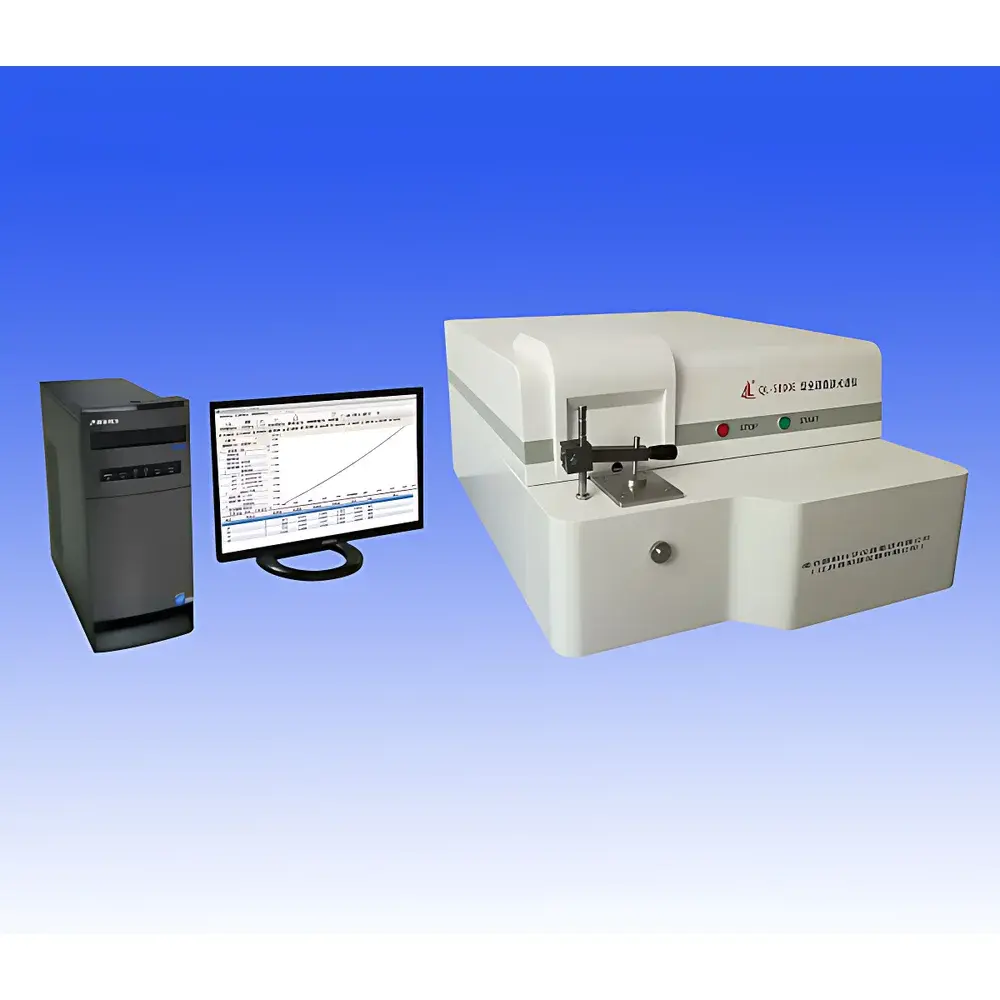
Qilin QL-5800E Full-Spectrum Direct-Reading Optical Emission Spectrometer (OES)
| Brand | Qilin / QL |
|---|---|
| Origin | Jiangsu, China |
| Manufacturer Type | Authorized Distributor |
| Product Origin | Domestic (China) |
| Model | QL-5800E |
| Instrument Type | Benchtop |
| Excitation Method | Spark Discharge |
| Detector Type | High-Performance CMOS Array (CCD-compatible architecture) |
| Focal Length | 401 mm |
| Grating Groove Density | 2400 lines/mm |
| Wavelength Range | 140–680 nm |
| Number of Detection Channels | 60 |
| Power Supply | AC 220 V, 50/60 Hz, 1000 W |
| Dimensions (W×D×H) | 780 × 565 × 360 mm |
| Weight | 78 kg |
| Typical Analysis Time | ~20 s per sample |
| Inter-electrode Gap | 4 mm |
| Electrode Material | Tungsten |
| Vacuum System | Integrated oil-free vacuum with differential pressure valve and multi-stage oil-trap protection |
Overview
The Qilin QL-5800E Full-Spectrum Direct-Reading Optical Emission Spectrometer is a benchtop spark-source optical emission spectrometer engineered for high-precision elemental analysis of solid metallic samples. It operates on the principle of atomic emission spectroscopy: when a conductive sample is subjected to controlled spark discharge in an argon-purged environment, constituent atoms are excited and emit characteristic wavelengths of ultraviolet–visible light. These emissions are dispersed via a Paschen–Runge mount with a 401 mm focal-length Rowland circle optical system and resolved by a high-sensitivity CMOS array detector covering 140–680 nm continuously. Unlike traditional PMT-based OES systems limited to fixed channels, the QL-5800E captures the full spectral range simultaneously—enabling flexible reconfiguration of analytical lines without hardware modification. Its vacuum-sealed optical chamber eliminates atmospheric absorption below 190 nm, ensuring accurate quantification of critical non-metals including C, P, S, N, B, and As—key requirements for quality control in ferrous and non-ferrous metallurgy.
Key Features
- Full-spectrum CMOS detection architecture with 60 configurable spectral channels—supports simultaneous multi-element analysis across all major metallic and non-metallic elements.
- Digital spark source with High-Energy Pre-Spark (HEPS) technology and adjustable discharge frequency (100–1000 Hz) and current (up to 500 A), optimized for diverse matrix types including Fe-, Al-, Cu-, Ni-, Mg-, Ti-, Zn-, Pb-, Sn-, Ag-, and Co-based alloys.
- Vacuum optical system with differential-pressure isolation valves and integrated oil-trap filtration—prevents pump oil backstreaming into the spectrometer chamber, ensuring long-term stability of CMOS sensor response and optical throughput.
- Modular argon gas management: jet-electrode design with tungsten electrode and localized argon sheath minimizes air ingress during excitation; integrated gas module replaces solenoid valves and flowmeters, enabling self-cleaning electrode purging and stable plasma conditions.
- Plug-in lens assembly allows rapid optical access for maintenance without breaking vacuum—reducing downtime and technician dependency.
- Real-time environmental monitoring: automatic regulation and logging of vacuum pressure, chamber temperature, argon pressure, and source parameters via embedded microcontroller.
- Ethernet-based TCP/IP communication interface ensures electromagnetic immunity, remote diagnostics, and seamless integration into LIMS or MES environments.
Sample Compatibility & Compliance
The QL-5800E accommodates flat, cylindrical, and irregularly shaped solid metal samples up to 40 mm in diameter using its open-type spark stand with adjustable clamping mechanism. Small-diameter wire analysis (≥3 mm) is supported with optional fixtures. The instrument meets core metrological requirements for routine industrial QA/QC: it supports ASTM E415 (Standard Test Method for Analysis of Carbon and Low-Alloy Steel), ISO 11573 (Metallic materials — Spark discharge atomic emission spectrometry), and GB/T 4336 (Chinese national standard for carbon steel analysis). While not pre-certified for FDA 21 CFR Part 11, its software architecture includes audit trail logging, user-level access control, and electronic signature readiness—facilitating validation under GLP and GMP frameworks.
Software & Data Management
The QL-5800E ships with bilingual (English/Chinese) Windows 7/10–compatible acquisition and analysis software. Calibration curves are factory-preloaded for common alloy grades (e.g., ASTM A36, EN AW-6061, UNS N06625), with support for custom curve development using certified reference materials (CRMs). Software features include automatic peak identification, inter-element interference correction, drift compensation via internal reference lines, and real-time signal-to-noise ratio monitoring. All raw spectra, processed results, instrument status logs, and operator actions are timestamped and exportable in CSV, XML, or PDF formats. Data integrity safeguards include write-once storage mode, cyclic buffer overwrite prevention, and optional encrypted database backup.
Applications
This spectrometer serves as a primary analytical tool in foundries, rolling mills, scrap recycling facilities, aerospace component suppliers, nuclear-grade material certifiers, and third-party testing laboratories. Typical use cases include incoming raw material verification, melt process control (ladle analysis), finished product certification (e.g., ASTM, EN, JIS compliance), failure root-cause investigation (e.g., trace element segregation), and scrap sorting for metal recovery. Its ability to quantify low-concentration non-metals in aluminum alloys (<10 ppm C), sulfur in stainless steels (<0.001%), and boron in superalloys makes it suitable for high-specification manufacturing where compositional tolerances are tight and regulatory documentation is mandatory.
FAQ
What sample preparation is required prior to analysis?
Flat, clean, and representative surfaces must be ground or milled to remove oxidation layers and ensure uniform spark interaction. No dissolution or digestion is needed—analysis is fully solid-state.
Does the instrument require liquid nitrogen or external cooling?
No. The CMOS detector is thermoelectrically stabilized; ambient air cooling suffices for continuous operation.
Can the QL-5800E be upgraded to support additional elements or matrices post-purchase?
Yes. New calibration curves and spectral line assignments can be loaded via software update—no optical or hardware retrofitting is necessary due to its full-spectrum detection capability.
Is argon consumption monitored in real time?
Yes. Integrated pressure transducers provide live feedback on argon supply pressure and chamber purge efficiency, with configurable low-pressure alarms.
How often does the vacuum system require maintenance?
Under normal operation (8 h/day), the oil-trap filter requires replacement every 12 months; vacuum pump oil change interval is 24 months—both documented in the preventive maintenance log within the software.




