
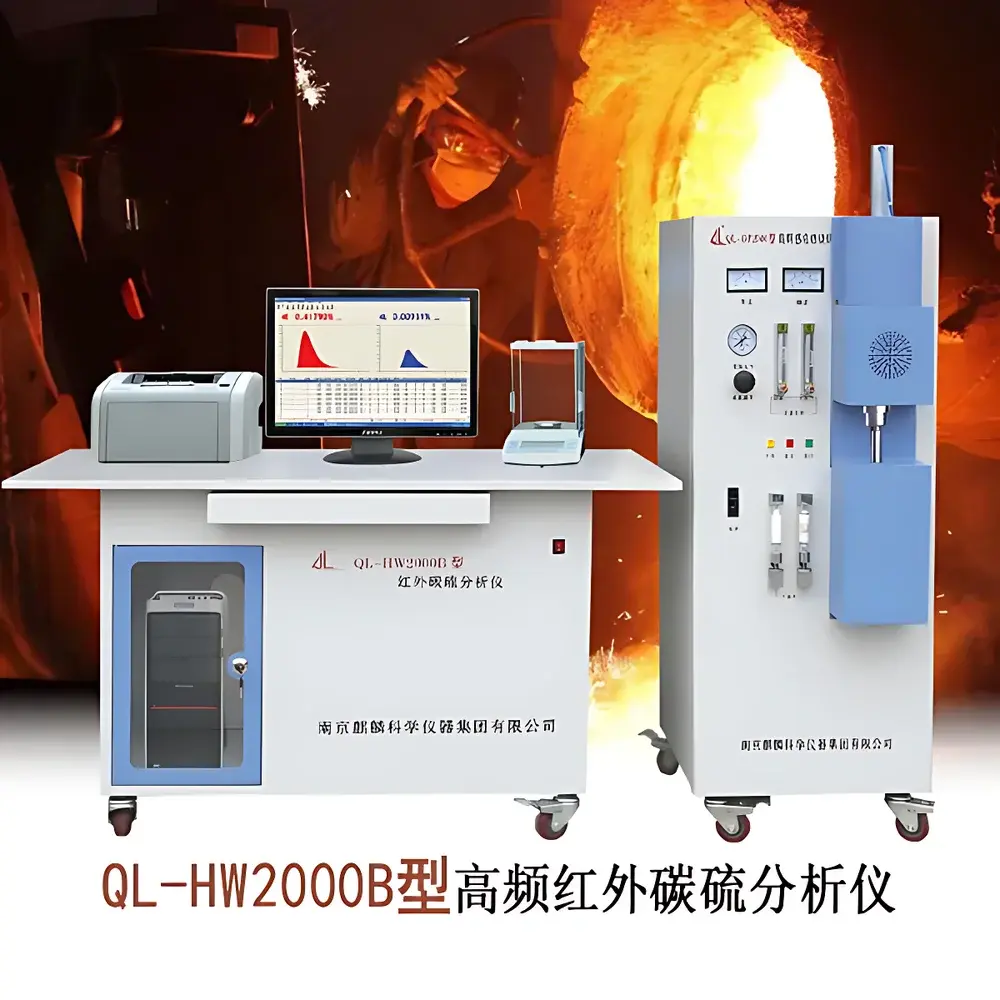
QL-Qilin HW2000B High-Frequency Infrared Carbon-Sulfur Analyzer
| Brand | Qilin (QL) |
|---|---|
| Origin | Jiangsu, China |
| Manufacturer Type | Authorized Distributor |
| Product Line | Nanjing Qilin HW2000 Series |
| Measurement Principle | Non-Dispersive Infrared (NDIR) Absorption |
| Heating System | 2.5 kVA High-Frequency Induction Furnace (18–20 MHz) |
| Carbon Range | 0.00001–10.0000 wt% (extendable to 99.999 wt%) |
| Sulfur Range | 0.00001–0.5000 wt% (extendable to 99.999 wt%) |
| Sensitivity | 0.1 ppm (minimum display resolution) |
| Precision | Carbon RSD ≤ 0.5%, Sulfur RSD ≤ 1.0% |
| Analysis Time | 25–60 s (user-adjustable) |
| Weighing Accuracy | 0.0001 g (compatible with Class I analytical balance) |
| Compliance | GB/T 20123–2006, ISO 15350:2000 |
| Key Components | Aviation-grade synchronous motor (≥100,000 h MTBF), narrow-band IR interference filters, pyroelectric IR detectors, Taiwan-made Airtac solenoid valves (rated ≥100,000 cycles), integrated temperature/pressure/flow compensation module |
Overview
The QL-Qilin HW2000B High-Frequency Infrared Carbon-Sulfur Analyzer is a fully integrated elemental combustion analyzer engineered for precise, routine quantification of total carbon (C) and total sulfur (S) in solid inorganic and organic matrices. It operates on the principle of non-dispersive infrared (NDIR) absorption spectroscopy: sample combustion in a high-frequency induction furnace generates CO₂ and SO₂ gases, which are swept through dedicated optical cells where their characteristic infrared absorption bands—centered at 4.26 µm (CO₂) and 7.35 µm (SO₂)—are measured by thermally stabilized pyroelectric detectors. The instrument’s dual-channel detection architecture, combined with narrow-band optical filtering, eliminates spectral overlap between carbon and sulfur signals—critical for high-carbon steels where SO₂ signal suppression from CO₂ matrix effects must be actively mitigated. Designed for metallurgical QC labs, foundry process control, and geological resource assessment, the HW2000B delivers trace-level sensitivity (0.1 ppm) and robust reproducibility across heterogeneous sample types without requiring matrix-matched calibration standards.
Key Features
- 2.5 kVA high-frequency induction furnace operating at 18–20 MHz, delivering rapid, uniform, and oxygen-rich combustion with minimal thermal gradient—ensuring complete oxidation of refractory carbides and sulfides.
- Dual independent NDIR optical modules with thermoelectrically stabilized pyroelectric detectors and hardened narrow-band interference filters (FWHM < 10 nm), enabling simultaneous, cross-talk-free measurement of CO₂ and SO₂.
- Integrated gas-handling system featuring Airtac (Taiwan) solenoid valves rated for >100,000 actuation cycles, precision mass flow controllers with real-time temperature/pressure compensation, and aviation-grade synchronous motors driving the IR gas cell carousel (MTBF ≥ 100,000 h).
- Modular motherboard architecture with embedded firmware for dynamic baseline correction, drift compensation, and automatic peak integration—minimizing operator-dependent variability.
- Full compliance with ISO 15350:2000 and GB/T 20123–2006 methodologies, including mandatory blank subtraction, calibration verification checks, and documented combustion efficiency validation per clause 7.3.
Sample Compatibility & Compliance
The HW2000B accommodates a broad spectrum of industrial and research materials—including ferrous alloys (carbon steel, stainless, cast iron, ductile iron), non-ferrous metals (Cu, Al, Zn base alloys), rare-earth compounds, cementitious binders, coal and coke, mineral ores (e.g., hematite, pyrite), catalysts, ceramics, and organic polymers. Sample mass ranges from 0.1 to 1.0 g (typical), introduced via ceramic crucibles pre-treated with tungsten oxide flux. All analyses adhere to ISO 15350:2000 requirements for combustion gas composition, carrier flow stability (±0.5% over 60 s), and detector linearity verification. Instrument qualification includes daily system suitability testing (SST) per ASTM E1019 protocols, with documented audit trails for calibration gas certification (NIST-traceable CO₂/SO₂ standards), furnace temperature profiling, and detector responsivity mapping.
Software & Data Management
The proprietary QL-Analyzer Suite v4.x provides ISO/IEC 17025-aligned data acquisition and reporting. Functions include multi-point linear/non-linear calibration curve generation with residual error visualization, automated RSD calculation per ASTM E1447, batch analysis sequencing, electronic signature support, and 21 CFR Part 11-compliant audit trail logging (user action, timestamp, parameter change, result modification). Raw spectral data (absorbance vs. time) and processed peak integrals are stored in vendor-neutral CSV and XML formats. Software supports GLP/GMP workflows via configurable user roles, password-protected method locking, and export-ready PDF reports containing sample ID, weight, dilution factor, calibration status, uncertainty estimation (k=2), and compliance statement against ISO 15350.
Applications
- Metallurgical QC: Rapid verification of C/S content in incoming raw materials (scrap, ferroalloys) and finished products (billets, bars, weld wire) against AISI/SAE, ASTM A29, or EN 10027 specifications.
- Foundry Process Control: Real-time monitoring of melt chemistry during ladle treatment to prevent porosity and hot-shortness caused by excess sulfur in cast irons or carbon segregation in high-strength steels.
- Mineral Resource Evaluation: Quantification of organic carbon and sulfide-bound sulfur in exploration core samples, supporting acid rock drainage (ARD) risk modeling per EPA Method 9045D.
- Cement & Refractories: Determination of residual carbon in clinker and free sulfur in gypsum additives—key parameters influencing setting time and sulfate resistance.
- R&D Laboratories: Method development for novel alloy systems (e.g., high-entropy alloys, MAX phases) where conventional wet chemistry fails to resolve ultra-trace sulfur (<10 ppm) in complex intermetallic matrices.
FAQ
What combustion atmosphere is used, and is oxygen purity critical?
High-purity helium or argon (≥99.995%) serves as the carrier gas; oxygen is introduced separately via a calibrated inlet upstream of the furnace. Oxygen purity must exceed 99.99% to avoid nitric oxide formation and ensure stoichiometric CO₂/SO₂ yield—verified during initial IQ/OQ.
Can the instrument analyze liquids or powders directly?
No. All samples must be solid and dry. Liquids require pre-evaporation and ashing; powders must be homogenized and pressed into pellets to ensure consistent combustion kinetics.
How often must the IR cells be cleaned or recalibrated?
Optical cells require cleaning only if condensate or particulate buildup is observed (typically every 500–1,000 analyses); full optical recalibration is recommended semiannually or after major maintenance, using certified span gases traceable to NIST SRM 1628c.
Is external balance integration supported?
Yes—the system accepts RS-232 or USB output from METTLER TOLEDO, SARTORIUS, or SHIMADZU analytical balances (0.0001 g readability) with auto-weight transfer and tare validation.
Does the analyzer meet FDA or pharmaceutical regulatory requirements?
While not marketed for cGMP drug substance release, its 21 CFR Part 11-compliant software, full audit trail, and ISO 15350 validation framework support use in API impurity profiling (e.g., residual catalyst sulfur in metal-catalyzed cross-coupling reactions) under client-defined validation protocols.
Related Products




