
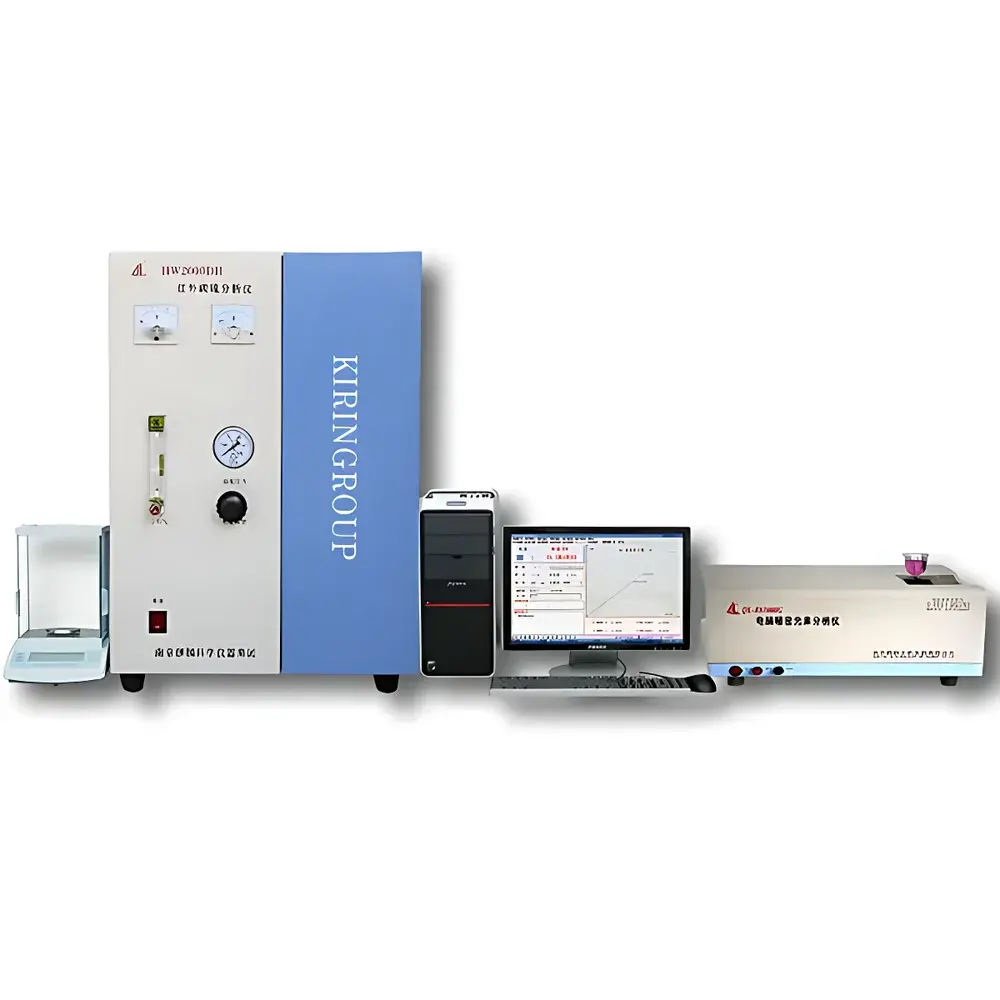
Qilin QL-S3000C Computer-Controlled Infrared & Photometric Multi-Element Analyzer
| Brand | Qilin (QL) |
|---|---|
| Origin | Jiangsu, China |
| Manufacturer Type | Authorized Distributor |
| Country of Origin | China |
| Model | S3000C |
| Price | USD 9,500 (FOB Jiangsu) |
Overview
The Qilin QL-S3000C is a dual-mode, computer-integrated elemental analyzer engineered for routine quantitative determination of carbon (C), sulfur (S), and up to 16 additional metallic and non-metallic elements—including Mn, P, Si, Cr, Ni, Mo, Mg, Cu, Al, V, W, Ti, Re, and rare earths—in ferrous and non-ferrous alloys. It combines infrared absorption spectroscopy for C/S quantification with high-precision photometric analysis (400–800 nm wavelength range) for multi-element detection via external sample dissolution. The instrument operates on standardized physicochemical principles compliant with ASTM E1019, ISO 15350, and GB/T 223 series methods, delivering trace-to-major-level quantification in metallurgical QC laboratories where reproducibility, regulatory traceability, and throughput are critical. Its architecture integrates microprocessor-based hardware control with Windows-based software, enabling full automation of calibration, measurement, data reduction, and reporting—without manual optical alignment or analog potentiometer adjustments.
Key Features
- Dual-detection platform: IR absorption cells for C/S (0.001–10.00% C; 0.0005–0.5000% S) + programmable photometric module with motor-driven grating monochromator (1 nm wavelength resolution, digitally adjustable from 400–800 nm)
- Computer-controlled sample handling: Auto-weight input via RS232/USB-connected analytical balance; optional manual mass entry for flexibility in R&D workflows
- Modular cuvette system: Interchangeable optical path lengths (10 mm, 30 mm, 50 mm) for optimized absorbance across concentration ranges
- Cold-light source design with imported photodiodes and auto-zero/full-scale calibration—eliminating thermal drift and lamp aging effects
- Sulfur titration module featuring electrodeless liquid delivery and anti-clogging valve technology for long-term operational stability
- Onboard curve storage: 99 user-definable calibration curves using linear/non-linear regression (e.g., polynomial, logarithmic); expandable via software update
- No internal fluidic valves or rubber tubing—external digestion minimizes maintenance, avoids cross-contamination, and extends service intervals
Sample Compatibility & Compliance
The QL-S3000C is validated for solid metal samples including carbon steels, stainless steels, cast irons, aluminum alloys, copper alloys, and nickel-based superalloys. Sample preparation follows standard acid digestion protocols (e.g., HCl/HNO₃ mixtures per ASTM E307) or high-frequency induction fusion for refractory matrices. All analytical procedures adhere to GB/T 223.3–5:1988 (C/S determination) and GB/T 223.68–69:1997 (Mn, Si, P, Cr, Ni), with documented method equivalence to ISO 4941 (steel analysis) and ASTM E1086 (spectrophotometric multi-element). System validation includes linearity verification (R² ≥ 0.999), repeatability testing (RSD ≤ 1.5% at mid-range concentrations), and spike recovery studies (95–102%). Full audit trail functionality supports GLP/GMP environments requiring FDA 21 CFR Part 11 compliance when deployed with validated software configuration.
Software & Data Management
The proprietary Windows application provides a fully localized English interface with intuitive menu navigation, real-time spectral preview, and dynamic wavelength assignment. Data acquisition includes automatic blank subtraction, background correction, and outlier rejection based on Dixon’s Q-test. Export formats include CSV, Excel (.xlsx), PDF reports (with lab header, analyst ID, timestamp, and instrument serial number), and XML for LIMS integration. All raw spectra, calibration logs, and result histories are stored in encrypted SQLite databases with configurable retention policies. Software updates are delivered via secure HTTPS channel with SHA-256 signature verification. Audit trails record every user action—including method modification, curve recalibration, and result editing—with immutable timestamps and operator login attribution.
Applications
- Metallurgical QC labs performing incoming material verification and heat-to-heat certification per ASTM A6/A6M and EN 10027 standards
- Foundry process control: real-time monitoring of melt composition prior to casting to prevent out-of-specification batches
- R&D departments developing new alloy grades—enabling rapid screening of dopant elements (e.g., rare earth additions for grain refinement)
- Third-party testing laboratories accredited to ISO/IEC 17025:2017, requiring documented uncertainty budgets and inter-laboratory comparison records
- Scrap metal sorting facilities requiring fast-turnaround identification of alloy families (e.g., distinguishing 304 vs. 316 stainless steel)
FAQ
What sample forms are compatible with the QL-S3000C?
Solid chips, drillings, or turnings (typically 0.2–0.5 g) from homogeneous metallic materials. Powdered samples require pelletization with binder; non-metals (e.g., ceramics) must undergo certified fusion protocols.
Does the system support ASTM E1019-compliant carbon/sulfur analysis?
Yes—the IR module meets all instrumental requirements of ASTM E1019, including detector linearity, furnace temperature ramping profile, and CO₂/SO₂ gas cell pathlength specifications.
Can calibration curves be transferred between instruments?
Curve parameters (coefficients, wavelength, pathlength) are exportable as .csv files and importable into other QL-S3000C units running identical firmware revision.
Is remote diagnostics supported?
The embedded TCP/IP interface enables secure remote access via VPN for firmware updates, log retrieval, and limited parameter troubleshooting—subject to customer IT policy approval.
What maintenance is required beyond routine cleaning?
Annual verification of IR cell purge gas flow rate and photometric dark-current baseline; no optical realignment or lamp replacement needed within first 36 months of operation.





