
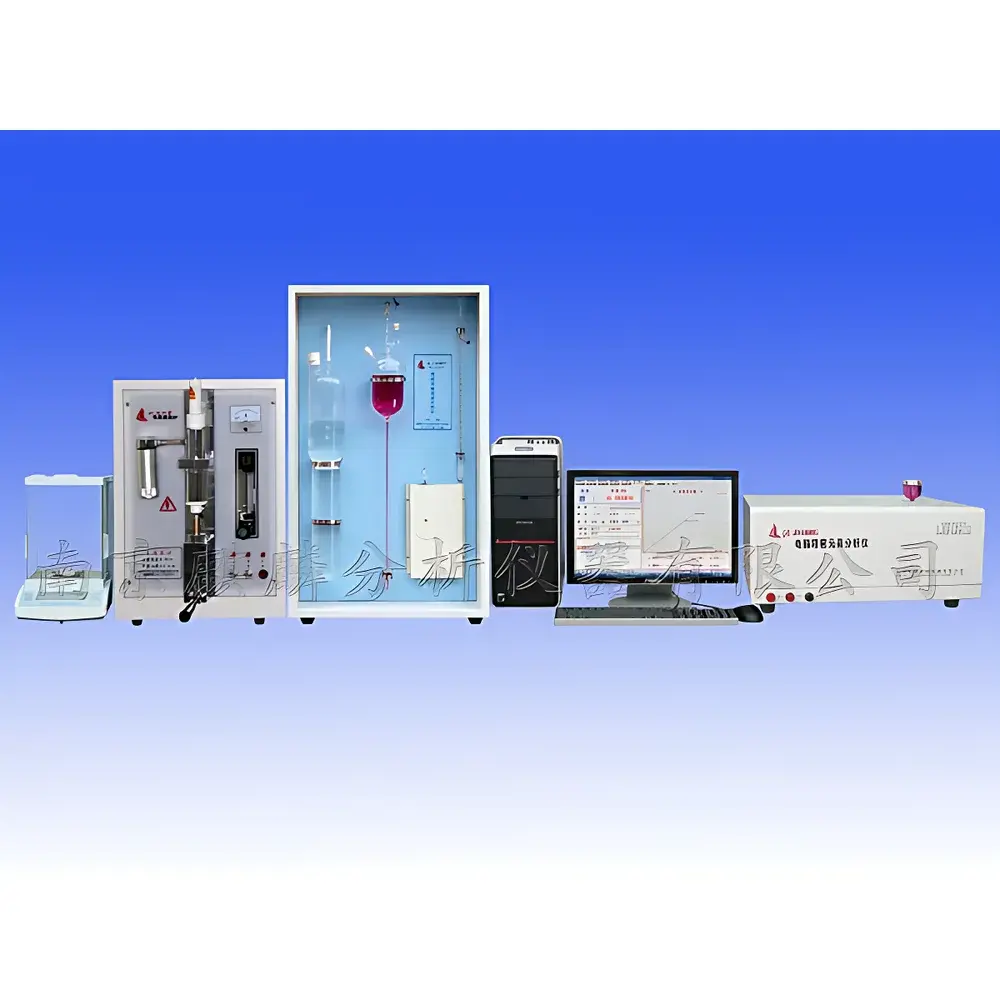
QL-S3000A Multi-Element Analyzer with Integrated Carbon-Sulfur Determination
| Origin | Jiangsu, China |
|---|---|
| Manufacturer Type | Authorized Distributor |
| Origin Category | Domestic (PRC) |
| Model | QL-S3000A |
| Price | USD 7,200 (FOB Jiangsu) |
| Measurement Principle | Combustion-Gas Volumetric (C), Iodometric Titration (S), and Computer-Controlled Photometric Colorimetry (Multi-Element) |
| Optical System | Motorized Grating Monochromator with Digital Wavelength Tuning (400–800 nm, resolution <1 nm) |
| Sample Throughput | ~2 min per full multi-element analysis (C, S, Si, Mn, P, Cr, Ni, Mo, Cu, Ti, etc.) |
| Calibration Capacity | Up to 99 user-definable calibration curves (linear & polynomial regression), expandable |
| Compliance | Meets GB/T 223.3–5:1988 and GB/T 223.68–69:1997 |
| Data Interface | RS-232/USB to industrial-grade Windows PC |
| Sample Handling | Off-line acid dissolution (non-pressurized) |
| Detection Range Examples | C 0.05–6.00 wt%, S 0.005–0.300 wt%, Mn 0.10–15.00 wt%, Si 0.10–5.00 wt%, P 0.005–0.80 wt%, Cr 0.01–25.0 wt%, Ni 0.01–30.0 wt%, Mo 0.101–6.00 wt%, Ti 0.01–5.00 wt% |
| Repeatability | RSD ≤1.5% for mid-range concentrations (per GB standards) |
| Environmental Rating | Designed for controlled laboratory environments (15–30 °C, <80% RH non-condensing) |
Overview
The QL-S3000A Multi-Element Analyzer with Integrated Carbon-Sulfur Determination is a dual-mode analytical platform engineered for routine quantitative elemental analysis of ferrous and non-ferrous alloys in metallurgical, foundry, and quality assurance laboratories. It integrates two validated analytical subsystems into a single coordinated architecture: a combustion-based carbon-sulfur module (CS3000) and a photometric multi-element module (BS1000A). Carbon quantification employs gas volumetric measurement following high-temperature combustion in an oxygen-rich furnace; sulfur is determined via iodometric titration using electrochemical endpoint detection. For simultaneous determination of up to 12 additional elements—including Si, Mn, P, Cr, Ni, Mo, Cu, Ti, Mg, and rare earths—the system utilizes off-line sample dissolution followed by computer-controlled photometric colorimetry. The optical engine features a motor-driven diffraction grating monochromator with digital wavelength positioning across 400–800 nm, enabling precise, repeatable spectral selection without manual adjustment. This architecture eliminates mechanical drift associated with traditional filter wheels or fixed-wavelength LEDs, supporting long-term stability and method flexibility.
Key Features
- Motorized diffraction grating monochromator with digital wavelength tuning (step resolution <1 nm), programmable via host PC interface
- Dual-analytical core: combustion-gas volumetric C/S module + photometric multi-element module with independent reagent delivery and flow control
- 99-user-expandable calibration curve library with polynomial and linear regression support; auto-curve validation and outlier rejection
- Off-line sample dissolution protocol—no internal valves, tubing, or pressurized digestion vessels—reducing maintenance frequency and chemical carryover risk
- Integrated cold-light source and imported photodetectors with automatic zero/full-scale self-calibration before each measurement cycle
- Optional electronic balance coupling: weight data auto-imported via RS-232 or USB; supports both fixed- and variable-mass sampling protocols
- Iodometric sulfur titration with electrodeless endpoint control and patented anti-clogging fluidic design for improved reliability
- Thermal line printer included for immediate hardcopy reporting; all results timestamped and traceable to operator ID and method version
- Robust industrial PC controller with pre-installed Windows OS, dedicated analysis software, and local database storage (≥100,000 records)
Sample Compatibility & Compliance
The QL-S3000A is validated for solid metallic samples requiring acid dissolution prior to photometric analysis, including carbon steels, low- and high-alloy steels, cast irons (gray and ductile), stainless steels, and copper- and aluminum-based alloys. Sample preparation follows standardized wet-chemistry protocols compliant with ISO 11572 (steel analysis) and ASTM E350 (general methods for metals). The instrument’s analytical performance conforms to Chinese national standards GB/T 223.3–5:1988 (carbon/silicon/manganese/phosphorus) and GB/T 223.68–69:1997 (sulfur/carbon), with documented precision (RSD ≤1.5%) and accuracy verified against certified reference materials (CRMs) from NIST, IRMM, and GBW series. Software includes configurable audit trail functionality—recording user actions, parameter changes, calibration events, and result modifications—to support GLP and GMP-aligned workflows. While not FDA 21 CFR Part 11-certified out-of-the-box, the system permits configuration for electronic signature and data integrity requirements upon customer request.
Software & Data Management
The embedded Windows-based application provides a fully localized English-language GUI with intuitive menu navigation, method wizard setup, and real-time spectral preview. All analytical parameters—including wavelength, integration time, reagent volumes, and curve coefficients—are stored within encrypted project files. Data export supports CSV, XLSX, and PDF formats with customizable templates aligned to internal QA reporting standards. Historical results are indexed by sample ID, batch number, analyst, date/time stamp, and method revision. Database queries enable trend analysis, statistical process control (SPC) charting, and material grade verification against specification limits. Backup and restore functions operate via external USB drive or network share; no cloud dependency. Raw absorbance values, calibration residuals, and titration curves are retained alongside final concentration outputs for full traceability.
Applications
This analyzer serves as a cost-effective, high-throughput solution for incoming raw material inspection, melt-shop process control, finished product certification, and supplier qualification testing. Typical use cases include rapid verification of alloy composition in heat-treated steel billets; monitoring residual elements (e.g., Cu, Sn, As) in recycled aluminum feeds; validating chromium/nickel ratios in austenitic stainless grades; and certifying phosphorus and sulfur levels in structural steels per ASTM A615 or EN 10025. Its dual C/S + multi-element capability eliminates the need for separate LECO-type analyzers and benchtop spectrophotometers in mid-volume labs with limited floor space and technical staffing. The system is especially suited for environments where regulatory documentation, method reproducibility, and operator training efficiency are prioritized over ultra-trace detection limits.
FAQ
What sample preparation is required for multi-element analysis?
Solid metal samples must be dissolved using standardized acid digestion (e.g., HCl/HNO₃ mixture) in open beakers or Teflon vessels; no microwave or high-pressure digestion is needed.
Can the instrument analyze non-metallic materials such as ores or slags?
Yes—provided the matrix is fully soluble in standard mineral acids and does not contain interfering turbidity or suspended solids post-digestion.
Is method development supported for custom elements or matrices?
Yes: users may define new calibration curves using CRMs or standard solutions; wavelength, reagent sequence, and timing parameters are fully editable.
How is system performance verified between calibrations?
Built-in diagnostic routines check lamp intensity, detector response linearity, and fluidic integrity; daily verification with a control standard is recommended.
Does the software support network deployment or LIMS integration?
Direct LIMS connectivity is available via HL7 or ASTM E1384-compliant ASCII file export; centralized server installation requires on-site configuration support.






