
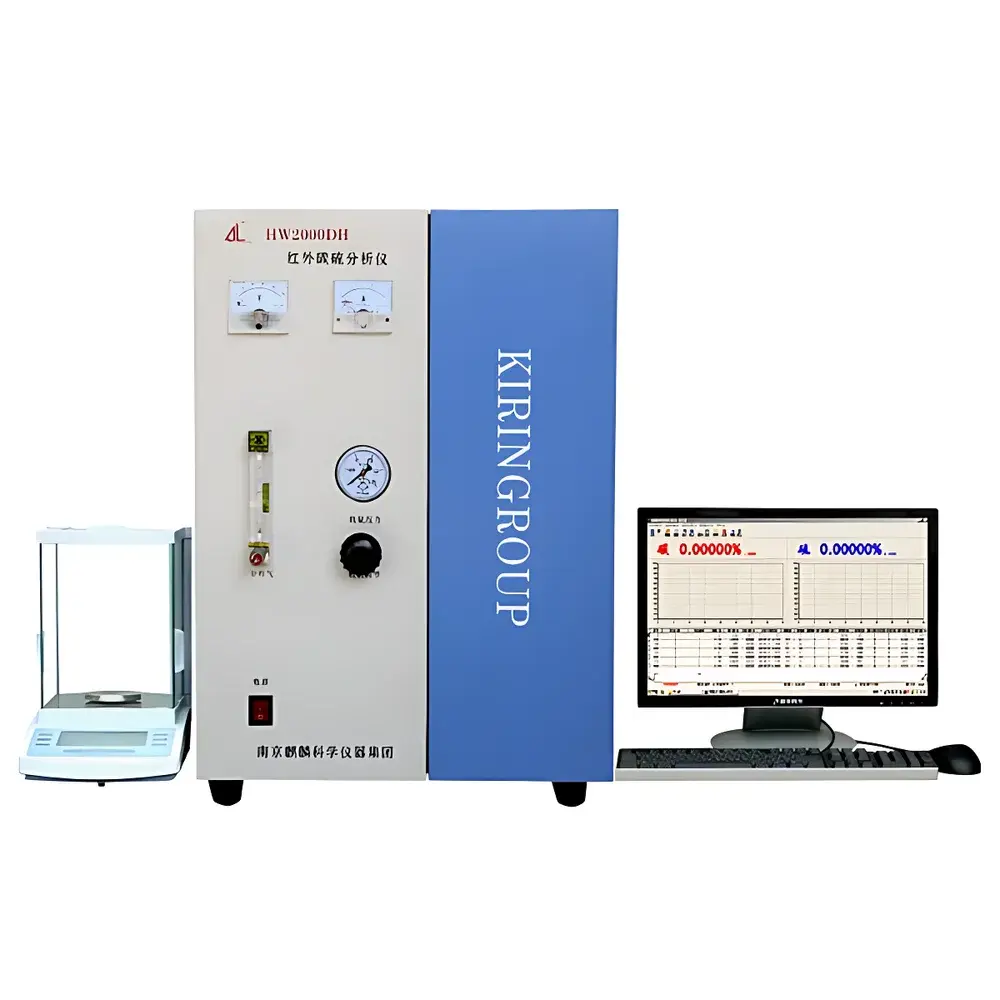
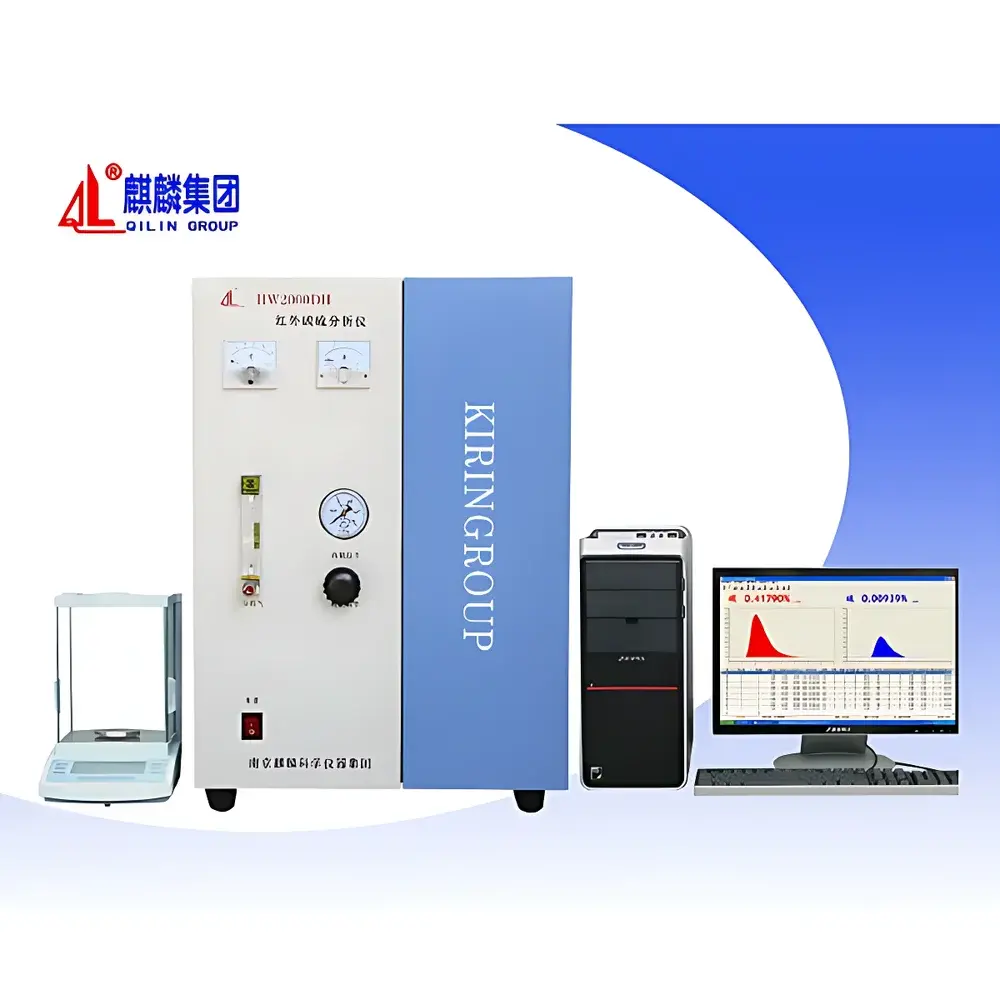
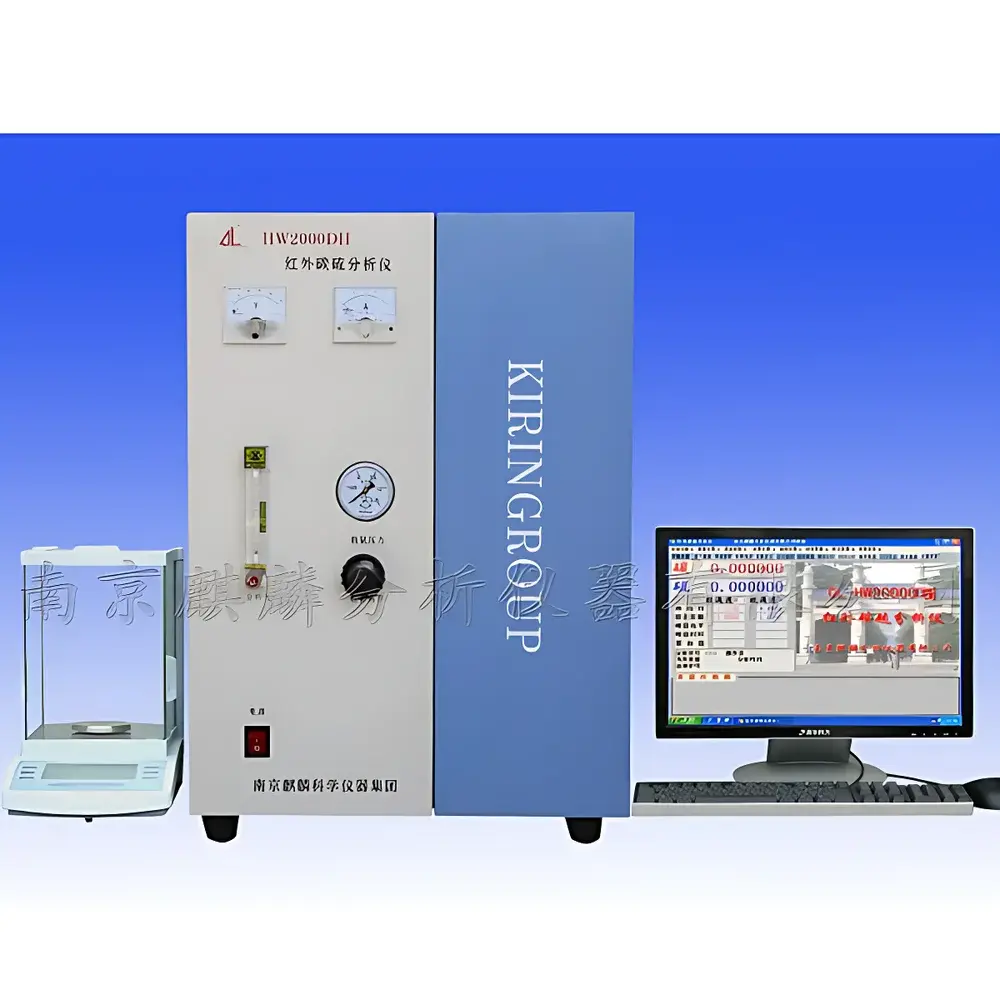
QL-HW2000DH Infrared Carbon-Sulfur Analyzer by QL Nanjing
| Brand | QL |
|---|---|
| Origin | Jiangsu, China |
| Model | HW2000DH |
| Measurement Principle | Infrared Absorption |
| Heating System | High-Energy Arc Furnace |
| Carbon Range | ω(C) 0.0010–10.00% |
| Sulfur Range | ω(S) 0.0005–0.500% |
| Analysis Time | Adjustable 20–60 s (typical 35 s) |
| Precision | Carbon compliant with GB/T 223.69–1997 |
| Sample Weighing | Analytical Balance (0.0001 g resolution) |
| Operating Environment | 10–30 °C, RH < 75% |
| Compliance | Designed for ISO/IEC 17025-aligned metallurgical QC labs |
Overview
The QL-HW2000DH Infrared Carbon-Sulfur Analyzer is a dedicated high-throughput elemental analyzer engineered for precise quantification of total carbon and sulfur mass fractions in ferrous and non-ferrous metallic matrices—including carbon steels, alloy steels, stainless steels, cast irons, nickel-based superalloys, and titanium alloys. It operates on the principle of non-dispersive infrared (NDIR) absorption spectroscopy: following complete combustion in a controlled high-energy arc furnace, evolved CO₂ and SO₂ gases pass through dual-wavelength infrared cells. Concentrations are determined via Beer-Lambert law-based calibration against certified reference materials (CRMs), delivering traceable, stoichiometrically grounded results. The instrument is designed for integration into quality control laboratories operating under ISO/IEC 17025, ASTM E1019, and JIS G 1211 compliance frameworks—particularly where rapid turnaround and repeatability across high-volume production batches are critical.
Key Features
- High-energy arc furnace with auto-ignition (arc initiation ≤ 0.4 s), enabling consistent, reproducible combustion of refractory and heterogeneous samples without flux addition.
- Dual-channel NDIR detection system with temperature-stabilized optical cells, optimized for simultaneous CO₂ and SO₂ measurement with minimal cross-sensitivity.
- Integrated analytical balance (0.0001 g resolution) supporting non-quantitative (variable-mass) sample introduction—reducing operator dependency and improving throughput.
- Modular gas handling subsystem featuring desiccant traps, catalytic oxidizer, and fine particulate filters to ensure baseline stability and long-term detector integrity.
- Rugged industrial-grade chassis with electromagnetic shielding and thermal isolation—engineered for continuous operation in foundry-adjacent environments (10–30 °C, RH < 75%).
- Firmware-controlled analysis time adjustment (20–60 s), allowing method optimization for low-carbon stainless grades or high-sulfur tool steels.
Sample Compatibility & Compliance
The QL-HW2000DH accepts solid metallic samples up to 1.0 g (typically 0.2–0.5 g), including drilled chips, turnings, and precision-cut coupons. It is validated for use with ASTM E1019-compliant CRMs such as NIST SRM 662a (low-C steel), SRM 664a (high-S steel), and IRMM-038 (stainless steel). All measurement protocols align with national standards GB/T 223.69–1997 (carbon) and GB/T 223.68–1997 (sulfur), which specify calibration verification, blank correction, and repeatability criteria (RSD ≤ 1.5% for C at 0.1%, RSD ≤ 2.0% for S at 0.01%). Instrument qualification documentation supports GLP audit trails and satisfies foundational requirements for GMP-relevant metal certification workflows.
Software & Data Management
The embedded Windows-based control software provides full method configuration, real-time spectral monitoring, automatic baseline compensation, and CRM-driven calibration curve generation. Data export conforms to ASTM E1382-compliant CSV and XML formats, enabling seamless import into LIMS platforms (e.g., LabWare, Thermo Fisher SampleManager). Audit trail functionality records user actions, parameter changes, and calibration events with timestamped, non-erasable logs—meeting basic FDA 21 CFR Part 11 readiness requirements when deployed with network-authenticated user accounts and electronic signature protocols. Raw spectral data and integrated peak areas are retained for retrospective reprocessing.
Applications
- Quality assurance of incoming raw materials (scrap, pig iron, ferroalloys) prior to charge preparation.
- In-process verification during ladle metallurgy and secondary refining to validate decarburization and desulfurization efficiency.
- Final product certification for ASTM A27, A36, A516, and EN 10025 structural steels.
- Research-grade compositional mapping of experimental alloys, including maraging steels and precipitation-hardened Ni-Cr-Mo systems.
- Failure analysis support—correlating elevated sulfur content with hot shortness or reduced weldability in fabricated components.
FAQ
What sample forms are compatible with the QL-HW2000DH?
Solid metallic specimens only—chips, turnings, or machined coupons. Powdered or liquid samples require pre-treatment (e.g., pelletization with binder) and are not supported out-of-the-box.
Does the instrument comply with international calibration standards?
Yes—it is validated using NIST and IRMM-certified reference materials and meets the performance thresholds defined in ASTM E1019, ISO 15350, and GB/T 223.68–1997 / GB/T 223.69–1997.
Can analysis time be adjusted per sample type?
Yes—total combustion and gas analysis duration is fully programmable from 20 to 60 seconds, allowing method tuning for low-concentration trace analysis or high-matrix interference mitigation.
Is electronic signature capability included for regulated environments?
The base software supports user-level access control and immutable audit logging. Full 21 CFR Part 11 compliance requires deployment on a validated IT infrastructure with external identity management and digital certificate integration.
What maintenance intervals are recommended for routine operation?
Daily: desiccant replacement and dust filter inspection. Quarterly: furnace liner inspection and ceramic crucible replacement. Annually: NDIR cell alignment verification and gain calibration using zero-gas and span-gas standards.





