
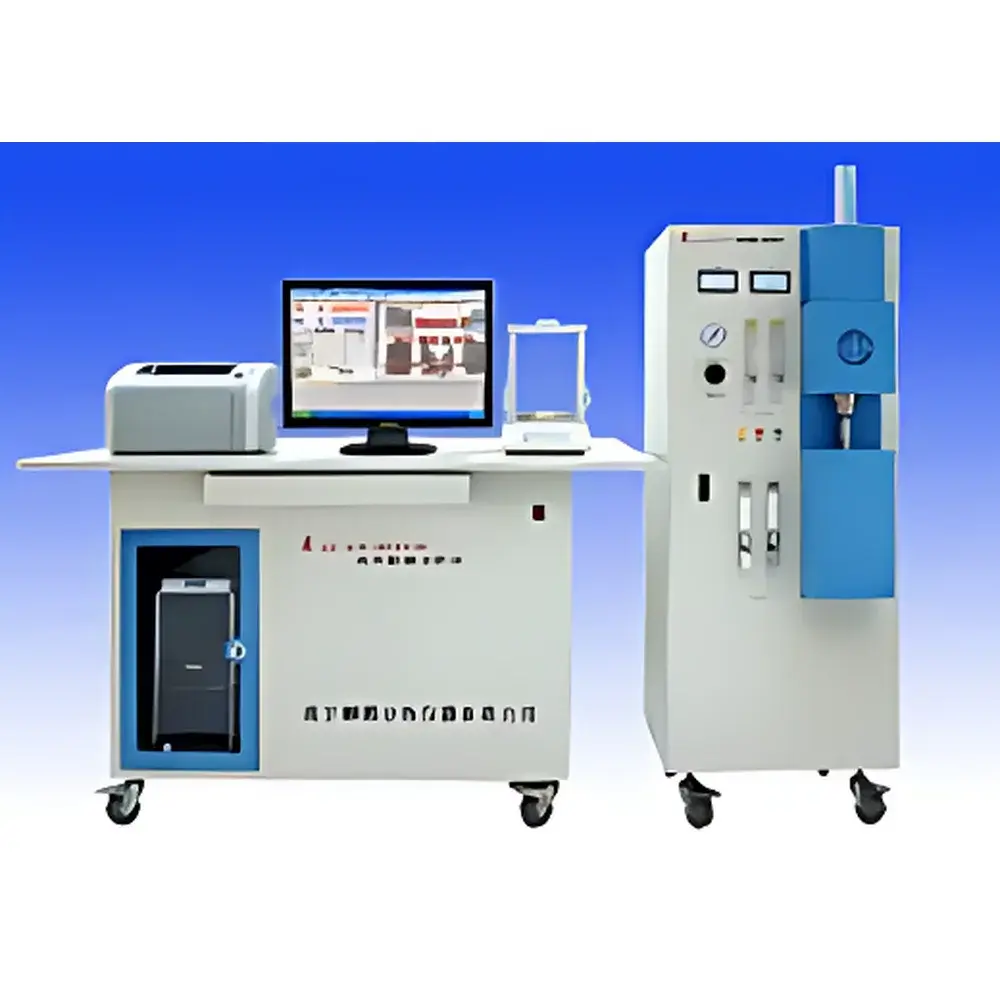
QL-HW2000 Series High-Frequency Infrared Carbon-Sulfur Analyzer
| Brand | Qilin (QL) |
|---|---|
| Origin | Jiangsu, China |
| Model | QL-HW2000 Series |
| Measurement Principle | Non-Dispersive Infrared (NDIR) Absorption |
| Heating System | 2.5 kVA, 18 MHz High-Frequency Induction Furnace |
| Carbon Range | 0.00001%–99.999% |
| Sulfur Range | 0.00001%–99.999% |
| Sensitivity | 0.1 ppm |
| Analysis Time | Adjustable 25–60 s (typical 35 s) |
| Weighing Capacity | 0–120 g |
| Balance Resolution | 0.0001 g |
| Compliance | GB/T 20123–2006, ISO 15350:2000, ISO 9556:1989 (C), ISO 4935:1989 (S) |
Overview
The QL-HW2000 Series High-Frequency Infrared Carbon-Sulfur Analyzer is a precision elemental combustion analyzer engineered for quantitative determination of total carbon (C) and total sulfur (S) in solid metallic and inorganic materials. It operates on the principle of high-frequency induction combustion followed by non-dispersive infrared (NDIR) absorption spectroscopy. Sample aliquots are combusted quantitatively in a pure oxygen atmosphere within a high-frequency induction furnace (18 MHz, up to 2.5 kVA), converting carbon and sulfur into CO₂ and SO₂ gases. These gaseous oxides pass sequentially through dedicated infrared cells, where their concentrations are measured via characteristic absorption bands at specific wavelengths (4.26 µm for CO₂, 7.35 µm for SO₂). The instrument’s optical path employs thermoelectrically stabilized detectors with low-noise amplification, ensuring baseline stability and signal reproducibility across extended operation cycles.
Key Features
- Modular architecture with isolated optical, electronic, and gas-handling subsystems—designed for long-term operational integrity and simplified maintenance.
- High-frequency induction furnace with continuously adjustable power output, enabling optimized combustion conditions for diverse sample matrices including ferrous alloys, non-ferrous metals, ores, ceramics, and refractory materials.
- Integrated analytical balance (0–120 g, 0.0001 g resolution) with RS232/USB interface for automated sample mass acquisition and stoichiometric normalization.
- Automated furnace head cleaning mechanism reduces particulate carryover and minimizes memory effects between analyses.
- Dedicated furnace head heating zone maintains consistent thermal environment during SO₂ generation, improving sulfur recovery reproducibility and reducing matrix-dependent bias.
- Real-time graphical display of combustion profiles—including CO₂ and SO₂ evolution curves—enabling visual validation of complete sample oxidation and detection of anomalies such as incomplete combustion or volatile interferences.
Sample Compatibility & Compliance
The QL-HW2000 supports analysis of pressed pellets, drillings, turnings, and powders from iron, steel, stainless steels, cast irons, aluminum alloys, copper alloys, nickel-based superalloys, manganese ferroalloys, limestone, coke, and slag. Sample mass is user-defined (typically 0.2–1.0 g), with no fixed crucible loading requirement due to dynamic mass compensation. Method validation adheres to internationally recognized standards: GB/T 20123–2006 and ISO 15350:2000 for general methodology; ISO 9556:1989 for carbon determination; and ISO 4935:1989 for sulfur determination. Instrument performance meets requirements for routine QC/QA in foundry, metallurgical R&D, and third-party testing laboratories operating under GLP frameworks. Data handling supports audit-trail generation compliant with basic 21 CFR Part 11 principles when deployed with configured system logs and user access controls.
Software & Data Management
The analyzer runs on a Windows-based application with fully localized Chinese GUI (English localization available upon request). The software provides over 40 functional modules, including method configuration, calibration curve management (linear and polynomial), multi-point standardization, drift correction, blank subtraction, statistical reporting (mean, SD, RSD, confidence intervals), result export (CSV, Excel, PDF), and customizable report templates. All analytical events—including balance readings, furnace parameters, detector voltages, peak integration windows, and operator logins—are timestamped and stored in a relational database. System diagnostics monitor gas flow rates, pressure differentials, cell temperatures, and detector responsivity trends, issuing alerts prior to performance degradation. Raw spectral data and time-resolved absorption traces are retained for retrospective reprocessing.
Applications
This analyzer serves critical roles in incoming raw material verification, melt shop process control, final product certification, and failure analysis. Typical use cases include: monitoring carbon segregation in continuous-cast billets; verifying sulfur content in bearing steels per ASTM A29/A29M specifications; certifying low-carbon grades for nuclear-grade stainless steels (ASTM A1016); assessing desulfurization efficiency in ladle metallurgy; quantifying residual carbon in graphite electrodes; and determining total sulfur in coal ash and limestone fluxes used in blast furnace operations. Its wide linear range (0.00001–99.999%) accommodates both ultra-trace impurity analysis and high-content alloy certification without hardware modification.
FAQ
What types of samples require pre-treatment before analysis?
Most metallic solids can be analyzed directly as drillings or turnings. High-silicon or high-chromium alloys may benefit from co-weighing with tungsten or tin accelerants to ensure complete combustion. Organic-rich or highly volatile samples (e.g., cokes, polymers) require controlled oxygen flow ramping and optional ceramic crucible liners.
Is calibration traceable to NIST or other national standards?
Yes—calibration is performed using certified reference materials (CRMs) traceable to NIST SRMs (e.g., NIST 678a, 681, 683c) or equivalent ISO-certified CRMs. Full calibration documentation, including CRM lot numbers and certificate expiration dates, is maintained within the software audit log.
Can the instrument be integrated into a LIMS environment?
The system supports ODBC-compliant database export and HL7-compatible ASCII result files. Custom API integration (RESTful or TCP/IP socket) is available via optional middleware module for direct LIMS synchronization.
What maintenance intervals are recommended for routine operation?
Daily: desiccant replacement, filter inspection, and leak check. Weekly: furnace head cleaning and optical window wipe. Quarterly: detector gain recalibration and gas line integrity test. Annual: full optical alignment verification and furnace coil resistance measurement.
Does the software support multi-user role-based access control?
Yes—administrator, analyst, and viewer roles are configurable with password protection, session timeout, and granular permissions for method editing, calibration, and data deletion.




