
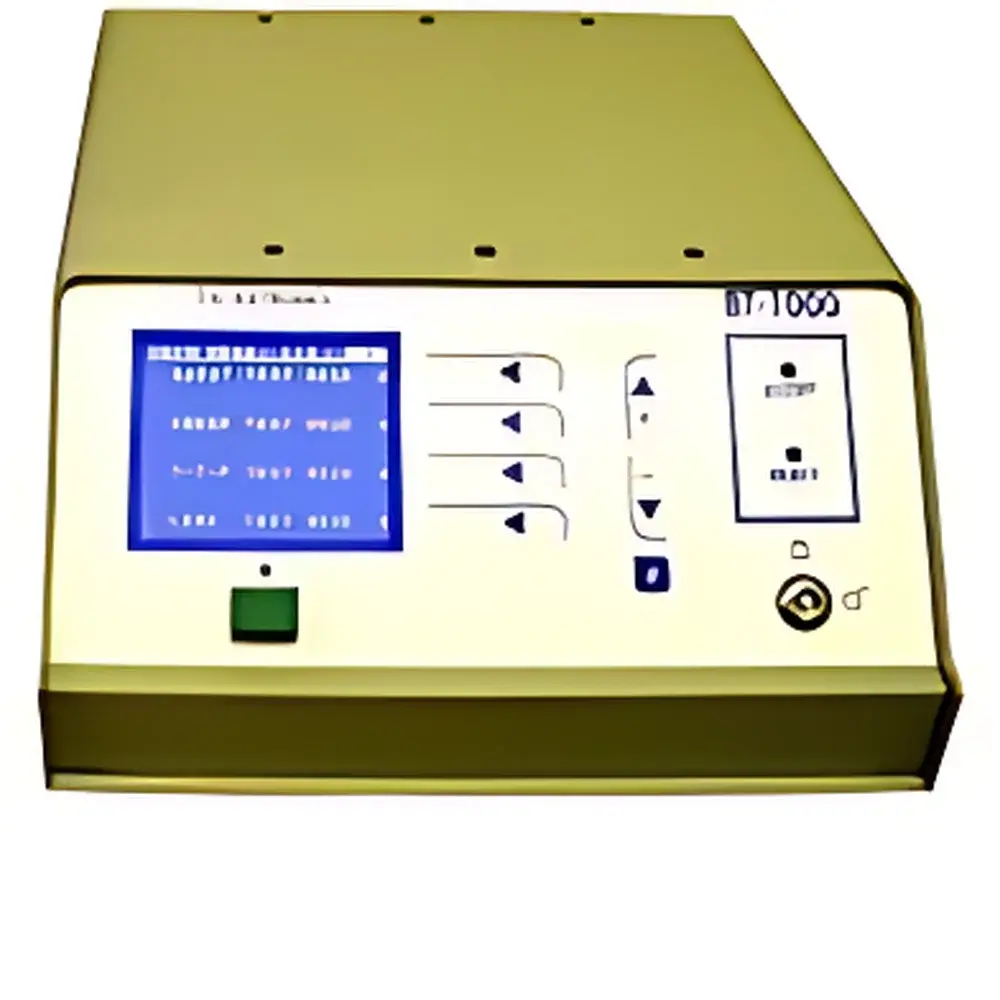
TM Electronics BT-1000 Fully Automated Packaging Integrity Tester
| Brand | TM Electronics |
|---|---|
| Origin | USA |
| Model | BT-1000 |
| Dimensions | 13" W × 15" D × 6.5" H |
| Power | 115 V, 50/60 Hz, 150 W |
| Pressure Range | 0.2–50 psig and 1–100 psi (oil-free, dry air) |
| Time Range | 0.1–1000 s |
| Resolution | 0.5 in H₂O |
| Test Modes | Burst, Creep, Creep-to-Failure, Leak Detection, and combined dual-mode tests (e.g., Creep/Leak, Leak/Burst) |
| Display | 20×16-character LCD with graphical capability |
| Data Storage | 1000 test results |
| Program Memory | 40 user-defined test protocols |
| Statistical Output | X̄-R control charts, histograms, mean, standard deviation, min/max, range, count |
| Interface | DB25 female (print & PLC auxiliary), DB25 male (RS-232 ASCII serial, PC/WINDOWS compatible) |
| Compliance | ISO 11607, ASTM F1140, ASTM F2054 |
| Calibration | NIST-traceable |
Overview
The TM Electronics BT-1000 Fully Automated Packaging Integrity Tester is an engineered solution for quantitative assessment of seal integrity and mechanical strength in sterile and non-sterile flexible packaging systems. It operates on the principle of controlled pressurization—applying regulated, oil-free compressed air to sealed packages while monitoring pressure decay (for leak detection) or time-to-failure under sustained load (for seal strength evaluation). Designed for regulatory-grade validation and routine quality assurance, the BT-1000 supports both deterministic and probabilistic testing paradigms required in medical device packaging, pharmaceutical primary containment, and aseptic food packaging environments. Its architecture integrates pneumatic actuation, high-resolution pressure transduction, and real-time data acquisition to deliver repeatable, auditable results aligned with process validation lifecycle requirements (IQ/OQ/PQ).
Key Features
- Eight standardized test modes—including independent and dual-sequence protocols (e.g., Creep/Leak, Leak/Burst)—enabling comprehensive evaluation of both seal robustness and barrier performance in a single platform.
- 16-step electronic pressure and flow control ensures precise modulation across low-pressure (<5 psig) and high-pressure (up to 100 psi) regimes, accommodating diverse substrates from Tyvek® and porous paper to aluminum-laminated films and rigid thermoformed trays.
- NIST-traceable calibration infrastructure with documented uncertainty budgets, supporting compliance with ISO/IEC 17025 laboratory accreditation requirements.
- Integrated SPC engine generating X̄-R control charts, histograms, and descriptive statistics (mean, σ, range, n) directly on the front-panel LCD—eliminating post-test manual data transfer for routine QC reporting.
- Hardware-enforced security via physical key-lock mechanism, preventing unauthorized modification of test parameters, stored protocols, or historical datasets—a critical control for FDA 21 CFR Part 11–aligned environments.
- Modular fixture interface enabling application-specific tooling design (e.g., channel clamps for pouch seals, vacuum-assisted platens for flat-bottom bags), ensuring consistent sample positioning and force distribution per ASTM F1886 practice.
Sample Compatibility & Compliance
The BT-1000 accommodates a broad spectrum of package geometries and material constructions: flat pouches, peel-open blisters, foil-lidded trays, and form-fill-seal configurations. It is validated for use with both permeable (e.g., medical-grade Tyvek®, filter papers) and impermeable (e.g., PET/Alu/PE laminates, cold-form foil) packaging systems. Regulatory alignment includes full conformance with ISO 11607-1:2019 (Packaging for terminally sterilized medical devices), ISO 11607-2:2019 (Validation requirements), ASTM F1140/F1140M (Internal pressurization resistance), and ASTM F2054 (Creep test method for flexible barrier materials). All test methods are implemented per defined acceptance criteria thresholds, with pass/fail logic programmable per protocol to support risk-based qualification strategies.
Software & Data Management
Data output is structured in ASCII format via RS-232 serial interface (DB25 male), fully compatible with Windows-based LIMS, MES, and statistical analysis platforms (e.g., Minitab, JMP). The instrument logs timestamped raw pressure vs. time profiles, final pass/fail status, statistical summaries, and operator ID (when integrated with external authentication systems). Print outputs—via DB25 female port—include configurable reports containing test ID, date/time, operator, protocol name, measured values, control limits, and graphical traces. Audit trail functionality is maintained through immutable internal memory storage; all modifications to programs or system settings are recorded with timestamps and user identifiers, satisfying GLP/GMP documentation integrity standards.
Applications
- Medical device packaging validation per ISO 11607 and AAMI TIR22 guidance.
- Pharmaceutical blister and pouch seal strength verification during stability and accelerated aging studies.
- Process capability analysis (Cp/Cpk) of heat-sealing operations in contract manufacturing organizations.
- Root cause investigation of field failures linked to seal delamination or micro-leak pathways.
- Supplier qualification testing for incoming packaging materials against agreed-upon specification limits.
- Supporting Design of Experiments (DoE) for seal parameter optimization (temperature, dwell time, pressure).
FAQ
Does the BT-1000 require external calibration equipment?
No—the unit includes built-in self-diagnostics and accepts NIST-traceable pressure calibrators via its analog input port; annual third-party calibration is recommended per ISO/IEC 17025.
Can test protocols be exported to multiple instruments?
Yes—programs stored in the 40-slot memory can be transferred via RS-232 using TM Electronics’ proprietary configuration utility or exported as ASCII text files for version control.
Is the system compatible with automated production line integration?
Yes—auxiliary I/O (DB25 female) provides discrete signals for PLC-triggered start/stop, pass/fail status relay outputs, and E-stop interlock compatibility per IEC 61508 functional safety guidelines.
What maintenance is required for long-term reliability?
Routine inspection of O-rings, filter replacement every 6 months (under continuous use), and quarterly verification of pressure transducer linearity using reference gauges.
How does the BT-1000 handle variable ambient temperature and humidity?
The pneumatic system incorporates inline desiccant and coalescing filters to ensure delivery of dry, particle-free air; internal thermal compensation algorithms adjust pressure readings based on ambient sensor input (±0.5 °C resolution).






