
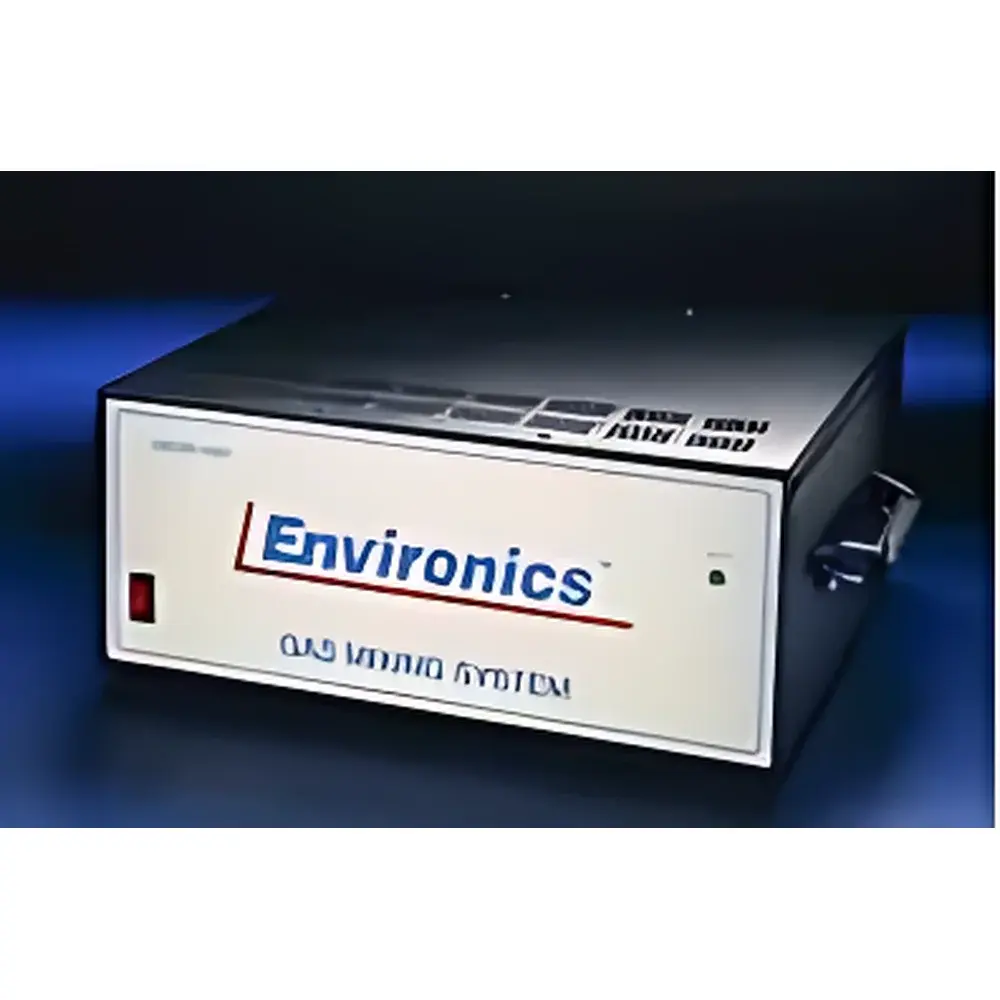
Environics S4000/S4040 Series Computer-Controlled Multi-Component Gas Dilution System
| Brand | Environics Oy |
|---|---|
| Origin | Finland |
| Model | S4000 / S4040 |
| Concentration Accuracy | ±1.0% of setpoint |
| Repeatability | ±1.0% |
| Max Operating Pressure | 75 psig (recommended: 25 psig) |
| Dilution Ratio | Up to 10,000:1 (S4040) |
| Gas Inputs | 4 (S4000) / 6 sample + 1 diluent (S4040) |
| Control Interface | RS-232, Windows-based software |
Overview
The Environics S4000 and S4040 Series are precision-engineered computer-controlled gas dilution systems designed for trace-level standard gas generation in environmental monitoring, regulatory compliance, and analytical instrument calibration. Based on thermal mass flow control and digitally compensated flow measurement principles, these systems generate stable, repeatable multi-component gas mixtures across concentration ranges spanning from percent (%) down to parts-per-trillion (ppt) levels—enabling rigorous zero/span/linearity/repeatability verification of ambient air analyzers, GC detectors, electrochemical sensors, and optical gas monitors. The S4000 serves as a robust multi-gas mixing platform for up to four independent cylinder sources; the S4040 extends this capability with dynamic dilution architecture, six sample gas inlets, intelligent flow path selection, and programmable dilution ratios exceeding 10,000:1—making it suitable for high-fidelity dynamic calibration of reference-grade monitoring stations, including those deployed by the U.S. EPA, California Air Resources Board (CARB), and European EEA national networks.
Key Features
- Thermal mass flow controllers (MFCs) with embedded NIST-traceable calibration coefficients stored in non-volatile memory—ensuring real-time flow correction and long-term stability without manual recalibration.
- Windows-based control software via RS-232 interface enabling full automation of calibration sequences—including multi-point zero/span, linearity ramps, and repeatability cycles—with audit-ready execution logs.
- Gas-specific K-factor compensation: user-defined cylinder compositions (e.g., NO/NO₂/SO₂/CO/O₃/THC in balance air or N₂) are stored and automatically applied to correct for molecular weight and thermal conductivity effects on MFC response.
- S4040-exclusive dynamic dilution module: selects optimal MFC pairs from ≥3 calibrated flow paths to maintain ±1.0% accuracy across extreme dilution ranges while minimizing cylinder consumption and cross-contamination risk.
- Modular hardware architecture supporting field-upgradable configurations—from dual-gas S4000 base units to fully expanded S4040 systems with redundant pressure regulation, particulate filtration, and optional ozone scrubbers.
Sample Compatibility & Compliance
The S4000/S4040 systems accommodate a broad spectrum of reactive and inert gases—including NO, NO₂, SO₂, CO, O₃, THC, VOCs, CH₄, NH₃, H₂S, and halogenated compounds—when used with chemically compatible wetted materials (316 stainless steel, electropolished surfaces, Kalrez® seals). All configurations comply with ISO 6145-7 (gas mixture preparation by dynamic dilution), ASTM D6348 (standard test method for determination of gaseous compounds by GC), and EU Directive 2008/50/EC requirements for ambient air quality monitoring equipment validation. Systems support 21 CFR Part 11-compliant data integrity when operated with validated software versions, including electronic signatures, change history, and immutable audit trails required under GLP/GMP and EPA Method TO-15/TO-17 workflows.
Software & Data Management
Environics’ proprietary Windows application provides intuitive graphical configuration of gas recipes, time-based sequence programming, real-time flow monitoring, and automated report generation (PDF/CSV). Each run is timestamped and linked to cylinder lot numbers, calibration certificates, and operator IDs. Raw MFC output, temperature/pressure compensation values, and calculated concentrations are logged at 1 Hz resolution. Exported datasets include metadata compliant with ASTM E1447 and ISO/IEC 17025 documentation standards—facilitating integration into LIMS environments and third-party QA/QC platforms. Optional OPC UA server module enables live data streaming to SCADA or cloud-based environmental dashboards.
Applications
- Primary and secondary calibration of regulatory-grade ambient air analyzers (e.g., chemiluminescence NOₓ, UV photometric O₃, NDIR CO, pulsed fluorescence SO₂).
- Dynamic generation of multi-gas challenge standards for sensor drift assessment, alarm threshold validation, and explosion-proof certification testing.
- Controlled exposure studies simulating urban pollution episodes, industrial stack emissions, or indoor air quality scenarios with sub-ppb precision.
- Cost-optimized use of expensive multi-component certified reference materials (CRMs)—reducing cylinder replacement frequency by >70% compared to static blending methods.
- Supporting ISO 17025-accredited laboratories in maintaining metrological traceability to NIST SRMs through documented dilution uncertainty budgets per GUM (JCGM 100:2008).
FAQ
What concentration ranges can the S4040 achieve with certified accuracy?
The system delivers ±1.0% accuracy from 100% down to low-ppt levels—dependent on primary standard purity, MFC range selection, and diluent gas quality. Typical validated working range: 1 ppm to 10 ppb for reactive gases; sub-ppb for stable species like CH₄ or CO₂.
Does the system require external calibration gas cylinders for verification?
No—built-in MFC calibration coefficients eliminate routine external verification. However, periodic CRM-based performance checks (e.g., using NIST-traceable 1 ppm NO in N₂) are recommended annually per ISO/IEC 17025 Clause 6.6.
Can the S4000/S4040 integrate with existing facility SCADA or EMS platforms?
Yes—via optional OPC UA or Modbus TCP gateways, enabling remote start/stop, real-time concentration readbacks, and fault status monitoring within centralized environmental management systems.
Is ozone-compatible configuration available for O₃ calibration applications?
Yes—S4040 systems can be ordered with ozone-resistant tubing (PTFE-lined SS), catalytic ozone destruct modules, and dedicated O₃ MFCs calibrated per EPA Method 40 CFR Part 53 Appendix A.
What maintenance intervals are recommended for long-term operational reliability?
Filter elements every 6 months; MFC zero checks quarterly; full system leak test and pressure regulator verification annually—documented per manufacturer’s Maintenance Log Template (ENVR-MT-040).







