
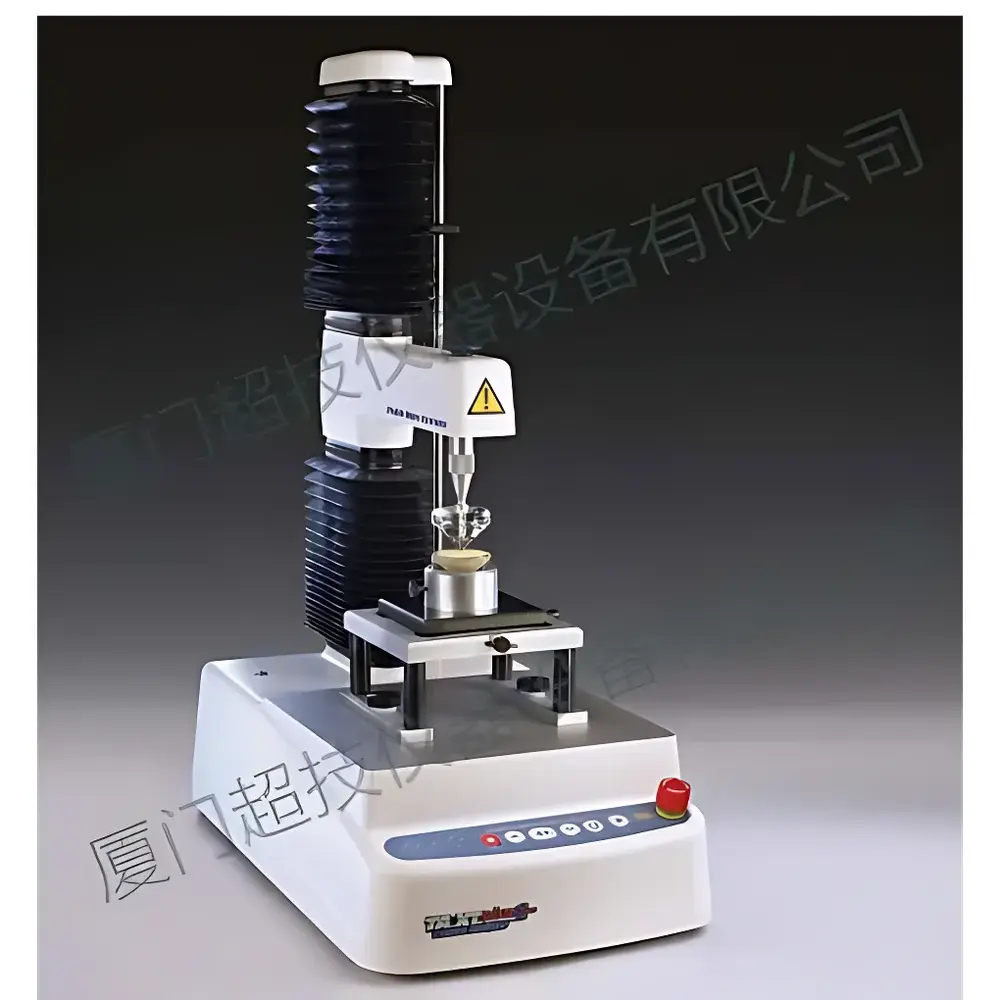
SMS TA.XT Plus Texture Analyzer for Cosmetics and Personal Care Products
| Brand | SMS |
|---|---|
| Origin | UK |
| Manufacturer Type | Authorized Distributor |
| Origin Category | Imported |
| Model | TA.XT Plus Cosmetic & Personal Care Texture Analyzer |
| Force Range | 0.5–50 kg |
| Force Resolution | 0.1 g |
| Test Speed Range | 0.01–40 mm/s |
| Maximum Travel Distance | 370 mm |
| Position Resolution | 0.001 mm |
| Data Acquisition Rate | >2,000 readings/sec (4 channels simultaneously) |
Overview
The SMS TA.XT Plus Texture Analyzer is a high-precision universal testing instrument engineered for objective, quantitative mechanical property characterization of semi-solid and soft-solid formulations in cosmetics, personal care, pharmaceuticals, and related industries. Based on the fundamental principles of uniaxial compression, penetration, extrusion, and shear deformation, the system applies controlled force and displacement to samples while capturing real-time load–displacement profiles. Its modular probe and fixture architecture enables standardized measurement of parameters critical to consumer perception—including hardness, cohesiveness, adhesiveness, spreadability, extrudability, yield stress, and slip resistance—thereby bridging the gap between instrumental data and sensory evaluation. Designed and manufactured by Stable Micro Systems (Surrey, UK), the TA.XT Plus adheres to ISO 11040-6, ASTM D217 (for consistency), and USP guidelines for performance verification of texture analysis systems.
Key Features
- High-resolution dual-load-cell architecture supporting seamless switching between low-force (0.1 g resolution) and high-force (50 kg capacity) measurement modes without recalibration.
- Motor-driven crosshead with closed-loop servo control ensures precise velocity regulation across the full range (0.01–40 mm/s), critical for simulating realistic application conditions such as finger-spread or pump-actuated dispensing.
- Sub-micron positional accuracy (0.001 mm) enables reproducible detection of subtle structural transitions—e.g., yield point onset in shear-thinning emulsions or fracture events in pressed powders.
- Integrated barcode scanning interface allows one-touch initiation of preconfigured test methods, reducing operator-dependent variability and accelerating throughput in QC environments.
- Remote operation capability via secure web-based interface compatible with iOS and Android tablets—enabling real-time monitoring, method execution, and automated email delivery of raw data files (CSV, TXT) and summary reports.
- Modular probe library includes conical penetrators, flat-ended cylinders, wire mesh screens, and custom-designed applicator simulators (e.g., lip balm applicator rollers, foundation sponge interfaces) compliant with ISO 17225-2 for cosmetic product testing.
Sample Compatibility & Compliance
The TA.XT Plus accommodates diverse sample formats: stick-form lip products (lipsticks, lip glosses), compressed powders (blushes, eyeshadows), anhydrous sticks (deodorants), water-in-oil and oil-in-water emulsions (moisturizers, sunscreens), and hydrogels (serums, masks). Sample holders are designed to minimize edge effects and ensure uniform stress distribution during compression or extrusion. All test protocols align with internationally recognized standards including ISO 16840-1 (cosmetic rheology), ASTM D866 (consistency of greases), and ICH Q5C (stability testing of biopharmaceuticals). Audit-ready software supports 21 CFR Part 11-compliant electronic signatures, user access levels, and immutable audit trails for GLP/GMP-regulated laboratories.
Software & Data Management
Texture Exponent Touch™ software provides intuitive graphical method building, real-time curve overlay, and automated parameter extraction—including peak force, work of shear, area under curve (AUC), and relaxation modulus. Built-in statistical tools support ANOVA, PCA, and correlation mapping against sensory panel scores. The platform hosts over 400 peer-reviewed application notes and video tutorials covering validated methods for SPF formulation screening, foundation transfer efficiency, mascara film integrity, and anti-perspirant active release kinetics. Raw data exports retain full timestamped metadata, channel synchronization markers, and environmental sensor logs (optional temperature/humidity integration).
Applications
- Quantifying spreadability and drag coefficient of facial moisturizers using controlled-speed spreading plates.
- Evaluating structural recovery time of silicone-based primers after mechanical disruption.
- Measuring extrusion force and flow consistency of tube-dispensed serums and cleansers.
- Assessing powder compact strength and friability of pressed eye shadows and blushes.
- Determining adhesion energy and peel resistance of hydrocolloid-based sheet masks.
- Correlating instrumental hardness with consumer-perceived “firmness” in BB creams and color-correcting concealers.
FAQ
Can the TA.XT Plus comply with regulatory submissions for cosmetic stability dossiers?
Yes—the system supports IQ/OQ/PQ documentation packages and generates ALCOA+ compliant data sets suitable for inclusion in CPNP notifications and EU Annex I ingredient declarations.
Is calibration traceable to national standards?
All force transducers are factory-calibrated against UKAS-accredited deadweight standards; optional annual recalibration services include NIST-traceable certificates.
How does the system handle temperature-sensitive formulations?
When integrated with Peltier-controlled environmental chambers (e.g., SMS TempControl™), the analyzer maintains ±0.5°C stability during extended creep or oscillatory tests.
Are probe geometries customizable for proprietary packaging formats?
SMS offers rapid prototyping of application-specific fixtures—e.g., pump-actuated nozzle interfaces or aerosol spray pattern simulators—under NDA.
Does the software support multivariate regression against sensory attributes?
Yes—Texture Exponent Touch™ includes built-in partial least squares (PLS) modeling tools to establish predictive equations linking instrumental parameters to hedonic scale ratings from trained panels.







