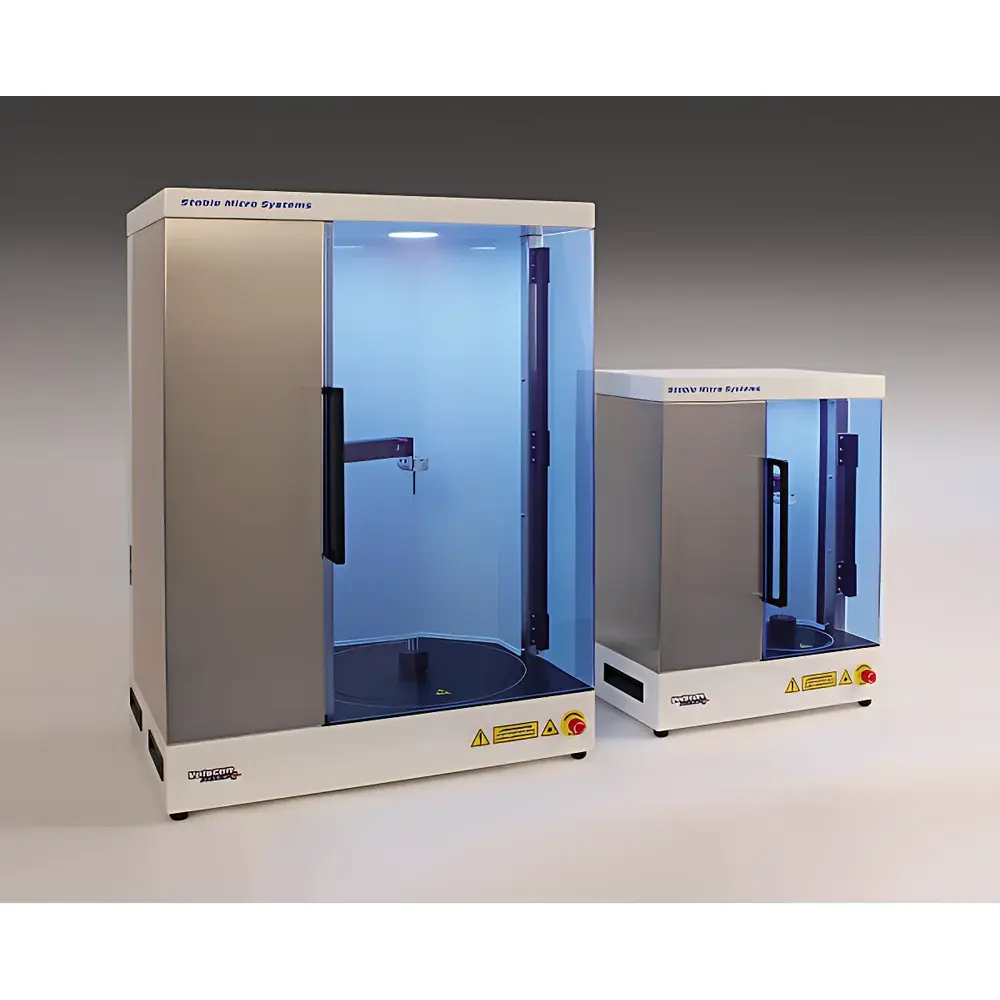
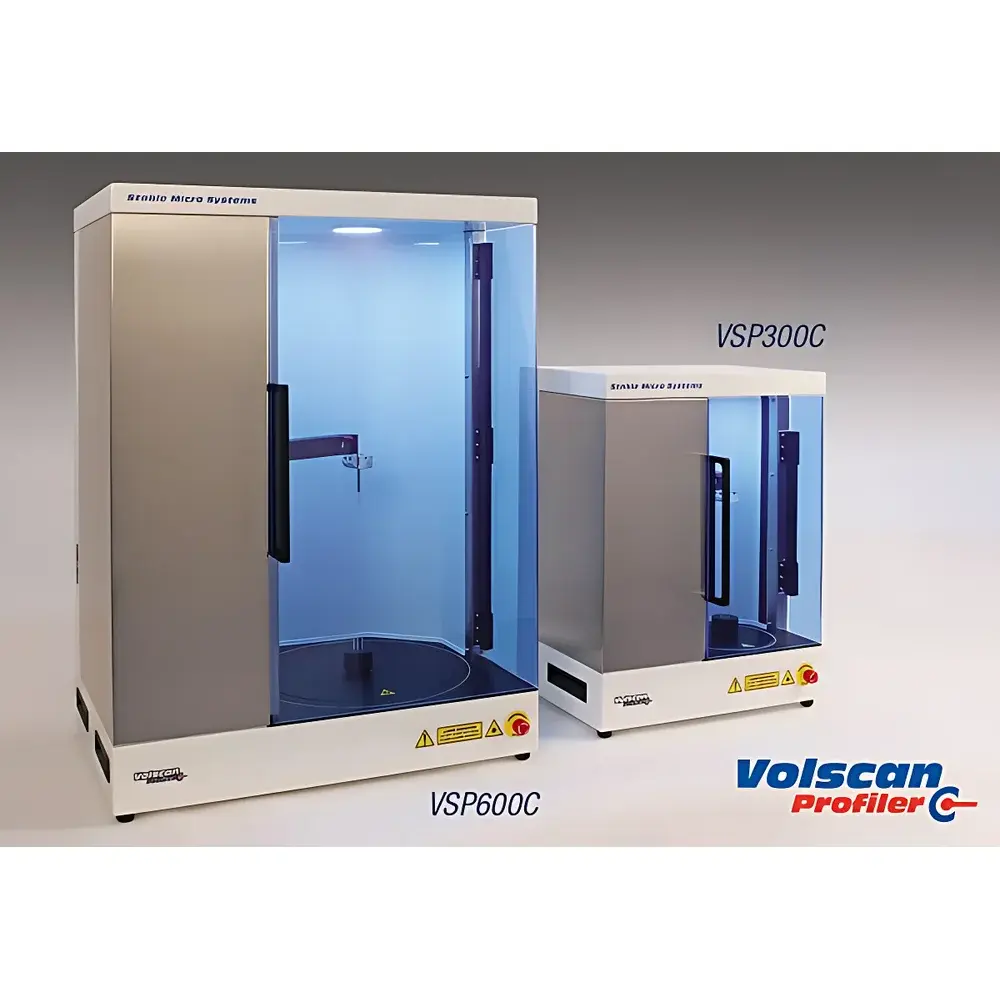
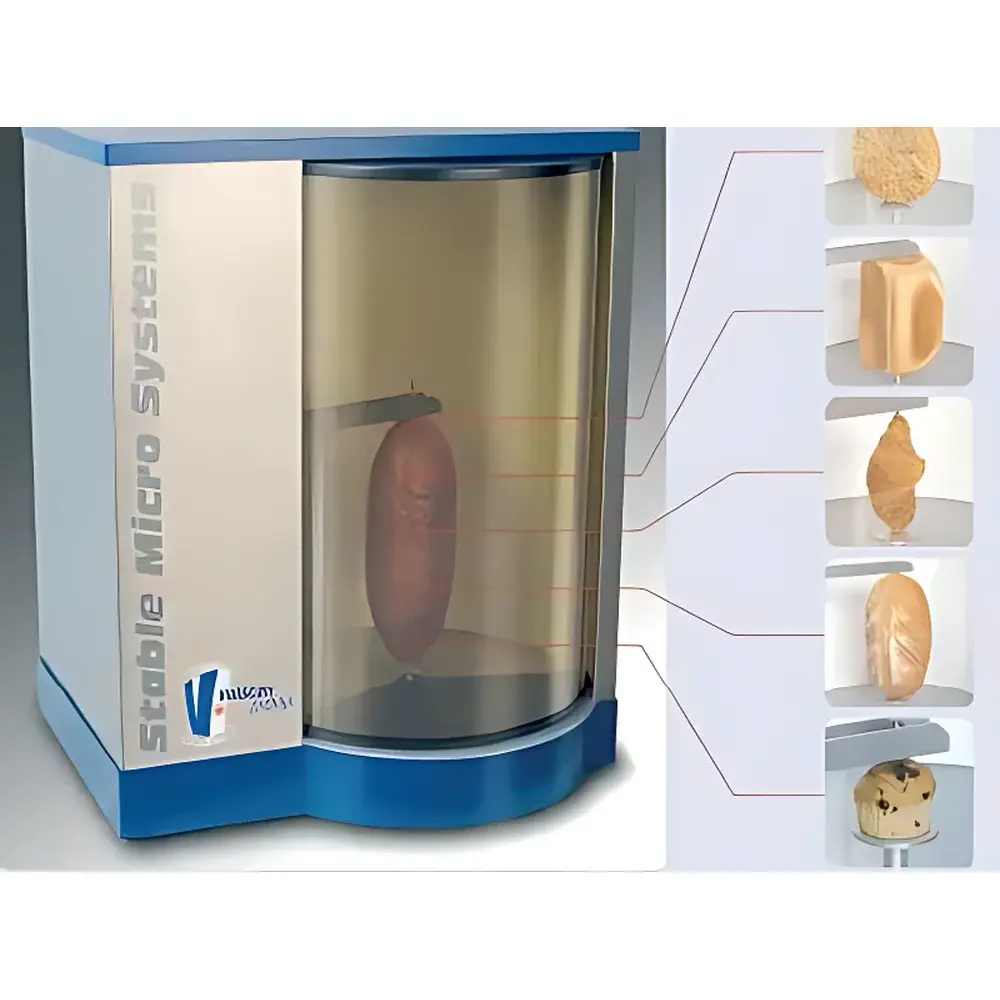
Stable Micro Systems Volscan Profiler Food Volume Analyzer
| Brand | Stable Micro Systems |
|---|---|
| Origin | United Kingdom |
| Model | Volscan Profiler |
| Sample Max Diameter | 380 mm (VSP 600C) / 190 mm (VSP 300C) |
| Sample Max Height | 600 mm (VSP 600C) / 300 mm (VSP 300C) |
| Max Sample Weight | 3 kg |
| Data Acquisition Rate | 400 points per rotation |
| Vertical Resolution | 0.05–50 mm |
| Volume Accuracy | ±1% |
| Mass Accuracy | <1% |
| Operating Temperature | 10–40 °C |
| Interface | USB, RS232, RS485 |
Overview
The Stable Micro Systems Volscan Profiler is a non-contact, laser-based 3D volumetric imaging system engineered for precise and repeatable volume measurement of irregularly shaped food products—particularly baked goods (e.g., bread loaves, buns, rolls), fruits, vegetables, and other soft or fragile commodities. Unlike displacement-based methods (e.g., seed displacement per AACCI Method 10-16.01), the Volscan Profiler employs rotating-stage laser profilometry to acquire high-density surface point clouds. Each full 360° rotation captures 400 discrete axial cross-sections with vertical resolution from 0.05 mm to 50 mm, enabling reconstruction of true geometric volume without mechanical compression or sample deformation. Its design conforms to internationally recognized standards for objective bakery evaluation—including AACCI Method 10-16.01—and supports traceable, audit-ready measurements required in GLP-compliant R&D, quality assurance, and regulatory documentation workflows.
Key Features
- Non-contact laser scanning eliminates compression artifacts—critical for delicate, aerated, or crumbly samples such as artisanal breads, nut- or fruit-studded loaves, and crisp-skinned produce.
- Dual configuration options: VSP 600C (max Ø380 mm × H600 mm) and VSP 300C (max Ø190 mm × H300 mm), both supporting up to 3 kg sample mass.
- Integrated precision balance enables synchronized mass–volume correlation; calculates specific volume (mL/100 g) automatically.
- Real-time 2D silhouette and full 3D surface mesh generation with exportable STL, OBJ, and CSV formats for downstream analysis.
- Adjustable rotational speed ensures optimal data fidelity across diverse sample geometries and surface reflectivities.
- Onboard environmental monitoring: simultaneous measurement of ambient room temperature and sample surface temperature (10–40 °C operational range).
- Industrial-grade I/O interfaces: USB 2.0, RS232, and RS485 for integration into automated production lines or LIMS environments.
Sample Compatibility & Compliance
The Volscan Profiler accommodates a broad spectrum of food matrices without preconditioning or fixturing: from ultra-soft pan breads and laminated pastries to textured whole-grain loaves, sliced baguettes, apples, potatoes, and molded confectionery. Its optical architecture tolerates variable surface finish—matte, glossy, or particulate-laden—without calibration drift. The system complies with measurement principles referenced in AACCI Method 10-16.01 and aligns with ISO 21502:2020 (Sensory analysis — General guidance for measuring volume of baked products). All volume calculations are deterministic and reproducible under standard laboratory conditions, satisfying internal QA protocols and external audit requirements including FDA 21 CFR Part 11 when deployed with validated software configurations and electronic signature controls.
Software & Data Management
Volscan software provides a calibrated, version-controlled environment for acquisition, visualization, and reporting. It delivers native 2D profile overlays and interactive 3D rotatable meshes with dimension annotation (length, width, height, volume, surface area). Export functions support Excel-compatible .csv for statistical process control (SPC), as well as .pdf reports with embedded metadata (operator ID, timestamp, instrument serial number, environmental readings). Audit trail logging records all parameter changes, measurement events, and user actions—enabling full traceability in GMP and GLP-regulated settings. Optional API integration allows direct ingestion into enterprise databases or MES platforms via TCP/IP or serial command protocols.
Applications
- Quality control labs quantifying loaf volume consistency across production batches to monitor dough formulation, proofing time, and oven spring performance.
- R&D teams correlating ingredient substitutions (e.g., gluten-free flours, hydrocolloids, enzyme additives) with volumetric expansion and structural integrity.
- Process engineers validating scaling parameters during line start-up or equipment changeovers using real-time volume feedback loops.
- Academic researchers studying gas cell structure evolution during fermentation and baking via longitudinal volumetric profiling.
- Ingredient suppliers demonstrating functional performance claims (e.g., “improved oven rise”) with objective, third-party-recognized metrics.
FAQ
What standards does the Volscan Profiler reference for volume measurement?
It implements the physical principles and reporting conventions defined in AACCI Method 10-16.01 and is consistent with ISO 21502:2020 for baked product volume assessment.
Can the system measure partially baked or frozen samples?
Yes—provided the sample remains dimensionally stable during scanning; surface condensation or frost must be minimized to maintain laser signal integrity.
Is calibration traceable to national metrology institutes?
The system uses factory-calibrated laser displacement sensors with documented NIST-traceable verification; annual recalibration services are available through Stable Micro Systems’ certified service centers.
Does the software support multi-user permissions and electronic signatures?
Yes—when configured in compliance mode, it enforces role-based access control, audit trails, and digital signature workflows compliant with FDA 21 CFR Part 11 requirements.
How is sample weight integrated into volumetric calculations?
An integrated precision balance (±0.1 g resolution) acquires mass concurrently with scanning; the software automatically computes specific volume (mL/100 g) and normalizes results for flour basis where applicable.