
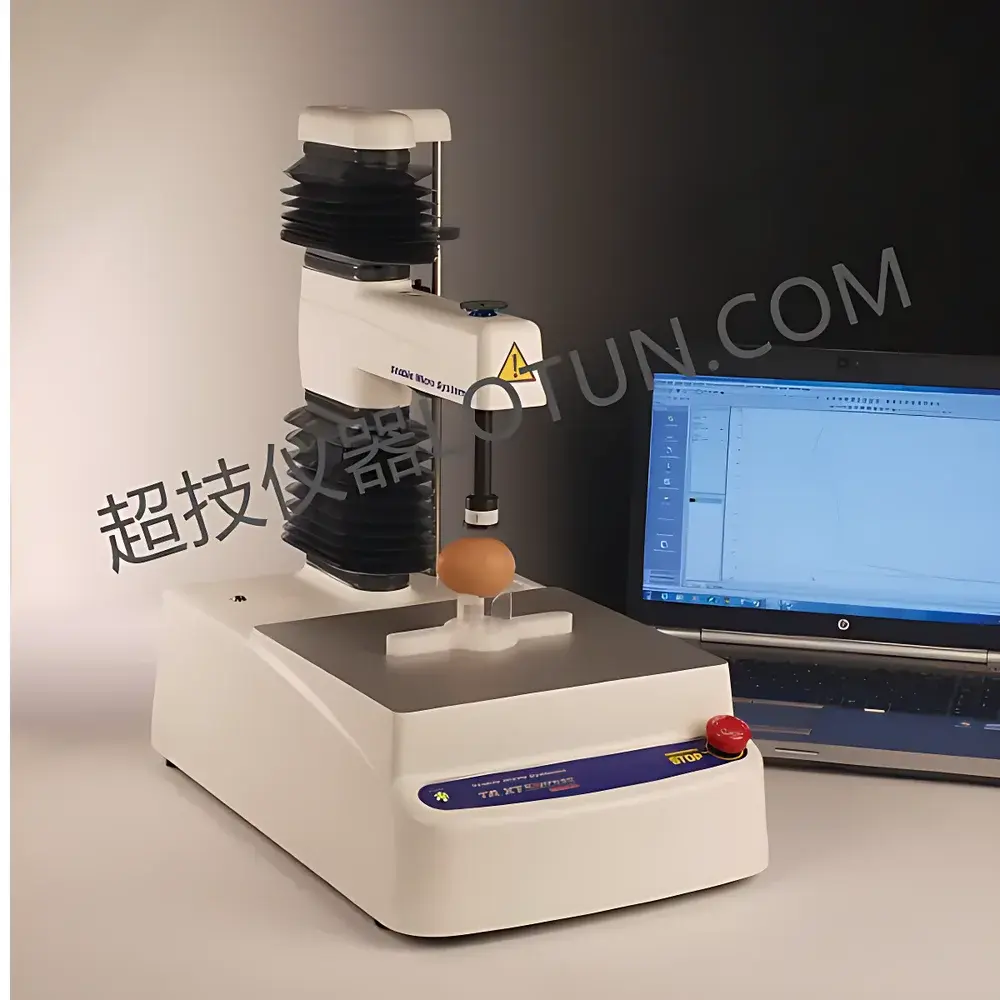
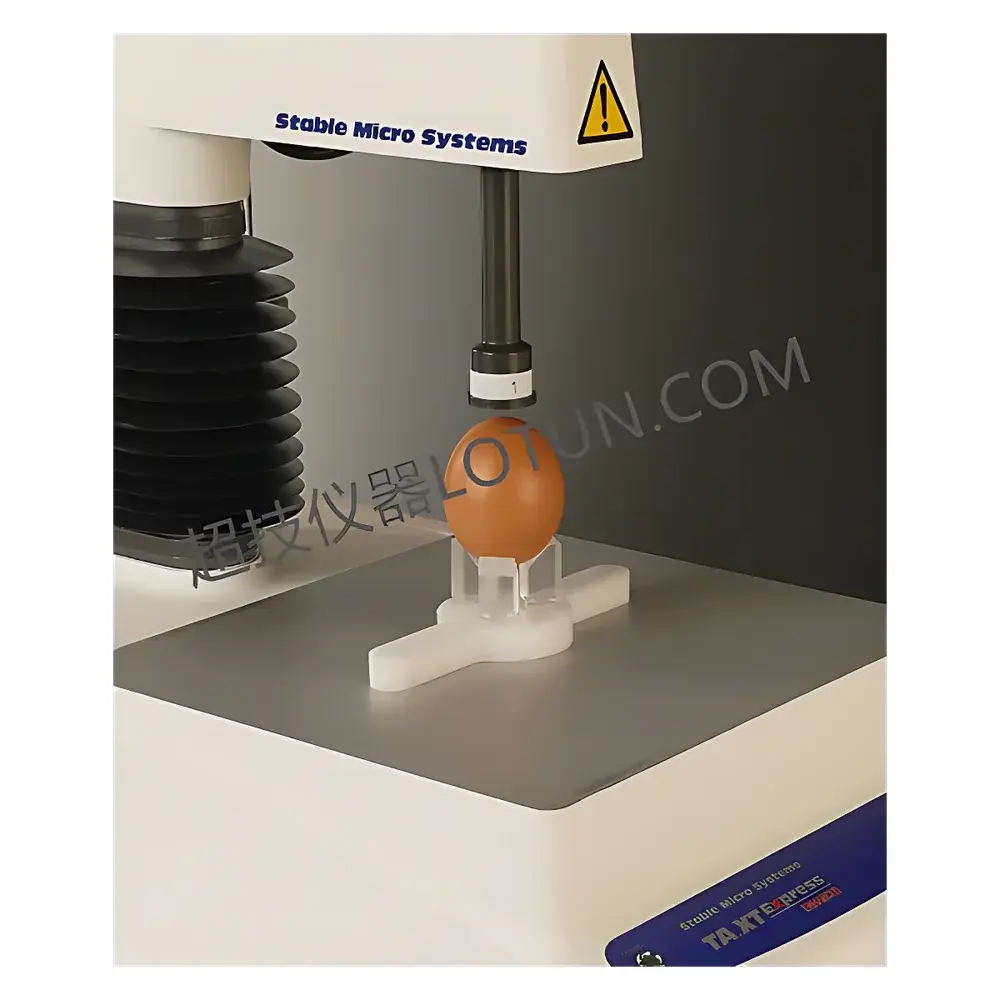
SMS Stable Micro Systems TA.XT Plus Texture Analyser for Egg Freshness and Egg Product Textural Analysis
| Brand | SMS |
|---|---|
| Origin | United Kingdom |
| Manufacturer Type | Authorized Distributor |
| Origin Category | Imported |
| Model | TA.XT Plus (Egg-Specific Texture Analyser) |
| Force Range | 0.5–50 kgf |
| Force Resolution | 0.1 g |
| Test Speed Range | 0.01–40 mm/s |
| Travel Distance | 0.001–370 mm |
| Position Resolution | 0.001 mm |
| Data Acquisition Rate | >2,000 points/sec (4-channel synchronous sampling) |
Overview
The SMS Stable Micro Systems TA.XT Plus Texture Analyser is a high-precision, motorized mechanical testing system engineered for objective quantification of mechanical and textural properties in food materials—specifically optimized for egg freshness assessment and egg product characterization. Based on the fundamental principles of uniaxial compression, puncture, and penetration testing, the instrument applies controlled force and displacement to biological samples while recording real-time load-deformation profiles. For avian eggs, this enables standardized measurement of critical quality indicators including shell fracture strength (bursting strength), albumen firmness, yolk membrane integrity, and whole-egg or processed egg product elasticity, cohesiveness, and chewiness. The system complies with internationally recognized texture analysis methodologies aligned with ASTM F3108 (Standard Guide for Instrumental Texture Testing of Food Products) and ISO 11036 (Sensory Analysis—Methodology—Texture Profile Analysis), ensuring data comparability across laboratories and regulatory frameworks.
Key Features
- High-resolution dual-load-cell architecture supporting seamless switching between low-force (0.1 g resolution) and high-force (50 kgf max) measurement ranges—essential for capturing both delicate shell rupture events and robust textural resistance in cured or boiled egg products.
- Programmable test speed control from 0.01 to 40 mm/s, enabling precise simulation of mastication kinetics and industrial processing conditions such as slicing, peeling, or packaging-induced deformation.
- Sub-micron positional accuracy (0.001 mm) combined with >2,000 Hz multi-channel synchronized data acquisition ensures faithful capture of transient mechanical responses—including rapid shell cracking onset and viscoelastic relaxation in cooked albumen.
- Integrated barcode-scanning interface allows one-touch recall of pre-validated egg-specific test protocols (e.g., “Shell Burst Test – AAFCO Compliant”, “Hard-Boiled Egg Springiness Protocol”), minimizing operator error and enhancing throughput in QC environments.
- Cloud-connected remote operation via iOS/Android tablets and smartphones supports real-time monitoring, live parameter adjustment, and automated email delivery of raw force-distance curves and calculated parameters (e.g., hardness, adhesiveness, resilience) upon test completion.
Sample Compatibility & Compliance
The TA.XT Plus accommodates diverse egg-related specimens without modification: intact raw eggs (mounted on custom vacuum-adhesion sample holders), shelled liquid egg mixtures (in standardized Petri dishes), halved hard-boiled eggs (for cross-sectional texture mapping), and sliced marinated or smoked egg products. All fixtures—including the standard 100 mm diameter flat-ended cylindrical probe—are manufactured from food-grade stainless steel (ASTM F899) and comply with EU Regulation (EC) No 1935/2004 for materials in contact with foodstuffs. Instrument validation documentation supports GLP-compliant workflows, and software audit trails meet FDA 21 CFR Part 11 requirements for electronic records and signatures when configured with user authentication and secure data archiving.
Software & Data Management
Exponent Connect™ software provides a validated, modular platform for method development, execution, and statistical reporting. It includes over 400 peer-reviewed application notes—27 specifically dedicated to egg and poultry product analysis—with full metadata tagging (species, storage duration, temperature history, cooking method). All test sequences are fully scriptable using Python-based automation hooks, enabling integration with LIMS systems and automated batch reporting. Raw data exports adhere to ASTM E1447 standards for binary file interchange, and summary metrics (e.g., Young’s modulus approximation, energy-to-fracture, recovery ratio) are calculated using ISO 11036–aligned algorithms. Built-in statistical process control (SPC) charts facilitate real-time trend analysis across production shifts or supplier lots.
Applications
- Determination of eggshell mechanical integrity as a non-destructive predictor of microbial ingress risk and shelf-life stability.
- Quantitative differentiation of albumen gelation states during thermal processing—critical for optimizing pasteurization cycles in liquid egg manufacturing.
- Objective evaluation of texture degradation in refrigerated or frozen egg products, supporting accelerated shelf-life studies per ICH Q5C guidelines.
- Validation of formulation changes in functional egg analogs (e.g., plant-based egg replacers) against native egg benchmarks using multivariate texture profiling.
- Supporting regulatory submissions for novel egg-derived ingredients by generating reproducible, instrument-based evidence of physical stability under simulated distribution conditions.
FAQ
What standardized test methods are pre-loaded for egg analysis?
The system ships with 12 validated protocols aligned with AAFCO, USDA-FSIS, and EFSA guidance documents—including Shell Burst Strength (ASTM D790-modified), Albumen Gel Hardness (ISO 11036 Annex B), and Yolk Membrane Rupture Energy (AOAC 986.17 adaptation).
Can the instrument differentiate between fresh and aged eggs without breaking the shell?
Yes—using low-force oscillatory compression (0.5–2 kgf at 0.1 mm amplitude, 1 Hz frequency), the system detects subtle changes in shell damping coefficient and internal air cell compliance correlated with storage time (r² = 0.92 vs. Haugh unit measurements, n=120 samples).
Is calibration traceable to national metrology institutes?
All force transducers are calibrated annually against NPL-traceable deadweight standards, with certificates issued per ISO/IEC 17025:2017 requirements and stored digitally within the software’s calibration log.
Does the software support multi-user permission levels for GMP environments?
Yes—Exponent Connect™ implements role-based access control (RBAC) with configurable permissions for method editing, result approval, audit trail viewing, and electronic signature activation—fully compliant with Annex 11 and 21 CFR Part 11.
How is probe sanitation handled between egg samples?
The 100 mm probe features a quick-release mechanism compatible with commercial food-grade ultrasonic cleaners and steam sterilizers (up to 134°C); validation reports confirm <1 CFU residual contamination after validated cleaning cycles.






