
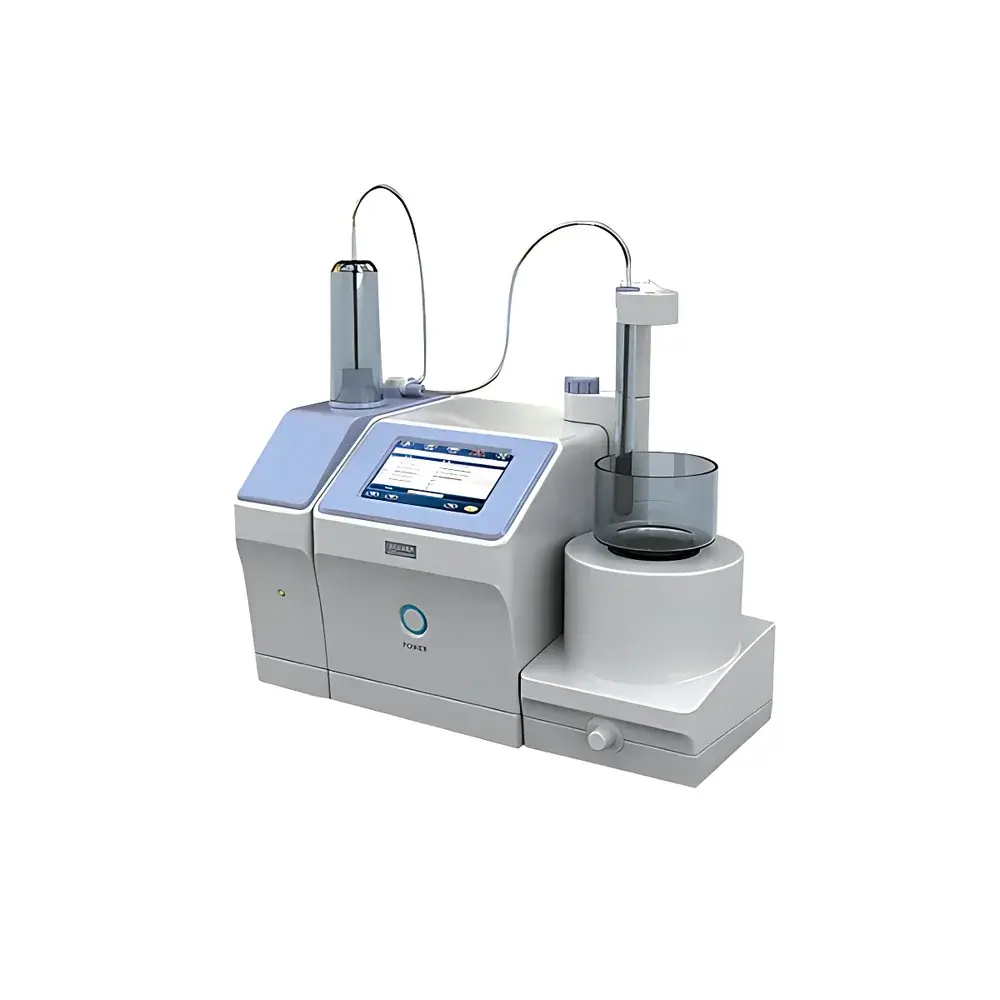
Sonnen T10 Chloride Ion Analyzer
| Brand | Sonnen |
|---|---|
| Model | T10 |
| Origin | Shanghai, China |
| Category | Other Elemental Analyzers |
| Measurement Principle | Potentiometric Titration with Silver Nitrate (AgNO₃) and Solid-State Chloride-Selective Electrode (Cl⁻-ISE) |
| Detection Limit | 0.1 mg Cl⁻ (equivalent to 0.1–5×10⁻⁵ mol/L) |
| mV Range | ±2000 mV |
| mV Resolution | 0.1 mV |
| mV Accuracy | ±0.2 mV |
| Titration Volume Resolution | 10 µL |
| Titration Accuracy | ±0.2% (at 20 mL) |
| Electrode Interfaces | 2–4 mV/pH, 2 polarizable, 2 reference |
| Dimensions (Main Unit) | 200 × 200 × 260 mm |
| Weight (Standard Configuration) | 4.3 kg |
| Data Storage | 500 test records |
| Custom Methods | 250 user-defined titration protocols |
| Connectivity | Bluetooth (up to 15 titration modules), Wi-Fi to PC |
| Display | High-brightness color touchscreen |
| Compliance | GB/T 176-2017, NY/T 1121.17-2006, GB/T 13025.5-2012, GB/T 15453-2018, GB/T 24890-2010, GB/T 14684-2001, GB/T 5009.39-2003, GB/T 5009.51-2003 |
Overview
The Sonnen T10 Chloride Ion Analyzer is a benchtop potentiometric titration system engineered for precise, trace-level quantification of chloride ions (Cl⁻) in diverse inorganic and aqueous matrices. It operates on the principle of argentometric titration—using standardized silver nitrate (AgNO₃) solution with endpoint detection via a solid-state chloride-selective electrode (Cl⁻-ISE) coupled with a stable reference electrode. This electrochemical method delivers high reproducibility and selectivity for Cl⁻ in complex samples where interfering anions (e.g., bromide, iodide) are present at low concentrations. Designed for routine compliance testing in construction materials, agricultural soils, industrial water treatment, food safety, and fertilizer quality control, the T10 meets the metrological requirements of multiple Chinese national standards—including GB/T 176-2017 for cement, GB/T 15453-2018 for cooling water, and GB/T 14684-2001 for construction sand—ensuring data integrity in regulatory and QA/QC environments.
Key Features
- Potentiometric endpoint detection with dual-electrode configuration: integrated Cl⁻-selective electrode and double-junction reference electrode for stable baseline and minimized liquid junction potential drift.
- High-resolution titration drive mechanism: 1/60,000-step micro-stepper motor enabling 10 µL minimum dispensing volume and ±0.2% volumetric accuracy at 20 mL capacity.
- Modular architecture: main unit supports Bluetooth pairing with up to 15 independent titration modules, allowing parallel analysis or sequential multi-parameter workflows without hardware reconfiguration.
- Intuitive 7-inch color touchscreen interface with switchable English/Chinese language support; no external PC required for operation or method execution.
- Embedded method library: 250 programmable titration protocols—including automatic blank correction, multi-point standard addition, and slope-based equivalence point calculation—configurable per sample matrix and regulatory requirement.
- Robust electrode interface design: four isolated mV/pH inputs, two polarizable electrode ports, and two dedicated reference electrode terminals accommodate third-party sensors and future expansion.
- Full audit trail capability: all measurements timestamped and logged with operator ID, method name, electrode calibration history, and raw mV vs. volume curve data.
Sample Compatibility & Compliance
The T10 is validated for direct analysis of aqueous extracts from concrete, mortar, aggregates, soil, salt products, industrial cooling water, boiler feedwater, compound fertilizers, soy sauce, and wheat gluten. Sample preparation follows standardized leaching procedures defined in GB/T 176-2017 (hot water extraction for cement), NY/T 1121.17-2006 (Ca(NO₃)₂ extraction for soil), and GB/T 13025.5-2012 (distilled water dissolution for salt). All reported results comply with the uncertainty budgets specified in ISO/IEC 17025:2017 for testing laboratories. While not FDA 21 CFR Part 11-certified out-of-the-box, the system supports GLP-compliant operation when paired with networked PC logging and electronic signature workflows.
Software & Data Management
Data acquisition and reporting are managed through the embedded firmware (v3.2+), which stores 500 complete test records locally—including raw potential curves, derivative plots, equivalence point coordinates, and final Cl⁻ concentration in mg/kg or mol/L. Export is supported via USB flash drive in CSV and PDF formats, preserving full metadata (date/time, operator, electrode serial numbers, calibration dates). Optional PC software (T10-Link v2.1) enables remote monitoring over Wi-Fi, centralized database synchronization, trend charting across batches, and automated report generation compliant with internal QA templates or external accreditation submissions.
Applications
- Construction materials testing: Quantification of water-soluble Cl⁻ in concrete admixtures, sand, crushed stone, and cement to assess corrosion risk to embedded steel reinforcement per GB/T 50476-2019 (Code for Durability Design of Concrete Structures).
- Agricultural soil analysis: Determination of bioavailable chloride in arable land and greenhouse substrates to evaluate salinity stress and optimize irrigation practices.
- Industrial water chemistry: Monitoring chloride ingress in closed-loop cooling systems and high-pressure boiler feedwater to prevent stress corrosion cracking (SCC) in austenitic stainless steels.
- Fertilizer quality assurance: Verification of Cl⁻ content in NPK blends and organic-mineral formulations to meet GB/T 24890-2010 limits for chloride-sensitive crops.
- Food safety screening: Detection of residual chloride in fermented and non-fermented soy products, condiments, and processed grains per GB/T 5009.39–2003 and GB/T 5009.51–2003.
FAQ
What chloride measurement principle does the T10 employ?
It uses potentiometric titration with silver nitrate and a solid-state chloride-selective electrode, detecting the inflection point in the E–V curve.
Is the instrument suitable for ASTM C1152/C1152M testing?
Yes—the methodology aligns with ASTM C1152 (acid-soluble chloride in concrete) when adapted with appropriate sample digestion and dilution protocols.
Can the T10 be integrated into a LIMS environment?
Via optional T10-Link software and TCP/IP communication, it supports HL7 and ASTM E1384-compliant data exchange for LIMS integration.
What maintenance is required for long-term electrode stability?
Chloride electrodes require weekly reconditioning in 0.001 mol/L NaCl and storage in moistened KNO₃ gel; reference electrodes should be refilled monthly with saturated KCl electrolyte.
Does the system support Good Laboratory Practice (GLP) documentation?
Yes—full electronic audit trail, user authentication, and calibration logs are retained onboard and exportable for GLP audits.




