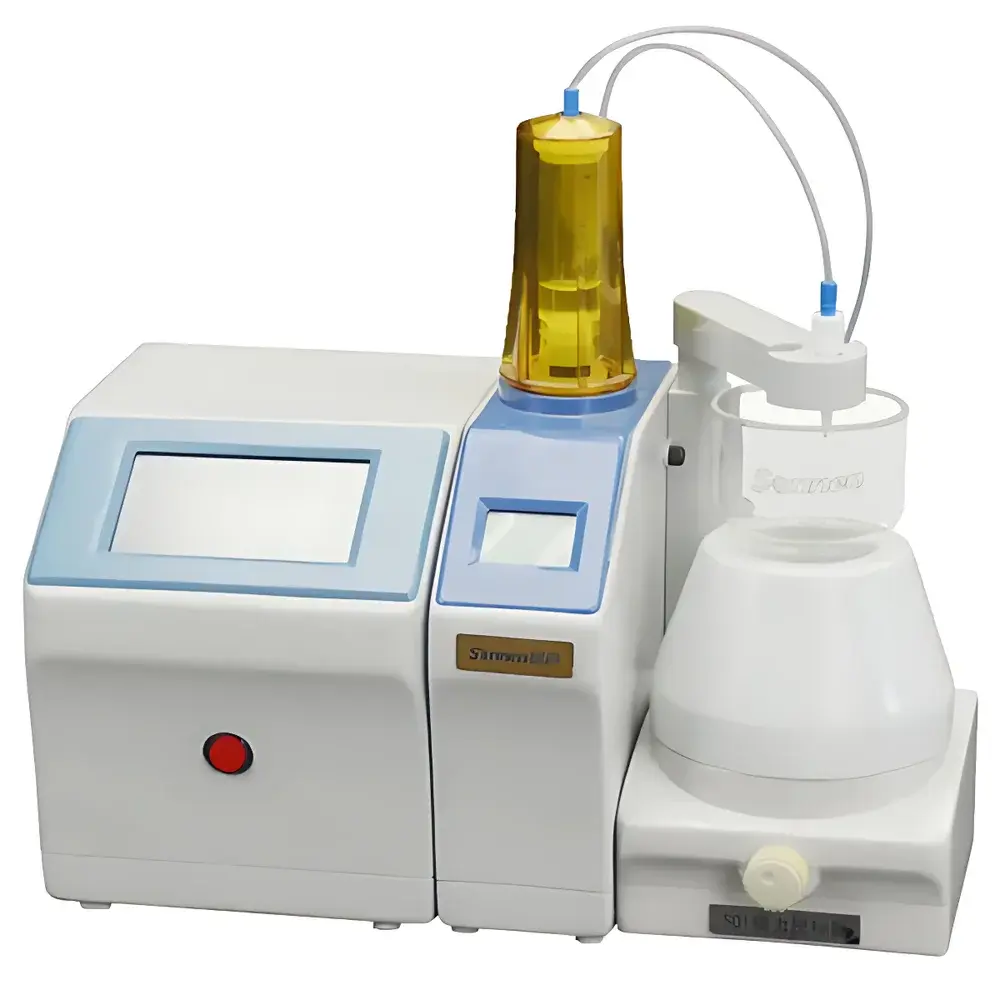
Sonnen T12 Fatty Acid Value (Acid Number) Titrator
| Brand | Sonnen |
|---|---|
| Origin | Shanghai, China |
| Model | T12 |
| Measurement Range | 0–300 mg KOH/100 g dry matter |
| Resolution | 0.01 mg KOH/100 g dry matter |
| Repeatability | ≤0.3% (at 20 mL sample volume) |
| Minimum Titration Volume | 10 µL |
| Titration Resolution | 1/60,000 |
| Max. Titration Error | ±0.15% (10 mL), ±0.2% (20 mL) |
| Titration Tube Capacity | 25 mL |
| Full/Empty Cycle Time | ~30 s |
| Display | High-brightness color touchscreen with optional Chinese/English UI |
| Communication Interfaces | RS-232/RS-485, USB |
| Wireless Expansion | Bluetooth-enabled, supports up to 15 independent titration modules |
| Predefined Methods | 250 user-customizable assay protocols |
| Data Storage | 500 test records |
| Auto-calibration | Integrated sensor self-calibration |
| Dimensions | 200 × 200 × 260 mm |
| Weight | 4.3 kg |
| Quality Certification | ISO 9001-compliant manufacturing |
Overview
The Sonnen T12 Fatty Acid Value (FAV) Titrator is a dedicated potentiometric and colorimetric titration system engineered for precise quantification of free fatty acids—expressed as acid number (mg KOH/100 g dry matter)—in edible oils, cereal grains, animal feed, food intermediates, and industrial lipid-based materials. It operates on standardized titration principles per AOAC Official Method 940.28, ISO 660:2020, and GB/T 5009.37–2019, delivering traceable, GLP-aligned results in routine quality control laboratories. Unlike generic titrators, the T12 integrates domain-specific chemometrics—including automatic endpoint detection via pH or photometric signal thresholding—and embeds regulatory logic for sample moisture correction, blank subtraction, and stoichiometric factor application. Its modular architecture enables scalable deployment across multi-product testing workflows without hardware reconfiguration.
Key Features
- High-resolution color touchscreen interface with dual-language (English/Chinese) firmware—designed for rapid method navigation and real-time parameter adjustment.
- Modular titration architecture: single main controller communicates wirelessly via Bluetooth 5.0 to up to 15 independently addressable titration units, enabling parallel analysis of heterogeneous sample batches.
- Precision dosing mechanism featuring monolithic ceramic-plunger burettes—chemically inert to organic solvents and strong alkalis, ensuring long-term volumetric stability and <10 µL minimum dispensing increment.
- Full automation suite: auto-initialization, zero-point calibration, quantitative aspiration, dynamic endpoint recognition, real-time titration curve rendering (pH vs. volume or absorbance vs. volume), and integrated calculation engine with customizable formula scripting (e.g., moisture-adjusted FAV, per-sample titer normalization).
- Embedded metrological assurance: onboard sensor auto-calibration routines for electrode drift compensation and photometric baseline validation prior to each assay sequence.
- Comprehensive data integrity framework: audit-trail-enabled operation logs, timestamped method versioning, and electronic signature support compliant with FDA 21 CFR Part 11 requirements when paired with validated LIMS integration.
Sample Compatibility & Compliance
The T12 accommodates solid, semi-solid, and liquid matrices—including crude vegetable oils, milled cereals, rendered animal fats, bakery shortening, and pelleted feed—following standardized solvent extraction (e.g., ethanol:diethyl ether 1:1 v/v) and neutralization protocols. All hardware and firmware comply with IEC 61010-1:2010 safety standards for laboratory electrical equipment. The instrument’s design and documentation align with ISO/IEC 17025:2017 clause 6.4 (equipment verification) and support full traceability under GMP/GLP environments. Certificate of Conformance and ISO 9001:2015 manufacturing certification are provided with each unit shipment.
Software & Data Management
Firmware v3.2 includes an embedded database supporting 500 locally stored test records with full metadata (operator ID, date/time stamp, method ID, raw curve data, intermediate values, final result). Export options include CSV, PDF (with embedded titration curves), and direct USB/RS-232 transmission to external printers or LIMS. The system permits creation and storage of 250 user-defined methods—including custom equivalence factors, dilution ratios, and post-processing equations—each assigned unique identifiers for version-controlled deployment. Remote diagnostics and firmware updates are supported via secure USB media; no cloud connectivity is implemented to preserve data sovereignty.
Applications
- Quality assurance of incoming oilseeds and refined edible oils for rancidity monitoring (hydrolytic spoilage indicator)
- Routine FAV screening in flour mills and rice processing facilities per national grain storage standards
- Feed formulation labs assessing oxidative stability of fat supplements in compound feeds
- Contract testing laboratories performing accredited acid number determinations for ISO/IEC 17025 scope accreditation
- Regulatory compliance testing for food labeling requirements (e.g., EU Regulation (EU) No 1169/2011 Annex III)
FAQ
What standards does the T12 validate against for fatty acid value determination?
It supports method execution per ISO 660:2020, AOAC 940.28, and GB/T 5009.37–2019, with configurable parameters to match specific solvent systems, indicator types, and endpoint criteria.
Can the T12 be integrated into an existing LIMS environment?
Yes—via RS-232 or USB virtual COM port, using ASTM E1384-compliant ASCII data packets containing result, metadata, and raw curve coordinates.
Is sensor calibration performed automatically before each test?
The system executes automated electrode offset verification and photometer dark-current compensation at startup and after extended idle periods; manual calibration remains available via guided wizard.
Does the instrument support moisture-corrected reporting as required by grain standards?
Yes—users may input gravimetric moisture content (%) during sample registration, and the firmware applies ISO 660-mandated dry-matter normalization automatically.
What maintenance intervals are recommended for the titration module?
Plunger seals require inspection every 6 months under continuous use; burette cleaning with ethanol followed by air-drying is advised after each solvent change.