
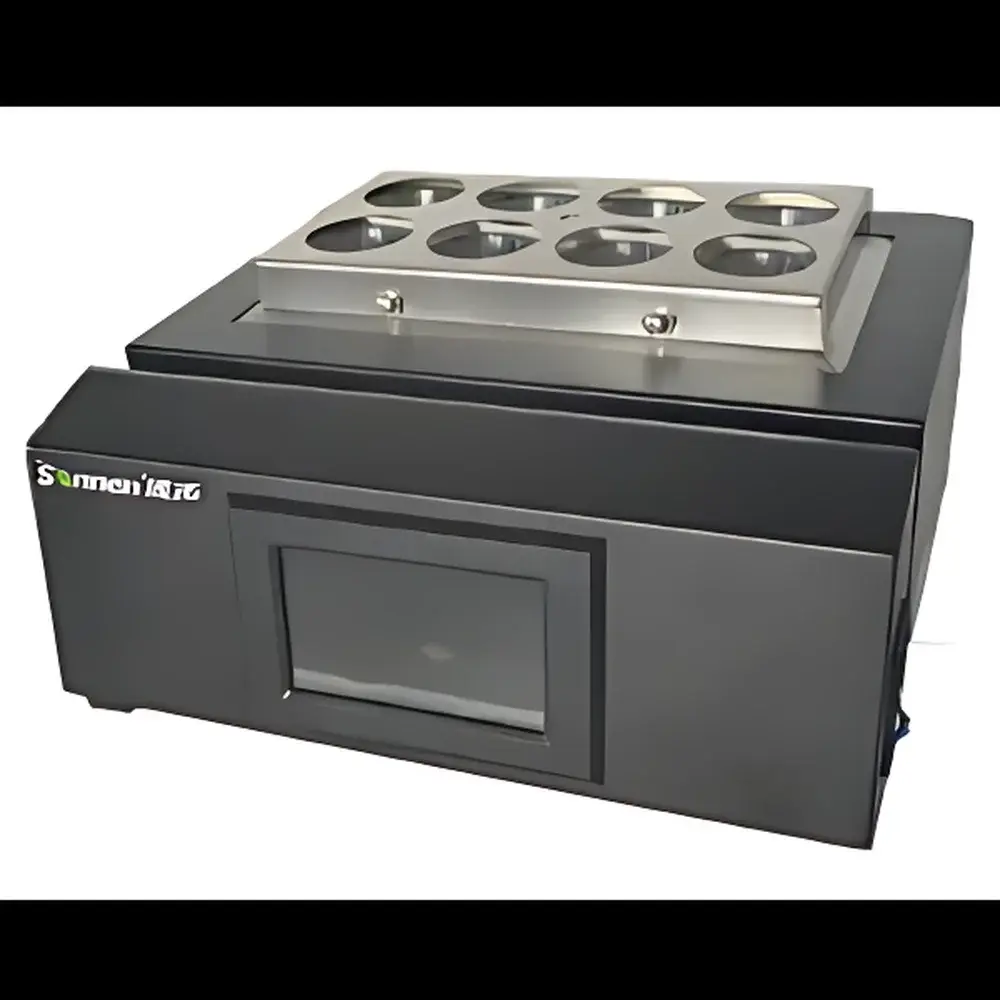
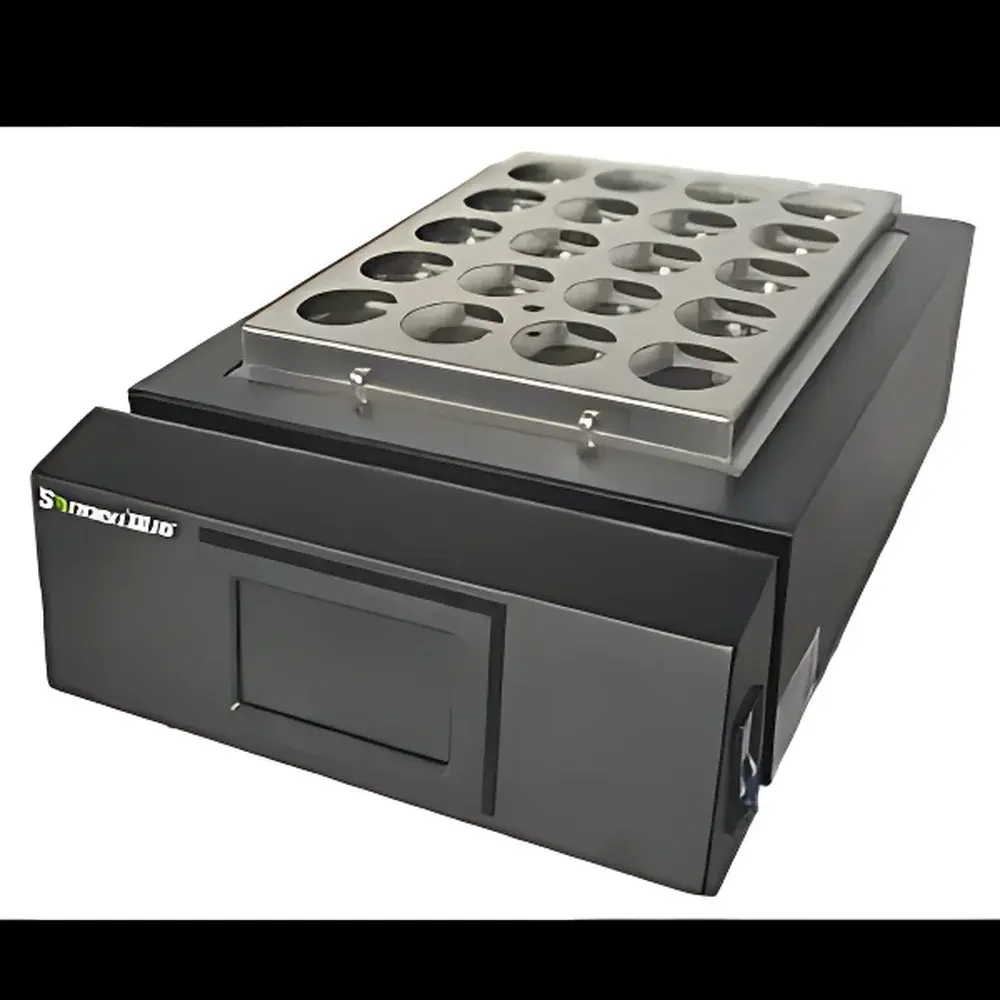
Sonnen X-Series Aluminum Block Automated Digestion System
| Brand | Sonnen |
|---|---|
| Origin | Shanghai, China |
| Model Variants | X08, X12, X20, X42, X56 |
| Digestion Capacity | 8 / 12 / 20 / 42 / 56 positions |
| Temperature Range | Ambient to 450 °C |
| Temperature Accuracy | ±1 °C |
| Heating Method | Integrated aluminum block resistive heating |
| Automation Level | Semi-automatic |
| Sample Vessel Compatibility | 100 mL and 300 mL digestion tubes |
| Max Sample Load | ≤6 g solid or ≤25 mL liquid |
| Power Supply | AC 220 V ±10%, 50 Hz |
| Rated Power | 2400 W |
| Safety Certifications | ISO 9001 compliant |
| Housing Finish | PTFE-coated enclosure with corrosion-resistant isolation design and acid drainage channels |
| Thermal Insulation | Ceramic fiber + active air-channel cooling |
| Protection Features | Over-temperature, over-current, over-pressure, real-time sensor health monitoring, audible/visual alarm with Chinese-language status prompts |
Overview
The Sonnen X-Series Aluminum Block Automated Digestion System is a semi-automated, benchtop electric heating digestion instrument engineered for reproducible, high-throughput sample preparation in environmental, food, agricultural, and clinical laboratories. It operates on the principle of controlled conductive heating via a monolithic, high-thermal-conductivity aluminum block—ensuring uniform temperature distribution across all digestion positions and minimizing inter-vessel thermal gradients. Unlike open-heating mantles or ceramic plates, the aluminum block architecture delivers rapid thermal response, precise ramp-and-hold profiles, and exceptional long-term stability—critical for standardized digestion protocols such as those specified in EPA Method 3015A (microwave-assisted acid digestion), ISO 11047 (determination of heavy metals in soils), and AOAC 981.10 (crude protein analysis via Kjeldahl digestion). Designed for routine use with concentrated mineral acids—including HNO3, H2SO4, HCl, and HF—the system integrates multiple passive and active safeguards to maintain operational integrity under aggressive chemical environments.
Key Features
- Modular aluminum heating block: Precision-machined, anodized aluminum block with integrated heating elements ensures homogeneous temperature distribution (±1 °C) and eliminates hot-spot formation during extended digestion cycles.
- Dual-mode programmable temperature control: Supports both CA mode (timer starts at initial power-on) and CK mode (timer initiates only upon reaching target setpoint), enabling compliance with multi-stage digestion protocols—e.g., low-temperature charring followed by high-temperature oxidation.
- Corrosion-resilient construction: Enclosure coated with industrial-grade PTFE; internal chamber features acid-resistant isolation barriers and integrated drain channels to divert spilled or condensed acid vapors away from electronics and structural components.
- Multi-layer thermal management: Hybrid insulation combining ceramic fiber bulk insulation and forced-air convection pathways minimizes external surface temperature rise (<45 °C at ambient 25 °C), enhancing operator safety and lab ambient stability.
- Comprehensive safety architecture: Real-time monitoring of heating element resistance, ambient chamber temperature, pressure buildup (via vapor expansion sensing), and power line integrity. Triggers audible alarm and on-screen bilingual (English/Chinese) fault codes upon anomaly detection.
- Intuitive human-machine interface: 7-inch capacitive color touchscreen with icon-driven navigation, recipe storage (up to 20 user-defined methods), and graphical temperature curve preview—supporting GLP-aligned method traceability without external software dependency.
Sample Compatibility & Compliance
The X-Series accommodates standard borosilicate or quartz digestion tubes (100 mL and 300 mL volumes) and supports sample loads up to 6 g dry mass or 25 mL liquid volume per vessel. Its validated performance spans key regulatory workflows: nitrogen/protein determination (AOAC 981.10, ISO 8968-1), COD digestion (ISO 6060, EPA 410.4), total phosphorus/arsenic extraction (ISO 15681-1, EPA 200.7), and heavy metal dissolution (Pb, Cu, Zn, Sn) in soils, sludges, and biological matrices per ISO 11047 and EN 13656. The system conforms to ISO 9001:2015 quality management requirements and incorporates design elements aligned with IEC 61010-1 (safety of laboratory equipment) and IEC 61326-1 (EMC for measurement/control devices). While not inherently 21 CFR Part 11 compliant, audit-ready electronic logs—including method parameters, start/stop timestamps, and temperature deviation flags—are exportable via USB for integration into LIMS or QA/QC documentation systems.
Software & Data Management
No proprietary PC software is required for basic operation; all method programming, real-time monitoring, and event logging occur locally on the embedded touchscreen controller. Each run generates a timestamped record containing: selected method ID, setpoint profile (ramp rates, hold durations, final temperature), actual block temperature trajectory (sampled every 5 seconds), and any triggered safety events. Logs are stored internally (≥1000 runs) and exportable as CSV files via USB-A port. For laboratories operating under GLP or GMP frameworks, the system supports manual annotation of analyst ID, sample batch number, and QC reference material data directly on the device—enabling full traceability without third-party middleware. Firmware updates are delivered via encrypted USB firmware image files, maintaining version control and change-log integrity.
Applications
- Kjeldahl and Dumas-based nitrogen/protein quantification in feed, dairy, and cereal products
- Oxidative digestion of wastewater, sediment, and sludge for ICP-OES/MS elemental analysis
- Acid leaching of geological samples (rocks, ores) prior to trace metal determination
- Total phosphorus and orthophosphate release in environmental water and soil testing
- Preparation of biological tissues (liver, muscle, plant matter) for heavy metal screening (Pb, Cd, As, Hg)
- Validation of digestion efficiency using certified reference materials (CRMs) such as NIST SRM 2710a or ERM-CC580
FAQ
What digestion tube sizes are supported?
The system is mechanically compatible with standard 100 mL and 300 mL digestion tubes made from borosilicate glass or quartz. Tube height clearance is 220 mm; outer diameter tolerance is ±0.5 mm.
Can the X-Series be used with hydrofluoric acid (HF)?
Yes—provided HF-compatible digestion tubes (e.g., PFA or quartz) are used and the instrument’s PTFE-coated housing and acid-drain channeling system are maintained per manufacturer cleaning protocols. HF exposure must remain confined to the digestion zone.
Is remote monitoring or network connectivity available?
No Ethernet or Wi-Fi interface is built-in. Data export is limited to USB-host file transfer. Integration with lab networks requires external serial-to-Ethernet converters or middleware solutions.
How often does the aluminum block require recalibration?
The integrated PT100 sensor is factory-calibrated and drift-stabilized. Annual verification against a NIST-traceable reference thermometer (e.g., Fluke 1523) is recommended for ISO/IEC 17025-accredited labs.
Does the system meet CE marking requirements?
It complies with essential requirements of the EU Low Voltage Directive (2014/35/EU) and EMC Directive (2014/30/EU); however, formal CE marking is contingent upon end-user responsibility for conformity assessment under applicable national transposition laws.



