
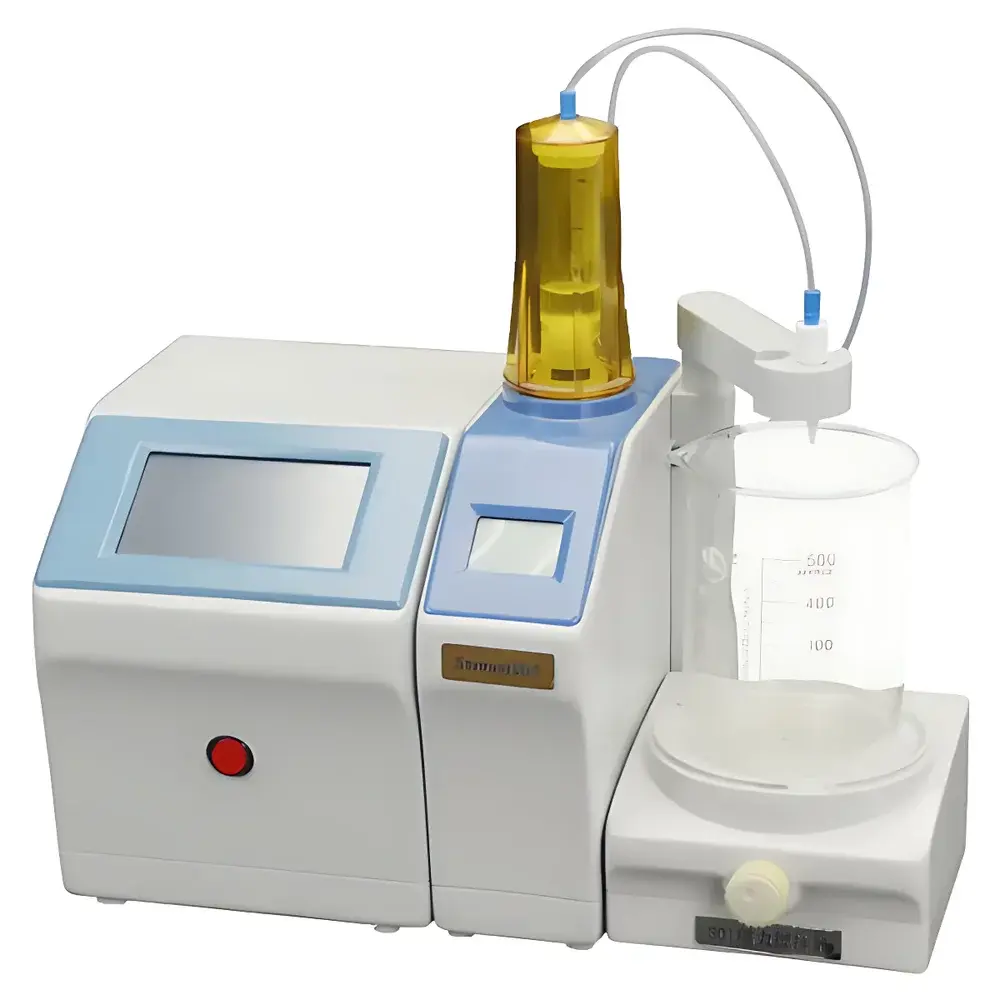
Sonnen T11 Intelligent Multi-Mode Potentiometric Titrator
| Brand | Sonnen |
|---|---|
| Origin | Shanghai, China |
| Model | T11 |
| Instrument Type | Universal Automatic Potentiometric Titrator |
| Application Scope | General-purpose chemical analysis |
| mV Measurement Range | ±2000 mV |
| pH Measurement Range | 0–14 |
| mV Resolution | 0.1 mV |
| pH Resolution | 0.01 |
| Temperature Resolution | 0.1 °C |
| Temperature Range (PT1000) | 0–50 °C |
| Colorimetric Resolution | 1/65535 |
| Titration Volume Range | <99.99 mL |
| Burette Capacity | 25 mL |
| Minimum Dispensing Volume | 10 µL |
| Titration Resolution | 1/60000 |
| Maximum Titration Error | ±0.15% (at 10 mL), ±0.2% (at 20 mL) |
| Burette Fill/Empty Time | ~30 s |
| Dimensions | 200 × 200 × 260 mm |
| Weight | 4.3 kg |
Overview
The Sonnen T11 Intelligent Multi-Mode Potentiometric Titrator is a precision-engineered electrochemical analysis platform designed for rigorous quantitative titrimetric applications in academic, pharmaceutical, petrochemical, metallurgical, and quality control laboratories. It operates on the fundamental principle of potentiometric endpoint detection—measuring the potential difference between a reference electrode and an indicator electrode as a function of titrant addition—to determine stoichiometric equivalence points with high reproducibility. Unlike single-mode titrators, the T11 integrates multiple detection modalities—including potentiometric, pH-metric, and colorimetric endpoints—within a unified hardware architecture, enabling method flexibility without hardware reconfiguration. Its modular design supports scalable deployment, with wireless Bluetooth expansion allowing up to 15 independent titration units to be coordinated from a single host controller—a configuration particularly advantageous for high-throughput QC environments requiring parallel sample processing.
Key Features
- High-brightness 7-inch color touchscreen with intuitive GUI; user-selectable English or Chinese language interface compliant with ISO/IEC 17025 documentation workflows.
- Dual communication protocols: RS-232/RS-485 serial interface and USB 2.0 port for direct connection to printers, LIMS, or laboratory PCs—enabling real-time data export in CSV or PDF formats.
- Modular titration unit architecture: Each unit employs a monolithic, corrosion-resistant ceramic-plunger burette system engineered for dimensional stability across repeated thermal and chemical stress cycles, ensuring long-term volumetric accuracy.
- Precision fluid handling: Minimum dispensing volume of 10 µL; titration resolution of 1/60000 full-scale (equivalent to ~0.42 µL per step on a 25 mL burette), supporting trace-level analyses in pharmaceutical assay validation.
- Automated operational sequences: Includes auto-initialization, zero-point calibration, fixed-volume dispensing, and dynamic endpoint recognition algorithms that adapt slope thresholds based on reaction kinetics.
- Embedded method library: 250 preconfigured titration protocols covering common applications—including acid-base, redox, complexometric (e.g., EDTA), and precipitation titrations—each editable to comply with USP & EP monograph requirements.
- Onboard data governance: 500 internal test records with timestamped metadata (operator ID, date/time, method name, raw sensor values, derivative curves); all stored in non-volatile memory with write-protection options.
Sample Compatibility & Compliance
The T11 accommodates aqueous and mildly organic solvent systems (e.g., ethanol/water, acetone/water mixtures) compatible with standard glass pH electrodes, silver/silver chloride reference electrodes, and platinum redox sensors. Its four independent electrode input channels support simultaneous dual-sensor monitoring—for example, concurrent pH and redox potential tracking during multi-step titrations. The integrated PT1000 temperature probe enables automatic temperature compensation per NIST SRM guidelines and ASTM E202-22 Annex A1. All measurement electronics conform to IEC 61326-1 (EMC for laboratory equipment) and IEC 61010-1 (safety requirements for electrical equipment). While not FDA 21 CFR Part 11–certified out-of-the-box, the system supports audit-trail-enabling firmware updates and password-protected user roles—facilitating alignment with GLP and GMP documentation standards when deployed with validated SOPs.
Software & Data Management
Data acquisition and reporting are managed via embedded firmware with optional PC-based software (T11 Control Suite v3.x) for advanced curve fitting, derivative peak analysis, and report generation per ISO/IEC 17025 Clause 7.8. Raw sensor outputs (mV, pH, temperature, absorbance) are logged at configurable intervals (10 ms–10 s), permitting kinetic profiling of slow-reacting systems. Users may define custom calculation formulas using standard arithmetic operators and built-in functions (e.g., log(), sqrt(), avg()), enabling direct computation of concentration, purity %, or equivalence ratios without post-processing. Exported datasets include full metadata headers—critical for regulatory submissions—and support direct ingestion into statistical process control (SPC) platforms such as Minitab or JMP.
Applications
- Pharmaceutical QC: Quantification of active pharmaceutical ingredients (APIs) via non-aqueous acid-base titration (e.g., amine hydrochlorides in glacial acetic acid).
- Water & Wastewater Analysis: Alkalinity (as CaCO₃), chloride (Mohr method), and cyanide (silver nitrate titration) per APHA Standard Methods 2320B, 4500-Cl⁻ B, and 4500-CN⁻ C.
- Petrochemical Testing: Total acid number (TAN) and total base number (TBN) determination in lubricants and fuels per ASTM D974 and D2896.
- Food & Beverage: Acidity (titratable acidity as citric or lactic acid), salt content (argentometric), and sulfur dioxide (iodometric) assays.
- Academic Research: Teaching of fundamental electrochemical concepts—including Nernst equation validation, buffer capacity analysis, and conditional stability constant estimation in complexometric systems.
FAQ
Does the T11 support GLP-compliant electronic signatures and audit trails?
The base firmware provides time-stamped operator logs and immutable record storage. Full 21 CFR Part 11 compliance requires implementation of third-party digital signature middleware and network-level access controls—not included as standard but technically feasible via API integration.
Can the T11 perform Karl Fischer water titration?
No—the T11 lacks dedicated coulometric or volumetric KF reagent handling modules, moisture-specific electrodes, and anhydrous environment sealing. It is not designed for trace water quantification below 100 ppm.
Is the colorimetric module compatible with standard spectrophotometric indicators?
Yes—it accepts common visual indicators (e.g., phenolphthalein, methyl orange, ferroin) and interfaces with external photometric sensors (via analog 0–5 V input) for automated color transition detection at user-defined wavelength bands.
What maintenance is required for long-term accuracy?
Monthly verification using certified pH buffers (NIST-traceable) and mV reference standards (±1 mV tolerance); annual recalibration of burette mechanics by authorized service centers using gravimetric dispensing validation per ISO 8655-3.
How does the wireless multi-unit control ensure synchronization?
Bluetooth 5.0 LE establishes deterministic polling intervals (<50 ms latency); each slave unit maintains local clock synchronization and reports status flags (valve position, motor encoder counts, sensor drift) to the master node for coordinated endpoint detection across parallel titrations.



