
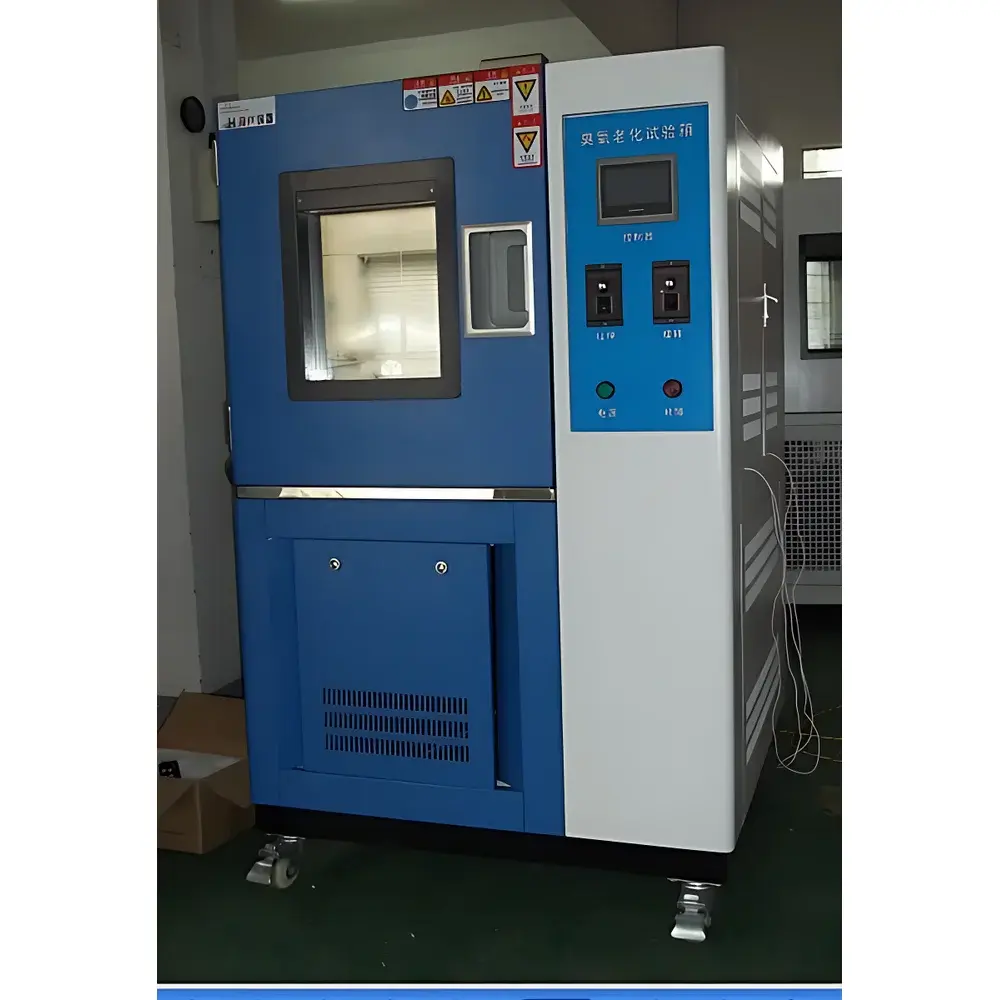
Jianhu JHC-100 / JHC-200 Ozone Aging Test Chamber
| Brand | Jianhu |
|---|---|
| Origin | Shanghai, China |
| Model | JHC-100, JHC-200 |
| Ozone Concentration Range | 10–1000 pphm (±10% accuracy) |
| Temperature Range | Ambient to 60 °C (uniformity ±2 °C) |
| Sample Rack Rotation Speed | 2 R/min |
| Sample Extension Frequency | 0.5 Hz |
| Gas Flow Rate | 20–80 L/min |
| Chamber Interior | Stainless Steel |
| Chamber Exterior | Cold-Rolled Steel with Powder Coating |
| Ozone Generator | Silent Discharge Type (RKC Controller Integrated) |
| Ozone Detection | Non-Dispersive UV Absorption at 254 nm |
| Air Drying System | Silica Gel Desiccant Tower + Air Dryer |
| Power | 3 kW (JHC-100), 6 kW (JHC-200) |
Overview
The Jianhu JHC-100 and JHC-200 Ozone Aging Test Chambers are purpose-built environmental test systems engineered for accelerated evaluation of elastomeric material degradation under controlled ozone exposure. These chambers operate on the principle of ozone-induced oxidative cleavage of unsaturated polymer chains—particularly critical in natural rubber (NR), styrene-butadiene rubber (SBR), nitrile butadiene rubber (NBR), and other diene-based elastomers. By replicating and intensifying atmospheric ozone concentrations (10–1000 pphm) at elevated temperatures (up to 60 °C), the system enables rapid assessment of crack initiation, propagation kinetics, and surface morphology changes under static or dynamic mechanical stress. The design conforms to standardized test methodologies referenced in ASTM D1149, ISO 1431-1, and GB/T 7762—ensuring data comparability across global R&D, quality control, and regulatory validation workflows.
Key Features
- Stainless steel inner chamber and powder-coated cold-rolled steel exterior ensure long-term corrosion resistance and structural integrity in high-ozone, humid environments.
- High-stability silent discharge ozone generator integrated with RKC digital temperature and concentration controller provides precise, repeatable ozone dosing without electromagnetic interference.
- Non-dispersive ultraviolet (UV) ozone sensor calibrated at 254 nm wavelength delivers real-time, drift-compensated concentration monitoring with ≤10% measurement deviation across the full 10–1000 pphm range.
- Dual-path air treatment system—including refrigerated air dryer and silica gel desiccant tower—maintains consistent dew point control (<−40 °C) to prevent condensation and ensure stable ozone generation efficiency.
- Thermally stabilized water bath maintains constant thermal mass for improved chamber temperature uniformity (±2 °C) and reduced thermal lag during ramp-and-soak cycles.
- Configurable sample loading options: JHC-100/JHC-200 support both static exposure and dynamic testing modes—rotating sample racks (2 R/min) for uniform exposure or motor-driven extension mechanisms (0.5 Hz) for strain-coupled aging per ISO 1431-2.
Sample Compatibility & Compliance
The JHC series accommodates standard dumbbell specimens (ASTM D412), ring-shaped tensile samples (ISO 37), and molded component sections up to 450 mm × 450 mm × 450 mm (JHC-100) or 550 mm × 550 mm × 550 mm (JHC-200). All internal surfaces are electropolished stainless steel (AISI 304), eliminating catalytic ozone decomposition pathways common in aluminum or painted enclosures. The system supports compliance documentation packages aligned with ISO/IEC 17025 laboratory accreditation requirements, including calibration traceability to NIST-certified ozone standards, temperature sensor verification logs, and chamber uniformity mapping reports. Optional IQ/OQ protocols are available for GMP-regulated environments requiring FDA 21 CFR Part 11–compliant audit trails.
Software & Data Management
While the base configuration utilizes embedded RKC PID controllers with local LED display and manual setpoint adjustment, optional RS-485 Modbus RTU interface enables integration with SCADA or LIMS platforms for centralized parameter logging, alarm escalation, and batch-level data archiving. All ozone concentration readings, chamber temperature profiles, and runtime counters are timestamped and exportable in CSV format. For laboratories operating under GLP or automotive OEM specifications (e.g., VW TL 226, Ford CETP), firmware-upgradable versions support password-protected user roles, electronic signature capture, and immutable event logs—including door opening events, power interruptions, and calibration interventions.
Applications
- Accelerated lifetime prediction of rubber seals, gaskets, hoses, and vibration dampers used in automotive, aerospace, and industrial hydraulic systems.
- Formulation screening of antiozonants (e.g., p-phenylenediamine derivatives) and nanofiller-reinforced composites under standardized aging conditions.
- Validation of surface coatings and halogen-free cable jacketing materials per IEC 60811-505 and UL 1581 Section 1060.
- Root cause analysis of field failures attributed to ozone cracking—correlating lab-generated crack density, orientation, and depth with service history data.
- Supporting ISO 1431-1 conformance testing for rubber product certification in EU CE marking and China CCC regulatory submissions.
FAQ
What ozone concentration range is supported, and how is it verified?
The chamber delivers 10–1000 pphm ozone with ±10% accuracy, verified using a non-dispersive UV photometer calibrated at 254 nm against primary ozone standards.
Is temperature uniformity validated across the working volume?
Yes—chamber uniformity is characterized per IEC 60068-3-5 using nine calibrated PT100 sensors; typical deviation remains within ±2 °C at 60 °C steady state.
Can the system operate continuously for extended validation studies?
Both JHC-100 and JHC-200 are rated for unattended 720-hour continuous operation with redundant thermal cutoffs and ozone generator duty-cycle management.
Does the chamber meet international test standard requirements?
It is configured to comply with ASTM D1149 (Method A/B), ISO 1431-1/-2, and GB/T 7762, including gas flow rate (20–80 L/min), sample rotation (2 R/min), and dynamic strain (0.5 Hz) specifications.
Are calibration certificates and maintenance documentation provided?
Factory calibration reports for ozone sensor, temperature probes, and flow meter are included; annual recalibration services follow ISO/IEC 17025 procedures with documented uncertainty budgets.



