
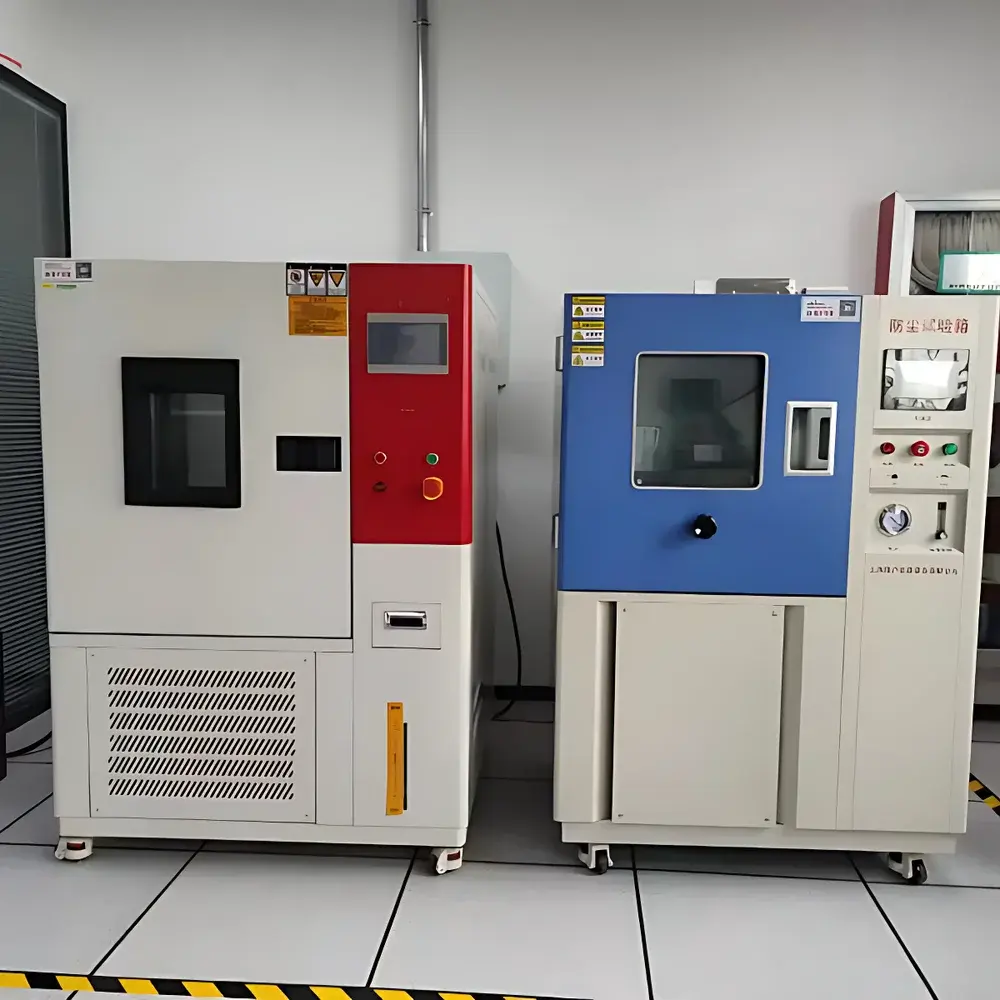
Jianhu JH-CTH Series Cold-Hot Thermal Shock Test Chamber
| Brand | Jianhu |
|---|---|
| Origin | Shanghai, China |
| Manufacturer Type | Authorized Distributor & OEM Partner |
| Country of Origin | China |
| Model | JH-CTH Series (2025–2026 Standard Configuration) |
| Price Range | USD 700 – 7,000 |
| Temperature Range | −70 °C to +150 °C |
| Cooling Method | Dual-stage Compression Refrigeration (Bitzer Compressor) |
| Explosion-Proof Design | Available (ATEX/IECEx-compliant option) |
| Temperature Fluctuation | ±0.2 °C |
| Temperature Uniformity | ±0.5 °C |
| Temperature Deviation | ±2.0 °C |
| Ramp Rate (Heating) | ≤60 min (−70 °C → +150 °C) |
| Ramp Rate (Cooling) | ≤45–80 min (+150 °C → −70 °C), configurable per test profile |
| Internal Chamber Dimensions | Custom-engineered (standard base: W600 × D600 × H600 mm |
| Control System | 10.1″ HD Touchscreen HMI with Embedded Linux OS |
| Data Logging | 200,000-cycle non-volatile storage |
| Communication Interfaces | RS485 (Modbus RTU), Ethernet (TCP/IP), optional OPC UA |
| Compliance | GB/T 2423.22–2012, IEC 60068-2-14, MIL-STD-810H, ISO 16750-4, ASTM D5229/D5229M (cold-hot cycling), GLP/GMP-ready audit trail (FDA 21 CFR Part 11 compliant firmware optional) |
Overview
The Jianhu JH-CTH Series Cold-Hot Thermal Shock Test Chamber is an industrial-grade environmental simulation system engineered for high-fidelity, repeatable thermal shock validation in reliability engineering and product qualification workflows. It operates on the principle of rapid air-to-air thermal transfer via dual-chamber (hot/cold) or single-chamber with cryogenic nitrogen injection architecture—enabling precise, programmable transitions between extreme temperature extremes without mechanical sample transfer. Designed in strict alignment with GB/T 2423.22–2012 (equivalent to IEC 60068-2-14) and validated against MIL-STD-810H Method 503.5, the JH-CTH delivers controlled thermal ramp rates up to 5 °C/s, facilitating accelerated life testing of components subjected to real-world thermal transients—such as battery modules in EV powertrains, hermetically sealed semiconductor packages, avionics housings, and polymer-based structural assemblies.
Key Features
- High-speed thermal transition: Achieves −70 °C ↔ +150 °C switching in ≤30 seconds (dual-chamber configuration), supporting rigorous automotive AEC-Q200 and aerospace DO-160 Section 24 compliance protocols.
- Precision temperature control: Multi-segment adaptive PID algorithm (patented Jianhu TCA-3.2 firmware) maintains ±0.2 °C fluctuation and ±0.5 °C uniformity across full working volume—verified per ISO 16750-4 Annex B calibration procedures.
- Explosion-proof variant available: Certified ATEX Zone 1 / IECEx Zone 1 (II 2G Ex db ib IIB T4 Gb) for safe thermal cycling of lithium-ion battery packs, electrolyte-filled sensors, and volatile organic compound (VOC)-exposed electronics.
- Integrated multi-stress capability: Optional coupling with electrodynamic shakers (up to 100 gpk) and humidity modules (10–98% RH, ±2% RH accuracy) enables synchronized thermal-mechanical-hygrometric stress profiling per ISO 16750-3 and SAE J2380.
- Robust hardware architecture: Features Bitzer semi-hermetic dual-stage compressors (low-temperature stage: R23/R508B blend), Omron E5CC digital PID controllers, 304 stainless steel interior with electropolished finish, and double-wall vacuum-insulated chamber walls (U-value ≤0.12 W/m²·K).
- Industry 4.0–ready connectivity: Native Modbus TCP and OPC UA support enables direct integration into MES (e.g., Siemens Opcenter, Rockwell FactoryTalk), LIMS, and PLM systems—ensuring traceable, timestamped, and digitally signed test records compliant with FDA 21 CFR Part 11 when configured with electronic signature module.
Sample Compatibility & Compliance
The JH-CTH accommodates a broad spectrum of physical samples—from 18650 cylindrical cells and automotive ECUs (up to 45 kg) to aerospace-grade turbine blades and wafer-level MEMS devices. Its customizable internal geometry supports fixtures for DIN 40041, IEC 60068-2-14, and JEDEC JESD22-A104E mounting standards. All standard configurations meet GB/T 2423.22–2012 Class II (severe shock severity), while explosion-proof variants conform to EN 60079-0 and EN 60079-1 for hazardous area operation. Calibration certificates are traceable to NIM (National Institute of Metrology, China) and include uncertainty budgets per ISO/IEC 17025:2017. The system is routinely deployed in GLP-certified laboratories (e.g., CATL, AVIC, SMIC) and supports IQ/OQ/PQ documentation packages aligned with ISO 9001:2015 and IATF 16949:2016 requirements.
Software & Data Management
Jianhu’s proprietary ThermoLink™ v4.2 software provides full lifecycle test management—from profile definition (with step, ramp, dwell, loop, and conditional branching logic) to real-time visualization, automated reporting (PDF/CSV/XLSX), and statistical process control (SPC) charting (X-bar R, Cpk, Ppk). Data integrity safeguards include encrypted local storage (AES-256), automatic backup to network drives, and immutable audit trails logging all user actions, parameter changes, and alarm events—including timestamps, operator IDs, and IP addresses. For regulated environments, optional 21 CFR Part 11 add-on enables role-based access control, biometric or smartcard authentication, and electronic signatures with long-term archival support. Remote diagnostics via secure TLS tunneling allow Jianhu engineers to perform predictive maintenance using live sensor telemetry (compressor current, refrigerant pressure, chamber delta-T, dew point).
Applications
- Electric Vehicle Battery Systems: Validation of thermal runaway propagation delay, cell-to-cell thermal coupling, and pack-level sealing integrity under −40 °C cold soak → +85 °C thermal shock cycles per UN ECE R100 and GB/T 31467.3.
- Semiconductor Packaging: Assessment of interfacial delamination, solder joint fatigue, and wire bond lift-off in QFN, BGA, and SiP assemblies per JEDEC JESD22-A104E and A106B.
- Aerospace Components: Qualification of optical benches, inertial measurement units (IMUs), and composite fairings per DO-160G Section 24 (Temperature Shock) and MIL-STD-810H Method 503.5.
- Medical Device Electronics: Verification of sterilization-resistant PCBs and implantable sensor housings per ISO 14971 risk management and IEC 60601-1 Clause 11.1.2 (environmental stress screening).
- Consumer Electronics: Accelerated aging of foldable display hinges, waterproof connectors, and MEMS microphones per IPC-9701A and Apple Spec 120-00027.
FAQ
What is the typical lead time for a custom-configured JH-CTH chamber?
Standard configurations ship within 12–15 business days from order confirmation. Fully customized units (e.g., −80 °C/+200 °C range, integrated vibration, ATEX certification) require 8–12 weeks, inclusive of FAT (Factory Acceptance Testing) and calibration verification.
Does Jianhu provide installation, commissioning, and operator training?
Yes. All systems include on-site installation, IQ/OQ protocol execution, NIST-traceable calibration, and 8-hour hands-on operator training—delivered by certified field application engineers. Training materials include bilingual SOPs, troubleshooting flowcharts, and video-based e-learning modules.
How is long-term reliability ensured during continuous operation?
Each unit undergoes 1,000-hour continuous burn-in at −70 °C/+150 °C extremes prior to shipment. Preventive maintenance intervals are defined per ISO 13374:2018—compressor oil analysis every 2,000 hours, refrigerant purity testing annually, and sensor recalibration every 12 months (certified by third-party metrology labs).
Can the JH-CTH be integrated into an existing lab automation framework?
Yes. Native support for Modbus TCP, OPC UA, and RESTful API enables bidirectional communication with LabVIEW, Python-based test sequencers, and enterprise SCADA platforms. Custom driver development and PLC interface engineering services are available upon request.
What warranty and service coverage is included?
Standard warranty: 36 months parts-and-labor coverage for full system; 60 months for Bitzer compressors and Omron sensors. Includes quarterly remote health checks, annual on-site calibration, and priority response SLA (4-hour remote diagnosis, 48-hour onsite dispatch for Tier-1 service centers).



