
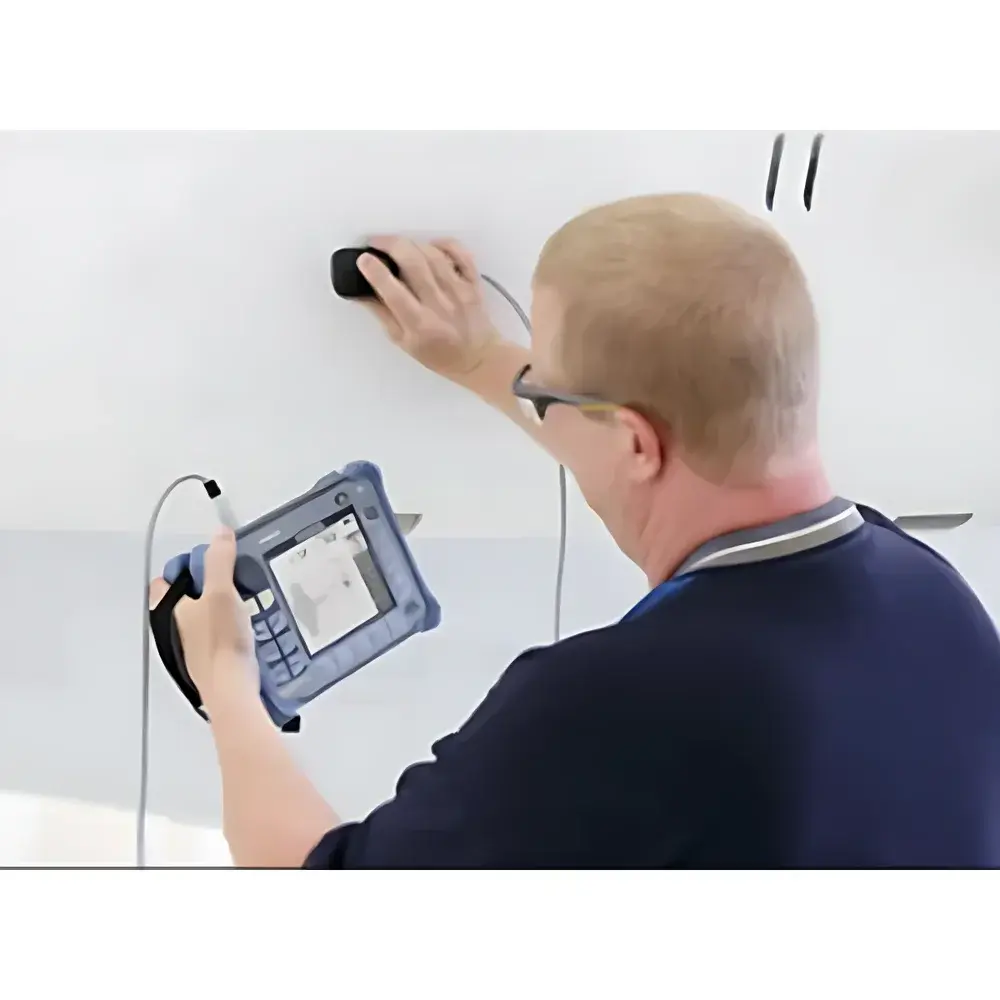
Olympus BondMaster 600 Multi-Mode Adhesive Bond Tester
| Brand | Olympus |
|---|---|
| Origin | Japan |
| Model | BondMaster 600 |
| Compliance | MIL-STD-810G, IP66, CE, FCC, IC, RoHS, RCM, KCC |
| Display | 5.7" VGA (640 × 480) color transflective LCD |
| Weight | 1.70 kg (with Li-ion battery) |
| Dimensions | 236 mm × 167 mm × 70 mm |
| Battery Life | Up to 9 hours |
| Operating Temperature | –10 °C to 50 °C |
| Storage Temperature | 0 °C to 50 °C (with battery) |
| Probe Interface | 11-pin Fischer |
| Gain Range | 0–100 dB (0.1/1 dB steps) |
| Frequency Ranges | RF/Pulse: 1–50 kHz |
| Sweep | 1–100 kHz |
| MIA | 2–50 kHz |
| Resonance | 1–500 kHz |
| Data Storage | 500 files (user-selectable preview) |
| Supported Probes | PowerLink-compatible transducers, standard dual-element probes, MIA-specific probes (B600M), resonance probes (B600M) |
| Software | BondMaster PC Software (included), supports report generation, data review, and GLP-compliant audit trail export |
Overview
The Olympus BondMaster 600 Multi-Mode Adhesive Bond Tester is a handheld ultrasonic instrument engineered for non-destructive evaluation (NDE) of adhesive bond integrity in layered and composite structures. It operates on multiple physical principles—including pulse-echo RF, gated pulse, frequency-swept excitation, mechanical impedance analysis (MIA), and resonance-based interrogation—to deliver high-fidelity signal response across diverse material systems. Unlike single-mode bond testers, the BondMaster 600 enables mode selection based on structural geometry, material attenuation, and defect morphology—making it suitable for aerospace-grade honeycomb composites, bonded metal laminates, and repaired carbon-fiber assemblies. Its architecture conforms to ASTM E1158 (Standard Guide for Ultrasonic Testing of Adhesive Bonds) and supports traceable measurement workflows required under AS9100 and ISO 9001 quality management systems.
Key Features
- IP66-rated ruggedized enclosure with reinforced corner bumpers and integrated dual-function stand/hanger for hands-free operation in confined or elevated workspaces.
- 5.7-inch full-VGA (640 × 480) transflective color LCD with adjustable brightness and instant full-screen toggle—optimized for outdoor or low-light inspection environments.
- Intuitive interface with dedicated RUN key for real-time display mode switching (A-scan, B-scan, Sweep, Spectrum, MIA, Resonance), eliminating menu navigation delays during field use.
- Preconfigured application setups for common scenarios: skin-to-core disbond detection in honeycomb panels, small-area delamination identification, repair zone differentiation, and metallic laminate bond assessment.
- Scan View (cross-sectional profile) and Spectrum View with dual frequency-tracking markers—enabling quantitative comparison of spectral response shifts associated with bond degradation.
- Two independent real-time readouts per active mode (e.g., peak amplitude + phase angle, or resonance frequency shift + Q-factor), configurable from mode-specific parameter sets.
- Backward and forward probe compatibility: fully supports Olympus PowerLink transducers and legacy non-PowerLink probes via optional adapter cables—ensuring integration into existing NDT fleets.
- Onboard file storage (500 files) with thumbnail preview, timestamped metadata, and user-defined naming—facilitating rapid post-inspection triage without immediate PC connection.
Sample Compatibility & Compliance
The BondMaster 600 is validated for use on multi-layered structures where acoustic coupling and impedance mismatch present challenges for conventional UT methods. It reliably detects disbonds in aluminum-honeycomb, titanium-honeycomb, Nomex®-core composites, and fiber-metal laminates (e.g., Glare®). Its MIA and resonance modes are particularly effective for thin-bondline applications (<0.1 mm) and geometrically complex parts such as tapered wing skins or curved fuselage sections. The instrument meets MIL-STD-810G environmental survivability requirements and carries CE, FCC, IC, RCM, KCC, and RoHS certifications. Its design supports compliance with FAA AC 20-108B (Ultrasonic Inspection of Composite Structures) and EASA AMC 20-27 guidance for in-service aircraft bond inspection. Audit-trail-capable data export via BondMaster PC Software aligns with GLP/GMP documentation expectations for regulated manufacturing and MRO environments.
Software & Data Management
BondMaster PC Software—supplied standard with every unit—enables comprehensive post-processing, comparative analysis, and regulatory reporting. Users can overlay A-scan traces from reference and test parts, generate cross-sectional B-scan reconstructions from linear scans, and extract frequency-domain features from sweep or resonance data. The software exports reports in PDF and CSV formats, embedding instrument configuration, calibration history, operator ID, and timestamped acquisition parameters. All data files retain embedded EXIF-like metadata compliant with ISO/IEC 17025 clause 7.5.2 (Control of records). Optional encrypted USB transfer and network-enabled remote firmware updates support enterprise-scale deployment and cybersecurity requirements outlined in NIST SP 800-171 for defense contractors.
Applications
- Detection of skin-to-core disbonds in aerospace honeycomb sandwich panels using RF or pulsed echo mode.
- Characterization of localized bond loss in irregularly shaped or tapered honeycomb structures via swept-frequency analysis.
- Discrimination between original bonded regions and patch repairs in CFRP components using MIA mode’s sensitivity to interfacial stiffness variation.
- Assessment of adhesive cure state and aging effects in thermoset-bonded aluminum laminates via resonance frequency shift monitoring.
- Qualitative screening of adhesive integrity in automotive battery module housings and wind turbine blade root joints—where access is limited and surface preparation is constrained.
FAQ
What distinguishes the B600 from the B600M model?
The B600 supports only through-transmission RF, pulsed, and swept-frequency modes. The B600M adds mechanical impedance analysis (MIA) and resonance modes—including dedicated calibration wizards and expanded frequency ranges—enabling deeper interfacial characterization.
Can the BondMaster 600 be used for quantitative thickness measurement?
No. It is purpose-built for bond integrity assessment—not dimensional metrology. Thickness evaluation requires calibrated time-of-flight measurements with known sound velocity, which falls outside its operational scope.
Is FDA 21 CFR Part 11 compliance supported?
While the instrument itself does not implement electronic signatures or role-based access control, BondMaster PC Software allows export of tamper-evident, time-stamped reports with full configuration logs—enabling organizations to build compliant documentation workflows within their validated IT infrastructure.
How is calibration performed for MIA and resonance modes?
Each uses a two-point reference method: users acquire signals from a known “good” part and a known “bad” part (e.g., intentionally debonded sample), then the instrument calculates optimal excitation frequency and threshold settings automatically.
What battery options are available?
A rechargeable lithium-ion pack (standard, 9-hour runtime) or eight AA alkaline cells (field-replaceable, ~6-hour runtime)—both supporting hot-swap capability without interrupting inspection.



