
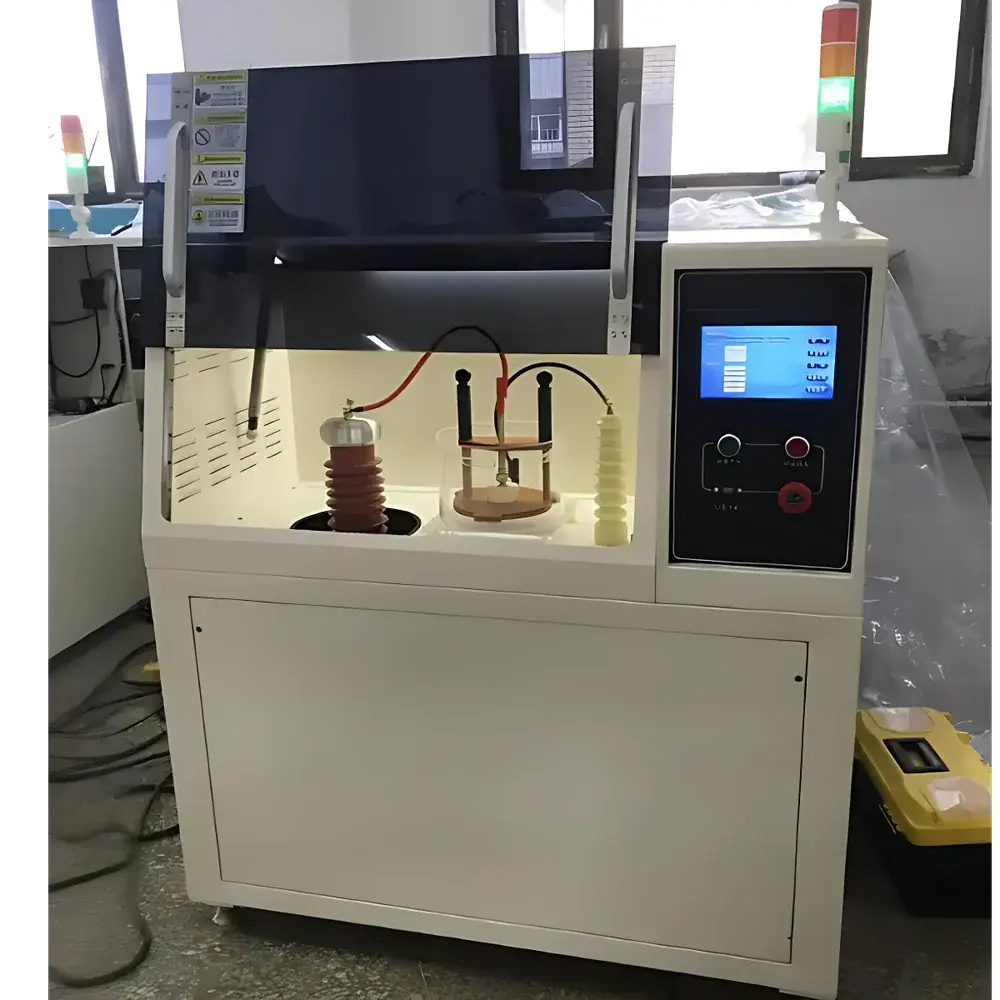
Jianhu JH Series Dielectric Breakdown Voltage Tester
| Brand | Jianhu |
|---|---|
| Origin | Shanghai, China |
| Model | JH Series Dielectric Breakdown Voltage Tester |
| Voltage Range | Up to 100 kV (configurable) |
| Measurement Accuracy | ±0.5% for voltage, ±1% for current |
| Channel Capacity | 2–8 independent parallel test channels |
| Compliance | IEC 60243-1, ASTM D149, GB/T 1408.1, ISO 60243 |
Overview
The Jianhu JH Series Dielectric Breakdown Voltage Tester is an engineered solution for standardized measurement of electrical insulation strength in solid and liquid dielectric materials. Based on the principle of controlled high-voltage ramping under defined electrode configurations (e.g., sphere-sphere, sphere-plane, or needle-plane per IEC 60243-1), the instrument applies a continuously increasing AC or DC voltage across a specimen until dielectric failure occurs—marked by a rapid current surge and loss of insulation resistance. This breakdown voltage, normalized to specimen thickness, yields the dielectric strength (kV/mm), a critical parameter for material qualification in power transmission, aerospace composites, polymer encapsulation, and medical device insulation. Designed for laboratory and production-line environments, the JH Series integrates precision high-voltage generation, real-time current monitoring, and automated pass/fail logic—ensuring repeatable, traceable results aligned with international electrotechnical standards.
Key Features
- Multi-channel architecture supporting 2–8 fully independent test stations, each with dedicated high-voltage output, current sensing, arc detection, and safety interlock circuits—enabling concurrent testing of heterogeneous samples without cross-talk or timing interference.
- High-fidelity voltage regulation with ≤0.5% full-scale accuracy and current measurement resolution down to 1 µA, achieved via calibrated shunt resistors and 16-bit isolated ADCs coupled with digital noise suppression algorithms.
- Programmable ramp rates (0.1–5 kV/s), hold times, and step-voltage protocols compliant with ASTM D149 Method A (short-time), Method B (step-by-step), and Method C (slow-rate), ensuring methodological flexibility across R&D and QC workflows.
- Integrated arc-quenching circuitry and automatic voltage cutoff within <10 ms of breakdown detection, minimizing carbon tracking and specimen damage while preserving electrode integrity for repeated use.
- Rugged industrial enclosure rated IP2X, equipped with dual redundant mechanical and electronic emergency stop systems, visible status LEDs, and transparent polycarbonate safety shield meeting EN 61010-1 requirements.
Sample Compatibility & Compliance
The JH Series accommodates specimens ranging from thin polymer films (≥0.05 mm) to rigid epoxy laminates (≤25 mm thick), liquids (via standardized oil cups per IEC 60156), and elastomeric seals. Electrode sets conform to IEC 60243-1 dimensions and surface finish specifications (Ra ≤0.8 µm). All test sequences are documented with timestamped metadata—including ambient temperature/humidity (via optional external sensor input), electrode gap, applied waveform (AC/DC/impulse), and post-test visual inspection notes. The system supports audit-ready reporting aligned with GLP and GMP frameworks, including user access logs, calibration history, and electronic signatures per FDA 21 CFR Part 11 when paired with validated software modules.
Software & Data Management
Jianhu’s proprietary TestMaster™ control software (Windows 10/11 compatible) provides intuitive test setup, real-time voltage-current waveform visualization, and automated report generation in PDF/CSV formats. Each test record includes raw acquisition data (10 kHz sampling), calculated dielectric strength, statistical summaries (mean, SD, CV%), and graphical trend analysis across batches. Software supports role-based user permissions, password-protected method libraries, and encrypted local database storage. Optional network interface enables integration into LIMS environments via OPC UA or RESTful API, facilitating centralized data aggregation and SPC charting. Calibration certificates and firmware update logs are embedded directly into the report archive for full traceability.
Applications
- Qualification of insulating varnishes, silicone rubbers, and polyimide films used in motor windings and flexible printed circuits.
- Batch release testing of transformer oils, cable joint compounds, and potting resins per IEEE C57.106 and IEC 60296.
- Comparative aging studies—tracking degradation of dielectric strength after thermal cycling, UV exposure, or humidity soak per IEC 60587.
- Material development support for aerospace-grade composites (e.g., carbon fiber/epoxy laminates) requiring certification under DO-160 Section 22.
- Teaching laboratories conducting standardized experiments per university curricula aligned with IEEE Std 930 and ASTM E1169.
FAQ
What voltage ranges are supported?
Standard configurations cover 0–20 kV, 0–50 kV, and 0–100 kV DC/AC RMS; custom ranges available upon request with recalibration documentation.
Is the system compliant with international safety standards?
Yes—designed and tested to EN 61010-1 (2010), IEC 61010-2-030, and UL 61010-1, including reinforced insulation, creepage/clearance verification, and third-party CE marking.
Can test parameters be locked to prevent unauthorized modification?
Operator-level accounts restrict access to calibration menus and method editing; administrator credentials required for changes to voltage limits, ramp profiles, or safety thresholds.
How is calibration maintained over time?
Annual recalibration is recommended using NIST-traceable high-voltage dividers and microammeters; built-in self-diagnostic routines verify HV generator linearity and current sensor drift before each test session.
Does the system support impulse voltage testing?
Not natively—this model is optimized for AC/DC withstand and breakdown tests per IEC 60243; impulse testing (e.g., lightning surge simulation) requires the separate JH-Impulse variant with dV/dt ≥100 kV/µs capability.



