
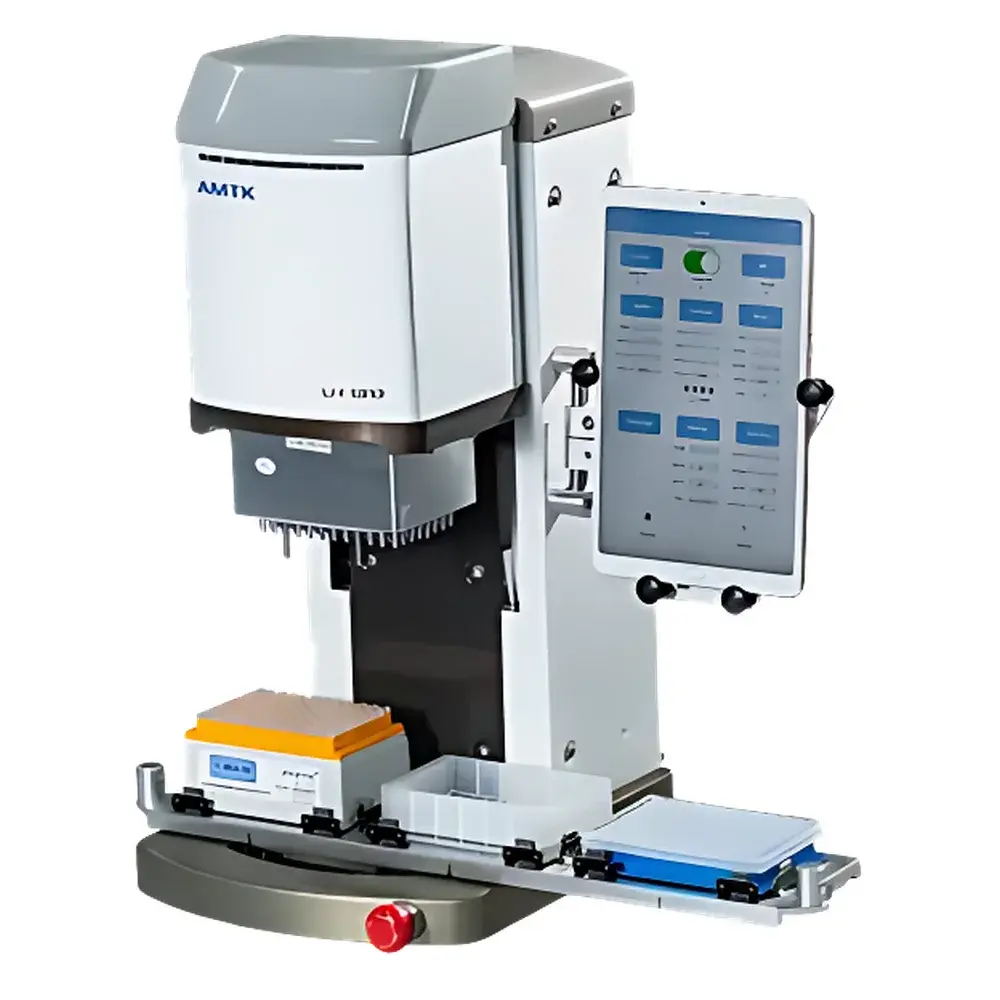
AMTK LH-1510+ Automated Liquid Handling Workstation
| Brand | AMTK |
|---|---|
| Origin | Jiangsu, China |
| Manufacturer Type | Authorized Distributor |
| Country of Origin | China |
| Model | LH-1510+ |
| Deck Positions | 3 |
| Pipetting Precision | CV < 5% at 1 µL |
| Pipetting Range | 0.5–1000 µL |
| Throughput | 96-well format (single-tip or multichannel mode) |
| Dimensions | 47 × 27 × 60 cm |
| Weight | 60 kg |
| Power Supply | AC 220 V, 50 Hz, 350 VA |
| Compatible Tip Volumes | 70 µL, 250 µL, and 1000 µL 96-channel disposable tip arrays |
| Actuation Principle | Air-displacement positive displacement pump |
| Tip Compatibility | Proprietary sterilized, low-retention, QC-validated polypropylene tips |
Overview
The AMTK LH-1510+ Automated Liquid Handling Workstation is an engineered solution for high-fidelity, medium-throughput liquid manipulation in regulated and research laboratory environments. Built upon a rigid XYZ three-axis gantry architecture with independent motorized motion control, the system delivers precise spatial positioning across three modular deck positions—enabling coordinated handling of source plates, destination plates, and auxiliary accessories (e.g., tip racks, reagent reservoirs, or temperature-controlled modules). Its core fluidic engine utilizes air-displacement pipetting technology, optimized for accuracy and reproducibility across a broad dynamic range (0.5–1000 µL), with certified coefficient of variation (CV) < 5% at 1 µL—a performance benchmark aligned with ISO 8655-6 and CLSI EP10-A3 guidelines for volumetric accuracy validation. Designed for walk-away operation in clinical diagnostics, public health laboratories, and academic core facilities, the LH-1510+ supports fully automated workflows without manual plate flipping or operator intervention during 384-well replication tasks—eliminating human error sources inherent in semi-automated platforms.
Key Features
- Three-position deck layout optimized for compact footprint (47 × 27 × 60 cm) while maintaining full accessibility to all mounted labware.
- Interchangeable 96-channel pipetting heads with calibrated volume ranges: 70 µL, 250 µL, and 1000 µL—each validated per ISO 8655-2 for linearity, accuracy, and repeatability.
- True column-wise dispensing capability: executes 8-channel sequential aspiration/dispense across 12 columns, enabling heterogeneous reagent addition (e.g., different master mixes per column) within a single 96-well plate.
- High-strength alloy pipette barrels with wear-resistant surface coating ensure mechanical durability over >100,000 cycles; field-replaceable in under 90 seconds without tools.
- Integrated tip ejection force calibration and real-time pressure sensing prevent clogging, tip leakage, or incomplete blowout—critical for viscous or volatile samples.
- Modular design supports future expansion with optional accessories: barcode readers, lid handlers, incubation decks, or integrated UV decontamination units.
Sample Compatibility & Compliance
The LH-1510+ accommodates standard ANSI/SLAS-compliant microplates (96-, 384-, and 1536-well formats), deep-well blocks, PCR strips, and tube racks (including 0.2–50 mL conical and skirted tubes). All liquid contact surfaces are chemically inert (polyether ether ketone [PEEK], medical-grade stainless steel, and fluoropolymer-coated components), ensuring compatibility with aqueous buffers, organic solvents (≤30% acetonitrile), enzymes, nucleic acids, and protein-based reagents. The platform conforms to IEC 61010-1 safety standards for laboratory equipment and meets electromagnetic compatibility (EMC) requirements per EN 61326-1. For regulated environments, audit trails, user access levels, electronic signatures, and protocol versioning can be enabled to support alignment with FDA 21 CFR Part 11, ISO/IEC 17025, and GLP/GMP documentation practices.
Software & Data Management
The workstation operates via AMTK’s proprietary Graphical Workflow Editor (GWE), a drag-and-drop interface supporting intuitive creation, simulation, and validation of complex protocols—including serial dilutions, plate replication, normalization, pooling, and conditional branching logic. All methods are saved as encrypted XML files with embedded metadata (operator ID, timestamp, instrument serial number, calibration log references). Raw execution logs—including tip usage count, pressure profiles, axis position traces, and error codes—are stored locally and exportable in CSV or PDF formats for QA review. Remote monitoring and firmware updates are supported over secure HTTPS connections; optional integration with LIMS via RESTful API enables bidirectional sample tracking and result ingestion.
Applications
- High-integrity nucleic acid library preparation for NGS workflows, including tagmentation, adapter ligation, and size selection normalization.
- Automated ELISA assay setup with multi-reagent addition, wash steps, and plate sealing—reducing inter-assay variability in serological testing.
- Cell-based assay seeding and compound dosing in 96- and 384-well formats for antiviral or antimicrobial screening programs.
- Standard curve generation and sample dilution series for qPCR, digital PCR, and immunoassay validation studies.
- Biobank sample aliquoting and inventory management, compliant with ISBER Best Practices for biorepository operations.
- QC/QA testing in blood bank and reference laboratories performing transfusion medicine assays (e.g., antibody screening, antigen typing).
FAQ
What regulatory standards does the LH-1510+ support for use in clinical laboratories?
The system supports configurable audit trail logging, role-based user authentication, and electronic signature capture—enabling compliance with FDA 21 CFR Part 11, CAP checklist GEN.40910, and CLIA §493.1253(b) requirements for automated test systems.
Can the LH-1510+ perform serial dilutions with variable step factors across columns?
Yes—the Graphical Workflow Editor allows definition of non-linear dilution schemes per column using arithmetic or logarithmic progression, with automatic tip change and mixing steps between transfers.
Is third-party tip compatibility available?
Only AMTK-validated, lot-tested tips are supported to guarantee precision and prevent cross-contamination; generic tips are not recognized by the system’s tip presence sensor or pressure calibration routines.
How is calibration verified and documented?
Gravimetric verification per ISO 8655-6 is performed at installation and annually thereafter; calibration certificates include uncertainty budgets and traceability to NIST SRM 2820 water standards.
Does the system support integration with robotic arms or track-based automation?
The LH-1510+ features TTL and RS-232 I/O ports for external trigger synchronization but is not designed as a node in fully integrated track systems; it functions optimally as a standalone or semi-integrated workstation.



