
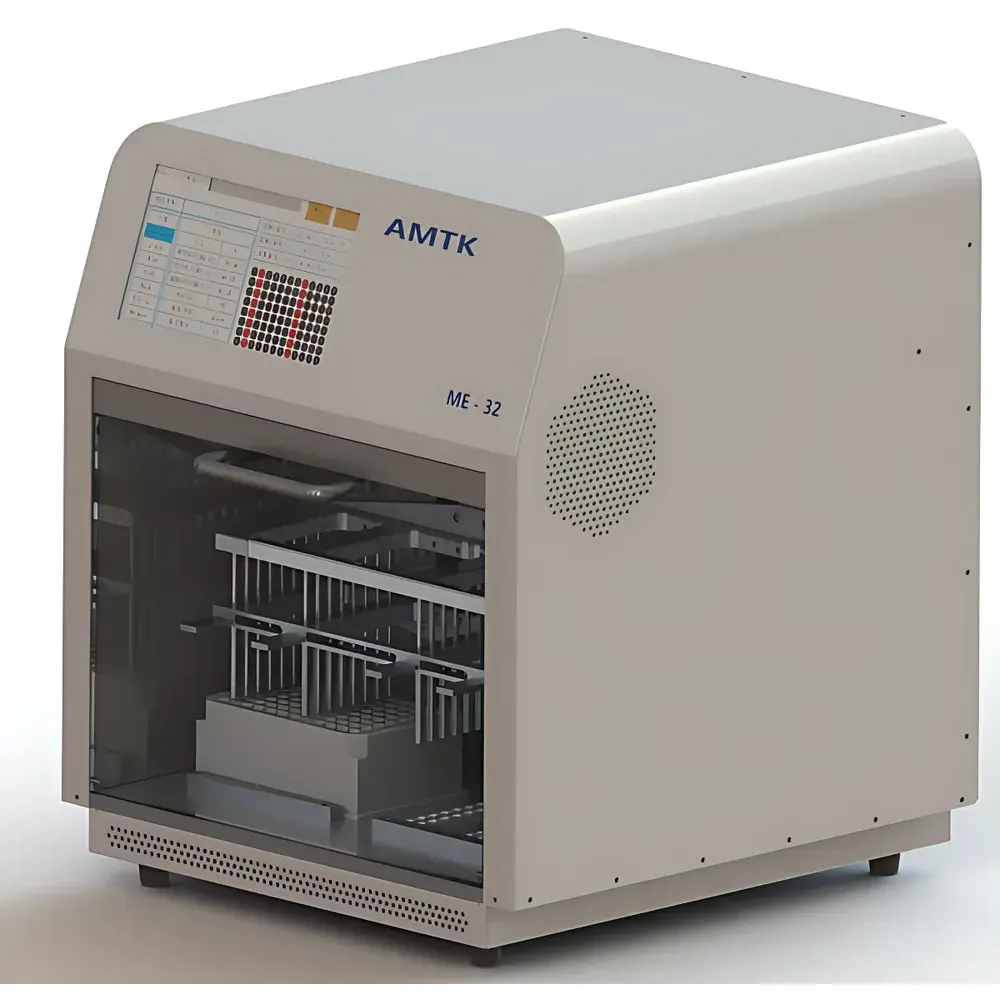
AMTK ME-32 Automated Magnetic Rod-Based Nucleic Acid Extraction System
| Brand | AMTK |
|---|---|
| Origin | Jiangsu, China |
| Manufacturer Type | Authorized Distributor |
| Region of Manufacture | Domestic (China) |
| Model | ME-32 |
| Instrument Type | Magnetic Bead-Based Extraction |
| Automation Level | Dedicated Fully Automated Platform |
| Throughput | 32 samples per run |
| Sample Volume Range | 20–1200 µL |
| Processing Time per Run | 15–30 minutes |
| Maximum Magnetic Bead Recovery Rate | >95% |
| Compatible Plate Format | 96-well deep-well plates |
| Heating Module Option | Ambient to +100 °C |
| Mixing Agitation | Multi-level programmable vortexing |
| Reagent Compatibility | Open-platform magnetic bead kits (third-party compatible) |
| Onboard UV Sterilization | Yes |
| Safety Interlock | Motorized lid sensor with automatic pause/resume |
| User Interface | 7-inch capacitive touchscreen, bilingual (English/Chinese) |
| Stored Protocols | >100 user-editable methods |
| Protocol Editor | Full graphical programming interface with stepwise parameter control (lysis temp, wash cycles, elution volume, mixing speed/duration, hold times) |
Overview
The AMTK ME-32 Automated Magnetic Rod-Based Nucleic Acid Extraction System is a dedicated, walk-away platform engineered for high-throughput, reproducible isolation of genomic DNA, plasmid DNA, viral RNA, and total RNA from diverse biological matrices—including whole blood, serum, plasma, saliva, buccal swabs, tissue homogenates, and cultured cells. It operates on the principle of magnetic rod technology: a set of 32 parallel magnetic rods—each fitted with disposable magnetic bead capture sleeves—selectively transports paramagnetic beads coated with nucleic acid-binding ligands through sequential reagent wells. Unlike pipetting-based liquid handling systems, this solid-phase transfer mechanism eliminates cross-contamination risk from residual liquid carryover and ensures consistent bead recovery across all channels. The system integrates thermally regulated lysis and elution zones, programmable multi-speed agitation for uniform bead suspension, and real-time positional feedback to maintain alignment during plate movement. Designed for compliance-critical environments, the ME-32 supports audit-ready operation under GLP and ISO 15189-aligned laboratory workflows.
Key Features
- 32-channel parallel processing with synchronized magnetic rod actuation and sleeve auto-loading/unloading
- Programmable temperature control: independent heating zones for lysis (up to +100 °C) and elution (ambient to +85 °C), with ±0.5 °C stability
- Multi-stage agitation: adjustable orbital shaking frequency (200–1200 rpm) and duration per step to optimize binding kinetics and wash efficiency
- Bilingual 7-inch capacitive touchscreen with intuitive icon-driven navigation and real-time protocol progress visualization
- Open reagent architecture: validated compatibility with commercial magnetic bead kits from QIAGEN, Thermo Fisher, Takara Bio, and domestic suppliers meeting ISO 13485-manufactured specifications
- Onboard UV-C (254 nm) irradiation chamber with configurable timer (1–60 min) and forced-air ventilation for post-run decontamination
- Mechanical safety interlock: motorized lid detection halts all motion immediately upon opening; resumes from last completed step after closure
- Embedded protocol library with >100 preloaded methods—including WHO-recommended SARS-CoV-2 RNA extraction, blood bank pathogen screening, and FFPE tissue DNA recovery workflows
Sample Compatibility & Compliance
The ME-32 accepts standard 96-well deep-well plates (1.2 mL capacity) and accommodates sample volumes from 20 µL (e.g., dried blood spots eluates) to 1200 µL (e.g., whole blood lysates). It supports input matrices compliant with CLSI EP12-A2 and ISO 20387 biobanking guidelines, including anticoagulated EDTA/K2EDTA blood, PAXgene RNA tubes, and stabilized saliva collection devices. All fluid-handling surfaces are autoclavable or chemically resistant (316 stainless steel rods, PTFE-coated sleeves). The system meets IEC 61000-6-2/6-3 EMC standards and carries CE marking under Directive 2014/30/EU (EMC) and 2014/35/EU (LVD). For regulated diagnostics use, it supports 21 CFR Part 11-compliant electronic signatures when paired with AMTK’s optional LIMS integration module and audit trail logging.
Software & Data Management
The embedded firmware (v4.2+) provides full protocol authoring via drag-and-drop step sequencing: users define incubation temperatures, mixing parameters, magnetic separation durations, and aspiration/transfer logic without scripting. Each method stores metadata including operator ID, timestamp, lot numbers of reagents used, and environmental logs (internal temperature/humidity). Export options include CSV-formatted extraction yield reports, QC pass/fail flags per well, and raw sensor data (motor current, thermal ramp profiles). Remote monitoring is enabled via Ethernet or Wi-Fi; secure HTTPS API allows integration with laboratory information systems (LIS) using HL7 v2.5.3 or ASTM E1384 message formats. All stored protocols are encrypted at rest using AES-256.
Applications
- Clinical molecular testing: high-volume screening for infectious agents (HBV, HCV, HIV, HPV, SARS-CoV-2) in central labs and reference testing facilities
- Blood bank nucleic acid testing (NAT): automated pathogen detection in donated blood units per AABB Technical Manual Chapter 18 requirements
- Epidemiological surveillance: field-deployable extraction for mobile biosafety level-2 (BSL-2) response units conducting outbreak investigations
- Academic research: scalable nucleic acid prep for NGS library construction, qPCR validation, and CRISPR guide RNA screening assays
- Veterinary diagnostics: zoonotic pathogen isolation from animal tissue, milk, and environmental swab samples
- Biomarker discovery: standardized extraction from biobanked cohorts adhering to ISBER Best Practices v3.0
FAQ
What types of magnetic bead kits are compatible with the ME-32?
The system supports any commercially available magnetic bead-based nucleic acid extraction kit designed for 96-well deep-well plates, provided the bead size falls within 0.5–2.0 µm diameter range and the binding chemistry is silica- or carboxyl-modified.
Can the ME-32 process fewer than 32 samples in a single run?
Yes—users may load partial plates (8, 16, or 24 samples); the system automatically adjusts magnetic rod positioning and reagent dispensing volumes accordingly.
Is calibration required before routine use?
No routine calibration is needed; however, annual performance verification using AMTK-certified QC beads and traceable temperature probes is recommended per ISO/IEC 17025 Clause 6.4.
How does the system prevent aerosol contamination during lysis?
All lysis steps occur under sealed plate conditions; the integrated UV chamber sterilizes exposed surfaces post-run, and optional HEPA-filtered exhaust ducting can be installed.
Does the ME-32 support remote software updates?
Yes—firmware updates are delivered via secure SFTP and require digital signature verification prior to installation; rollback capability is retained for all prior three versions.



