
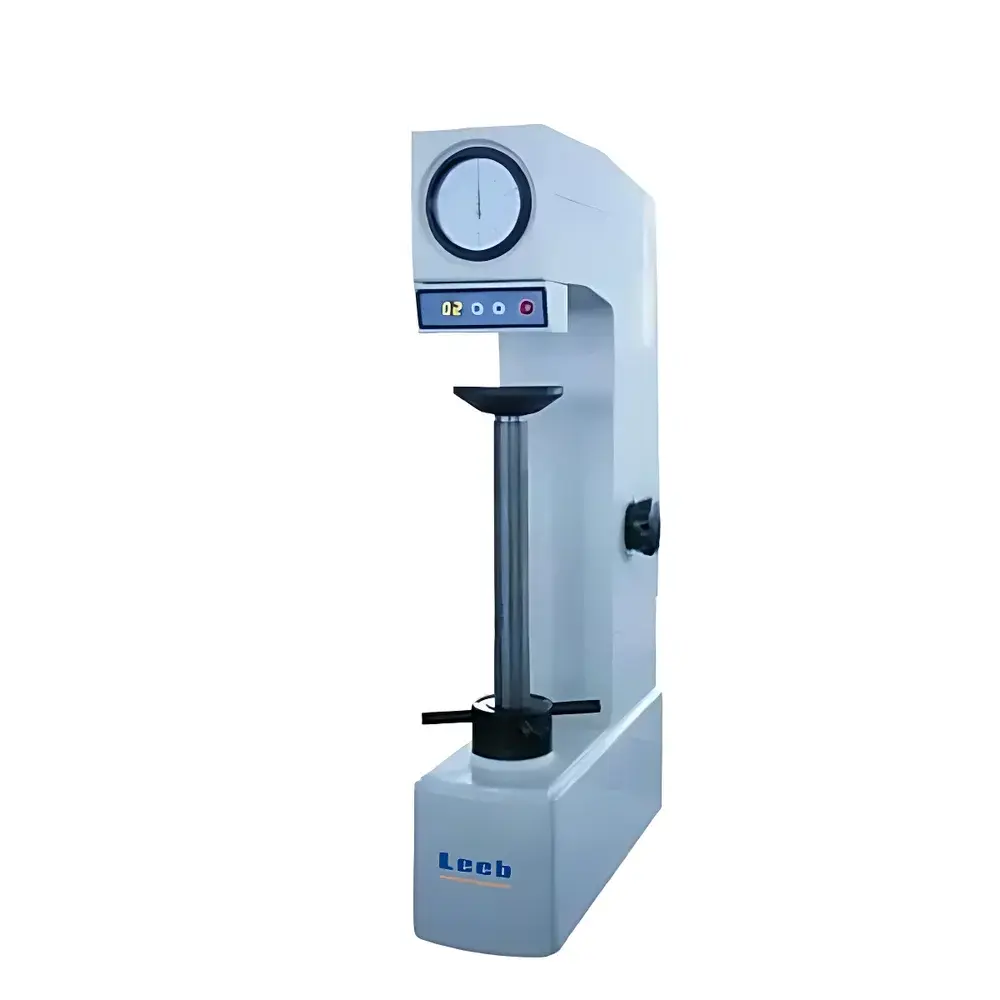
Olympus TH520 Rockwell Hardness Tester
| Brand | Olympus |
|---|---|
| Origin | Japan |
| Model | TH520 |
| Testing Direction | Vertical |
| Maximum Test Height | 400 mm |
| Applicable Standards | ASTM E18, ISO 6508, JIS Z 2245 |
| Hardness Scales | HRA, HRB, HRC, HRD, HRF, HRG, HRH, HRR, HR15N, HR30N, HR45N, HR15T, HR30T, HR45T |
| Load Application | Automatic motorized loading with dual-scale force system (major/minor loads) |
| Indenter Types | Diamond cone (120°, 0.2 mm tip radius) and hardened steel ball (1/16", 1/8", 1/4", 1/2") |
| Measurement Repeatability | ≤ ±0.5 HR under standardized conditions |
| Compliance | GLP-ready architecture with audit-trail-capable software interface |
Overview
The Olympus TH520 Rockwell Hardness Tester is an industrial-grade, vertically oriented hardness measurement system engineered for precision, reliability, and operational efficiency in quality control and materials characterization laboratories. Based on the standardized Rockwell hardness principle—defined by ASTM E18, ISO 6508, and JIS Z 2245—the instrument determines material resistance to plastic deformation through depth-differential indentation under controlled major and minor loads. The TH520 employs a dual-scale electromechanical loading mechanism that automatically applies and maintains standardized forces (e.g., 10 kgf minor load; 60/100/150 kgf major loads), followed by high-resolution displacement transduction of the indenter’s residual penetration depth. This methodology delivers direct Rockwell number readouts without intermediate calculations, ensuring traceability to national metrology institutes and compatibility with international calibration hierarchies.
Key Features
- Vertical test axis with 400 mm maximum specimen height clearance—enabling evaluation of large forgings, rolled sections, cast housings, and heat-treated components without sectioning.
- Motorized load application and unloading sequence compliant with ASTM E18 timing tolerances (±0.5 s for dwell periods), minimizing operator-induced variability.
- Interchangeable indenters: conical diamond (120° apex angle, 0.2 mm tip radius) for HRA/HRC/HRD scales and hardened steel balls (1/16″, 1/8″, 1/4″, 1/2″ diameters) for HRB/HRF/HRH scales—each certified to ISO 6508-2 geometric and hardness specifications.
- Integrated mechanical zero-reference system with hardened anvil and precision-ground test stage, ensuring consistent contact geometry across repeated measurements.
- Robust cast-iron frame with vibration-damping base and rigid column assembly—designed to suppress environmental micro-vibrations and maintain measurement stability during extended shift operations.
- Front-panel digital display with real-time load status, scale selection, and hardness value output—supporting immediate verification without external software dependency.
Sample Compatibility & Compliance
The TH520 accommodates a broad spectrum of metallic materials per standard Rockwell applications: hardened steels (HRC), annealed low-carbon steels (HRB), aluminum alloys (HRF, HRH), copper alloys (HR30T), case-hardened surfaces (HR15N–HR45N), and thin-sheet coatings (HR15T–HR45T). Specimen surface flatness requirements follow ISO 6508-1 (≤ 0.002 mm deviation over 1 mm² contact area); minimum thickness must exceed 10× residual indentation depth to prevent anvil influence. All hardness values are traceable to NIST SRM 126x series reference blocks. The system architecture supports GLP and GMP environments via documented calibration procedures, periodic verification logs, and mechanical interlock verification of indenter alignment prior to each test cycle.
Software & Data Management
While the TH520 operates as a standalone instrument, its RS-232 and optional USB interfaces enable integration with Olympus-certified data acquisition software (e.g., HM-Link v4.x). This software provides automated test sequencing, statistical process control (SPC) charting (X̄–R, Cp/Cpk), PDF report generation with embedded calibration certificates, and 21 CFR Part 11–compliant user access controls—including electronic signatures, audit trails for result modification, and encrypted local database storage. Raw displacement and load-time profiles are exportable in CSV format for third-party analysis or LIMS ingestion.
Applications
- Metallurgical process validation: monitoring quench-and-temper response in structural steels, carburizing depth verification in gear blanks, and decarburization layer assessment in wire rod production.
- Supplier quality assurance: incoming inspection of tool steels, bearing rings, valve seats, and aerospace fasteners against AS9102 first-article requirements.
- R&D laboratories: correlation studies between Rockwell hardness and tensile strength (per ASTM E140), wear resistance mapping across heat-affected zones (HAZ), and coating adhesion screening via substrate hardness gradients.
- Calibration laboratories: secondary standard verification using certified reference materials (CRMs) and inter-laboratory comparison protocols aligned with ILAC P14 guidelines.
FAQ
What Rockwell scales does the TH520 support?
The TH520 supports all standard Rockwell scales: HRA, HRB, HRC, HRD, HRF, HRG, HRH, HRR, HR15N, HR30N, HR45N, HR15T, HR30T, and HR45T.
Is the TH520 suitable for testing curved surfaces?
Yes—when used with optional spherical or V-groove anvil attachments, the TH520 meets ASTM E18 Annex A3 requirements for cylindrical specimens with diameters ≥ 25 mm.
How often must the TH520 be calibrated?
Per ISO/IEC 17025, daily verification with certified reference blocks is required before use; full calibration by an accredited provider is recommended annually or after any mechanical impact or relocation.
Does the TH520 meet FDA or aerospace regulatory requirements?
Yes—the mechanical design, documentation package, and software interface comply with FDA 21 CFR Part 11 for electronic records and signatures, and support AS9100D clause 8.5.2 for inspection equipment control.
Can the TH520 perform Brinell or Vickers tests?
No—the TH520 is dedicated exclusively to Rockwell hardness measurement per its mechanical and control architecture; multi-method instruments require separate platforms.



