
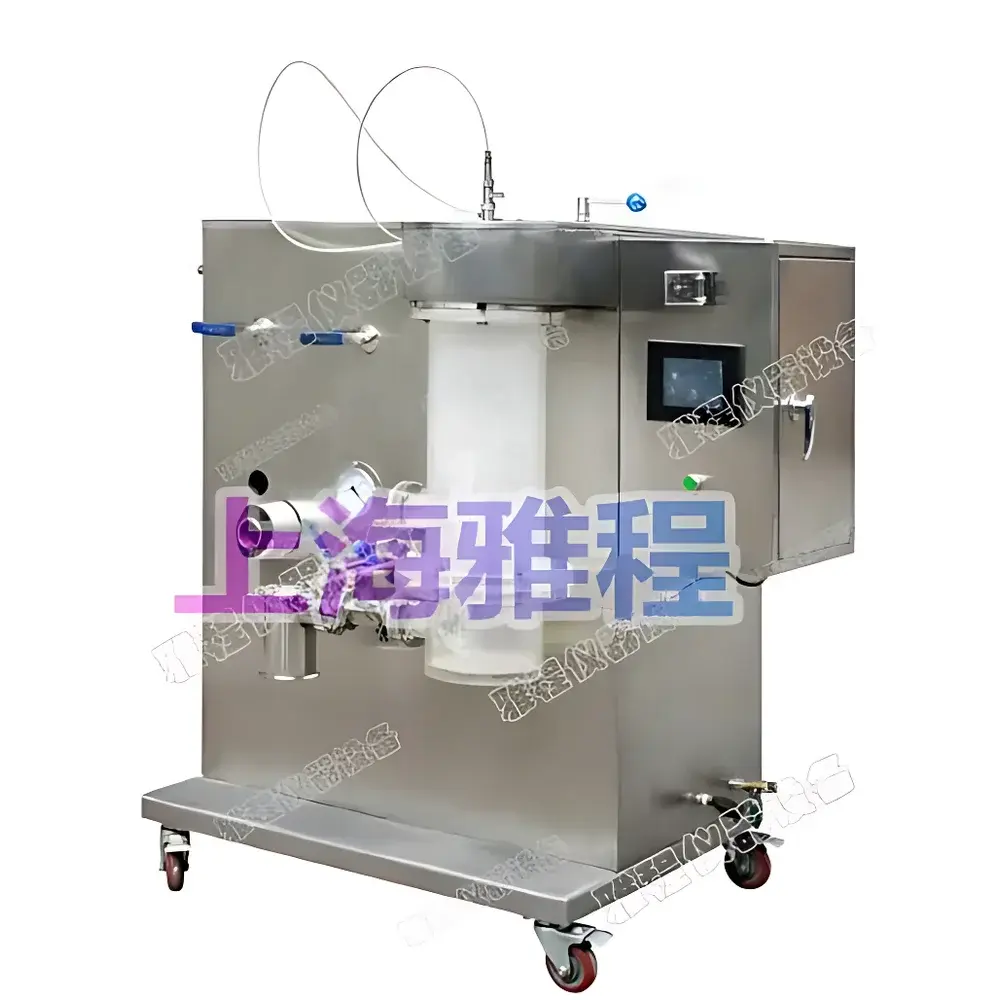
Yacheng YC-3000 Laboratory Spray Freeze Dryer
| Origin | Shanghai, China |
|---|---|
| Manufacturer Type | Authorized Distributor |
| Origin Category | Domestic (PRC) |
| Model | YC-3000 |
| Price | USD 28,000 (FOB Shanghai) |
| Application Scope | R&D and Small-Batch Processing in Academic & Industrial Laboratories |
| Cooling System | Air-Cooled Hermetic Compressor |
| Condenser Temperature | ≤ −60 °C |
| Spray Freezing Temperature | < −15 °C |
| Chamber Pressure (Vacuum) | < 20 Pa (No Load) |
| Spray Pressure Range | 2–5 bar (Adjustable) |
| Air Compressor Output | 4.2 m³/h |
| Cold Air Flow Rate | 5.5 m³/min |
| Batch Capacity | 245 mL per Cycle |
| Display | Full-Color LCD Touchscreen (Chamber Temp, Peristaltic Pump Speed, Fan Frequency, Needle Clearance Frequency, Chamber Pressure) |
Overview
The Yacheng YC-3000 Laboratory Spray Freeze Dryer is an integrated benchtop processing system engineered to combine the rapid atomization of spray drying with the structural preservation advantages of vacuum freeze drying. Unlike conventional lyophilizers that rely solely on sublimation under static freezing conditions, the YC-3000 employs a two-stage hybrid process: first, liquid feedstock is atomized into fine droplets under controlled pressure and immediately flash-frozen upon contact with a cryogenic environment (< −15 °C); second, frozen micro-droplets are transferred to a high-vacuum chamber (≤ 20 Pa) where primary drying proceeds via conductive heating and sublimation under gentle ambient air convection—eliminating thermal stress while preserving labile macromolecular architecture. This methodology is particularly suited for heat-sensitive biologics, viscous botanical extracts, enzyme suspensions, dairy concentrates, fruit purees, and polymer dispersions where conventional thermal drying induces denaturation, Maillard reactions, or irreversible aggregation.
Key Features
- Hybrid drying architecture integrating pneumatic spray atomization and low-temperature vacuum sublimation in a single compact platform
- Air-cooled hermetic compressor refrigeration system achieving condenser temperatures ≤ −60 °C for efficient vapor trapping and stable vacuum maintenance
- Full-color LCD touchscreen interface displaying real-time operational parameters: chamber temperature, peristaltic pump speed, fan frequency, needle clearance frequency, and absolute chamber pressure
- Adjustable spray pressure (2–5 bar) and programmable peristaltic feed control enabling reproducible droplet size distribution and particle morphology tuning
- Standard ISO-KF 25 vacuum flange connections with sanitary quick-clamp couplings compliant with ISO 28560-1 for leak-tight integrity and rapid maintenance access
- Integrated vacuum pump power socket on main chassis—no external power routing required for pump operation
- Low-noise operation (< 62 dBA at 1 m), CE-compliant electrical architecture, and IP20-rated enclosure for laboratory-grade safety and reliability
Sample Compatibility & Compliance
The YC-3000 accommodates aqueous and partially organic solutions with total solids content up to 45 wt%, including but not limited to herbal extracts (e.g., ginseng, astragalus), whey protein isolates, monoclonal antibody formulations, probiotic suspensions, pectin-based hydrogels, and poly(lactic-co-glycolic acid) (PLGA) nanoparticle dispersions. Its non-contact freezing mechanism avoids ice crystal damage associated with bulk freezing, while the absence of direct radiant heating preserves secondary and tertiary protein structure. The system supports GLP-compliant documentation workflows through timestamped parameter logging and optional USB data export. While not certified to FDA 21 CFR Part 11 out-of-the-box, its audit trail-capable firmware architecture allows integration with validated LIMS environments under user-defined SOPs aligned with ISO 9001:2015 and ISO/IEC 17025:2017 laboratory management frameworks.
Software & Data Management
The embedded controller records all critical process variables—including chamber pressure, condenser temperature, feed rate, and spray cycle timing—at 1 Hz resolution. Data is stored internally for up to 100 batches and exportable via USB 2.0 to CSV format for post-processing in MATLAB, Python (Pandas), or industry-standard statistical analysis tools. Optional Ethernet connectivity enables remote monitoring and alarm notification via Modbus TCP. All parameter setpoints are password-protected and version-controlled; system configuration changes generate immutable log entries with operator ID and timestamp—supporting traceability requirements under GMP Annex 11 and USP Analytical Instrument Qualification guidelines.
Applications
- Rapid formulation screening of amorphous solid dispersions for enhanced oral bioavailability
- Stabilization of thermolabile vaccines and mRNA-LNP complexes without cryoprotectant overuse
- Production of free-flowing, spherical microparticles from high-sugar fruit juices (e.g., pomegranate, acerola) with minimal collapse
- Preparation of nanostructured catalysts and MOF precursors with preserved surface area and porosity
- Lyophilization of microbial cultures and starter cultures for food fermentation R&D
- Processing of shear-sensitive nanocellulose suspensions into redispersible aerogel powders
FAQ
What types of solvents are compatible with the YC-3000?
Aqueous buffers, ethanol/water mixtures (< 30 vol%), glycerol solutions (< 15 wt%), and low-boiling-point excipients such as tert-butanol are routinely processed. Chlorinated or highly volatile solvents (e.g., chloroform, diethyl ether) are not recommended due to compressor oil compatibility and vacuum pump safety constraints.
Can the particle size distribution be controlled?
Yes—via coordinated adjustment of nozzle orifice diameter, spray pressure (2–5 bar), feed viscosity, and cold air flow rate (5.5 m³/min). Typical output ranges from 5–50 µm median diameter (D50) as verified by laser diffraction (Malvern Mastersizer).
Is validation support available for IQ/OQ protocols?
Yacheng provides factory-verified calibration certificates for pressure transducers and PT100 temperature sensors. Comprehensive URS-aligned IQ/OQ templates and test scripts are supplied upon request for qualified site implementation.
What maintenance intervals are recommended?
Compressor oil replacement every 3,000 operating hours; vacuum pump oil change every 500 hours; condenser coil cleaning quarterly; O-ring inspection and lubrication biannually per ISO 13485 preventive maintenance schedules.



