
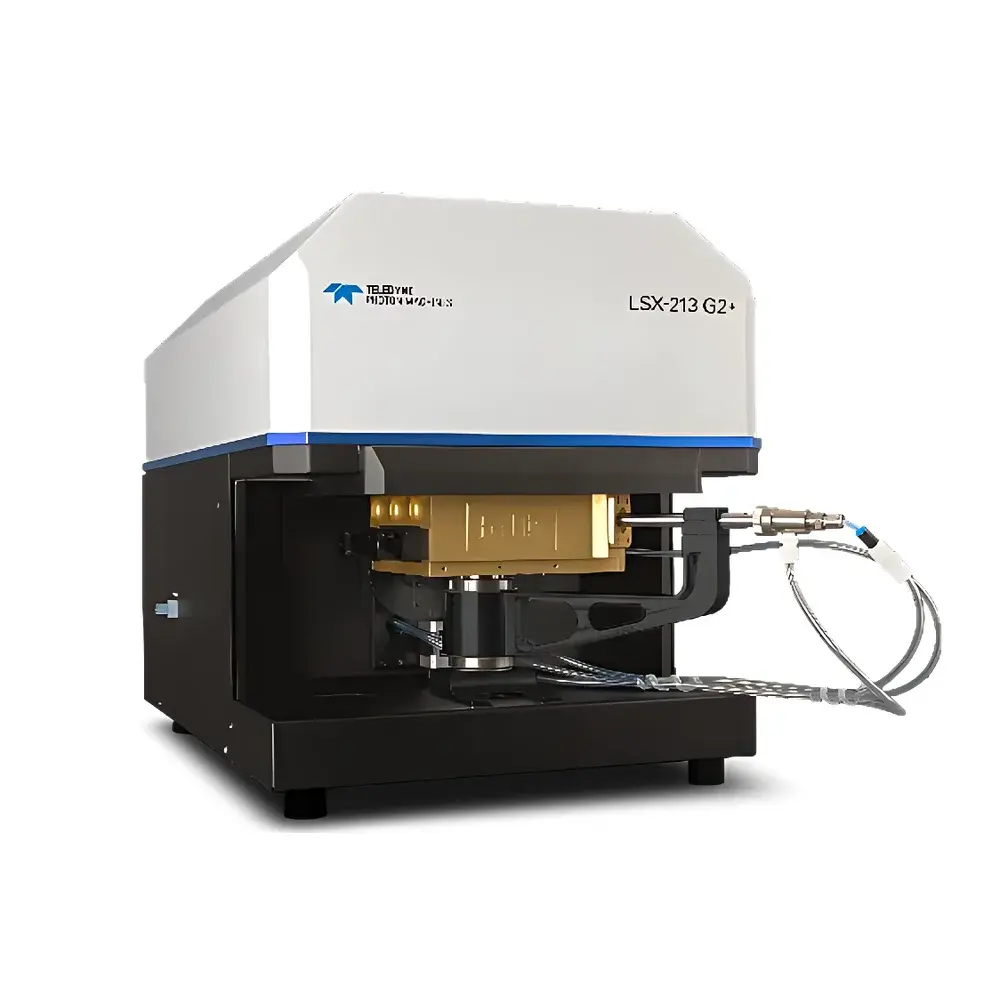
Teledyne Photon Machines LSX-213 G2+ Solid-State Laser Ablation System
| Brand | Teledyne Photon Machines |
|---|---|
| Origin | Imported |
| Model | LSX-213 G2+ |
| Laser Wavelength | 213 nm (5th harmonic of Nd:YAG) |
| Pulse Energy | >4 mJ |
| Pulse Width | <5 ns |
| Ablation Spot Size Range | 4–200 µm (14 standard apertures) |
| Microscope Magnification | 2.6×–32.5× |
| Optical Resolution | <2 µm |
| XY Stage Step Resolution | 0.16 µm |
| Laser Type | Q-switched, solid-state Nd:YAG |
Overview
The Teledyne Photon Machines LSX-213 G2+ is a high-performance, compact solid-state laser ablation system engineered for precise, reproducible microsampling of solid materials in elemental and isotopic analysis workflows. It utilizes fifth-harmonic generation (213 nm) from a Q-switched Nd:YAG laser, delivering deep UV photons with high photon energy and minimal thermal diffusion—ideal for minimizing fractionation effects during ablation of conductive and non-conductive geological, metallurgical, biological, and ceramic samples. Designed specifically for coupling with inductively coupled plasma mass spectrometers (ICP-MS) and multi-collector ICP-MS (MC-ICP-MS), the LSX-213 G2+ enables spatially resolved trace element and isotope ratio measurements at micron-scale resolution. Its robust optical architecture, integrated digital microscope, and motorized XYZ sample stage support both single-spot analysis and raster or line-scan protocols under fully automated control.
Key Features
- Q-switched, air-cooled Nd:YAG laser operating at 213 nm (fifth harmonic), offering superior beam stability and long-term pulse-to-pulse energy reproducibility
- Pulse energy exceeding 4 mJ with pulse duration <5 ns—optimized for efficient ablation with minimal thermal load and reduced elemental fractionation
- Adjustable ablation spot size from 4 µm to 200 µm via a precision aperture wheel with 14 calibrated positions, enabling flexible spatial resolution selection without realignment
- High-magnification zoom microscope (2.6×–32.5×) with sub-2 µm optical resolution and integrated LED illumination for accurate targeting and real-time monitoring of ablation craters
- Motorized XY translation stage with 0.16 µm step resolution and closed-loop positioning feedback, ensuring positional accuracy and repeatability across large-area mapping sequences
- Compact footprint and modular design facilitate straightforward integration into existing ICP-MS laboratories; pump lamp replacement is tool-free and requires less than 15 minutes
- Intuitive touchscreen interface and hardware-triggered synchronization with ICP-MS acquisition systems (e.g., via TTL or analog signal input)
Sample Compatibility & Compliance
The LSX-213 G2+ accommodates a broad range of solid sample types—including polished thin sections, pressed powder pellets, metal alloys, glass standards, mineral grains, and biological tissue mounts—without requiring conductive coating. Its deep-UV wavelength ensures efficient ablation of transparent and wide-bandgap materials (e.g., quartz, zircon, sapphire) where longer-wavelength lasers suffer from poor absorption. The system complies with international laboratory quality frameworks: all operational parameters (laser energy, spot size, repetition rate, dwell time, stage coordinates) are digitally logged with timestamps and user IDs, supporting GLP/GMP documentation requirements and audit readiness. Data export formats (CSV, ASCII) are compatible with LIMS integration, and software logs meet traceability criteria aligned with ISO/IEC 17025 and FDA 21 CFR Part 11 when used with validated configurations.
Software & Data Management
Control and method development are executed through Photon Machines’ LA-iLASS software—a Windows-based platform supporting full instrument automation, real-time crater imaging, and synchronized data streaming to ICP-MS acquisition software (e.g., Thermo Fisher Isotope, Agilent MassHunter, Nu Instruments NuScript). Method templates include pre-configured protocols for U–Pb geochronology, REE profiling, fluid inclusion analysis, and biomineralization studies. All acquisition metadata—including laser firing events, stage positions, energy calibration curves, and shutter status—are embedded in raw data files. Software supports batch processing of multi-sample trays, automated focus routines, and offline crater dimension measurement using calibrated pixel-to-µm conversion. Audit trail functionality records operator actions, parameter modifications, and system diagnostics for regulatory review.
Applications
- High-spatial-resolution U–Th–Pb and Lu–Hf isotope dating of zircon, monazite, and apatite crystals
- Trace element mapping in meteorites, lunar samples, and terrestrial igneous rocks
- In situ analysis of fluid and melt inclusions in quartz and feldspar hosts
- Quantitative metal distribution profiling in battery cathode materials and semiconductor thin films
- Elemental imaging of calcified tissues (e.g., teeth, bone) for biomedical and paleodietary research
- Reference material characterization (e.g., NIST SRM 610, USGS GSE-1G) for ICP-MS calibration validation
FAQ
What distinguishes the LSX-213 G2+ from excimer-based 193 nm laser ablation systems?
The LSX-213 G2+ uses a solid-state Nd:YAG laser with harmonic generation, eliminating the need for toxic halogen gases, high-voltage excitation, and frequent gas replenishment. It offers superior long-term energy stability, lower maintenance overhead, and faster warm-up times compared to excimer platforms.
Can the LSX-213 G2+ be upgraded to support time-resolved analysis or dual-cell configurations?
Yes—the system supports optional add-ons including a fast-gas exchange ablation cell (e.g., TwoVol or AU Cell), helium/nitrogen mixing modules, and time-resolved signal deconvolution firmware for transient signal optimization.
Is remote operation supported for unattended overnight runs?
Absolutely. LA-iLASS includes scheduler functionality, email alerting on completion or error conditions, and secure remote desktop access via institutional VPN—fully compliant with IT security policies in regulated environments.
Does Teledyne provide application-specific method development support?
Yes. Photon Machines’ global applications team offers remote and on-site method optimization, including matrix-matched calibration strategies, ablation yield assessment, and ICP-MS interface tuning for maximum sensitivity and precision.





