
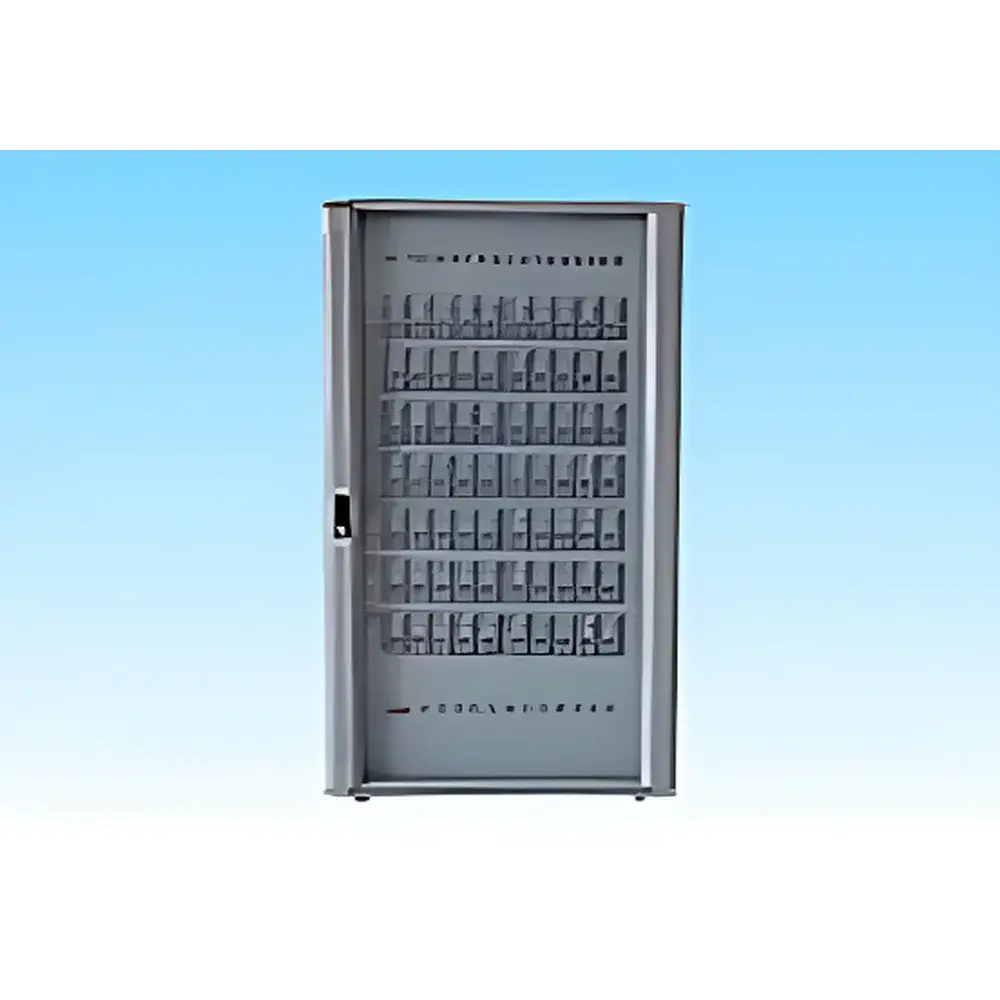
HK-7000 Toxic & Combustible Gas Alarm Controller
| Brand | Huake Instrument |
|---|---|
| Origin | Beijing, China |
| Manufacturer Type | Authorized Distributor |
| Origin Category | Domestic (PRC) |
| Model | HK-7000 |
| Pricing | Available Upon Request |
| Input Signal | 4–20 mA (calibratable within 2–30 mA) |
| Display | 4-digit LED (0–9999), real-time clock (YYYY-MM-DD HH:MM:SS), bar-graph %FS indication |
| Output | RS-485 Modbus RTU digital interface |
| Relay Outputs | SPST dry contact, rated AC220V/3A or DC24V/3A |
| Operating Temperature | 0–70 °C |
| Relative Humidity | ≤93% RH (non-condensing) |
| Data Retention | Non-volatile memory with power-loss-proof event logging (“black box”) |
| Enclosure Options | Wall-mounted unit or modular rack-mount cabinet (10–60 channels) |
| Dimensions (Unit) | 80 × 210 × 60 mm (W × H × D) |
Overview
The HK-7000 Toxic & Combustible Gas Alarm Controller is a centralized monitoring and alarm management system engineered for continuous, reliable supervision of multi-point gas detection networks in industrial, utility, and facility safety applications. It operates on the principle of analog signal aggregation—receiving standardized 4–20 mA current loop outputs from certified toxic gas (e.g., CO, H₂S, Cl₂, NH₃) and combustible gas (e.g., CH₄, LEL hydrocarbons) transmitters—and converting them into actionable status information, visual indicators, and relay-triggered safety responses. Designed for integration into broader process safety systems (PSS), the controller supports scalable deployment from compact wall-mounted configurations to fully modular rack-mount cabinets accommodating up to 60 independent detection channels. Its architecture complies with fundamental functional safety expectations for non-SIL-certified alarm annunciators per IEC 61508 and aligns with operational requirements outlined in OSHA 1910.120 (HAZWOPER) and NFPA 72 (National Fire Alarm and Signaling Code) for fixed gas detection system interfaces.
Key Features
- Scalable channel capacity: Configurable for 10 to 60 detector inputs via modular cabinet integration or standalone wall-mount unit
- Dual-stage audible and visual alarm activation with configurable thresholds and latching behavior for both first- and second-level alerts
- Real-time clock with date/time stamping (YYYY-MM-DD HH:MM:SS) applied to all alarm events and operator actions
- Non-volatile “black box” memory: Stores minimum 10,000 event records—including alarm entries, relay actuations, sensor faults, and manual acknowledgments—with retention unaffected by power interruption
- Redundant output modalities: 4-digit LED numeric display, linear bar-graph (%FS) visualization, RS-485 Modbus RTU serial communication, and isolated dry-contact relay outputs (AC220V/3A or DC24V/3A)
- Wide-range analog input tolerance: Accepts and validates 4–20 mA signals; full-scale calibration support extends to 2–30 mA for compatibility with legacy or specialty transmitters
- Environmental resilience: Rated for operation at 0–70 °C ambient temperature and up to 93% RH (non-condensing), suitable for control rooms, switchgear enclosures, and mechanical utility spaces
Sample Compatibility & Compliance
The HK-7000 interfaces exclusively with 4–20 mA analog-output gas detectors compliant with IEC 60079-29-1 (toxic gases) and IEC 60079-29-2 (combustible gases). It does not perform direct gas measurement but serves as a certified signal conditioning, alarming, and supervisory node within a larger gas detection ecosystem. While the controller itself is not SIL-rated, its deterministic response timing (<500 ms typical alarm propagation latency), hardware watchdog circuitry, and EEPROM-based event logging support adherence to GLP-aligned data integrity practices. The device meets CE marking requirements for EMC Directive 2014/30/EU and Low Voltage Directive 2014/35/EU. All relay outputs are rated per IEC 61810-1 for industrial control applications.
Software & Data Management
Data acquisition and archival are handled internally without external software dependency. Event logs—including timestamped alarms, acknowledged states, sensor fault codes, and user-initiated resets—are stored in cyclic non-volatile memory with automatic overwrite protection for critical entries. The RS-485 interface supports Modbus RTU protocol (slave ID configurable, baud rates 9.6–115.2 kbps), enabling seamless integration with SCADA systems, DCS historian modules, or third-party HMI platforms. No proprietary drivers or cloud connectivity are required; configuration is performed locally via front-panel keypad navigation. Audit trails comply with basic ALCOA+ principles (Attributable, Legible, Contemporaneous, Original, Accurate) for routine environmental health and safety (EHS) reporting.
Applications
- Centralized monitoring of distributed gas sensors in boiler rooms, compressor stations, and chemical storage areas
- Alarm annunciation and interlock triggering for ventilation shutdown, emergency purge sequencing, or fire suppression activation
- Regulatory compliance support for EPA 40 CFR Part 63 Subpart SS (fugitive emissions monitoring) and OSHA PSM-covered processes
- Utility infrastructure protection: natural gas distribution hubs, LNG terminals, and wastewater treatment biogas handling zones
- Facility-wide ambient air quality surveillance in pharmaceutical manufacturing clean utilities and semiconductor fab support areas
FAQ
Does the HK-7000 perform gas concentration measurement?
No—it is a signal aggregation and alarm management controller only. Gas concentration values must be provided by externally installed, certified 4–20 mA transmitters.
Can historical alarm data be exported to a PC?
Yes, via RS-485 Modbus RTU using standard polling commands; raw event log entries (timestamp, channel ID, event type, duration) are accessible as discrete holding registers.
Is the cabinet-mounted version supplied with pre-wired detector channels?
No—cabinet units are delivered as empty modular frames with backplane bus wiring; field-installed HK-7000 controller modules and associated terminal blocks are added per project specification.
What is the maximum cable length supported between the controller and remote transmitters?
Up to 1,200 meters with 1.5 mm² shielded twisted-pair cable under standard 24 VDC loop power conditions, assuming ≤250 Ω total loop resistance.
Does the device support HART communication?
No—only native 4–20 mA analog input and RS-485 Modbus RTU digital output are implemented; HART-enabled devices require external signal converters.







