
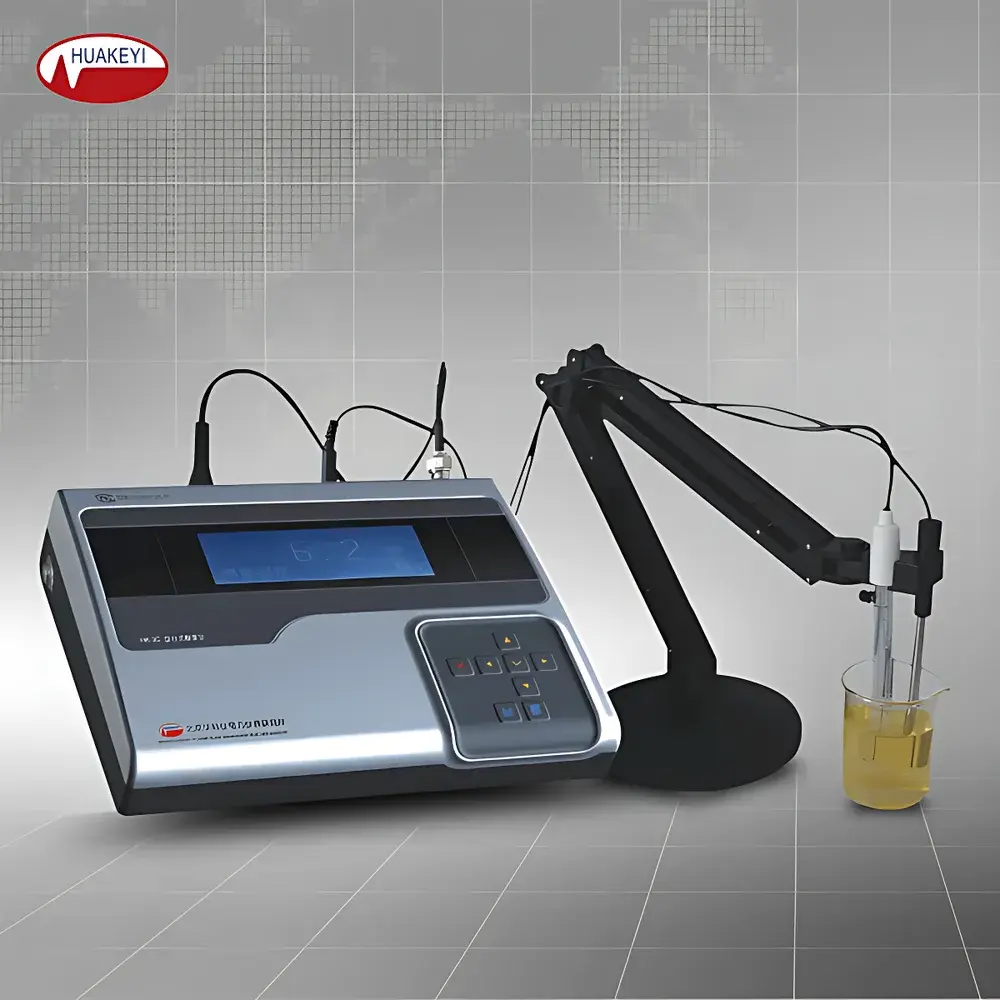
Huake Instrument HK-3C Benchtop Precision pH Meter
| Brand | Huake Instrument |
|---|---|
| Origin | Beijing, China |
| Model | HK-3C |
| Instrument Type | Benchtop |
| Parameter Type | Single-parameter (pH) |
| Measurement Range | 0.00–14.00 pH |
| Resolution | 0.01 pH |
| Accuracy | ±0.02 pH |
| Calibration Solutions | GB/T 604–2002 compliant standard buffers (pH 4.00, 6.86, 9.18 at 25 °C) |
| Temperature Compensation | Automatic or manual (0.1–60.0 °C) |
| Input Impedance | ≥1 × 10¹² Ω |
| Response Time (T₉₀) | ≤60 s at 25 °C |
| Display | 192 × 64 dot-matrix LCD (switchable Chinese/English) |
| Power Supply | AC 100–240 V, 50–60 Hz |
| Power Consumption | 3 W |
| Dimensions | 270 × 200 × 65 mm (L × W × H) |
| Weight | 1.5 kg |
Overview
The Huake Instrument HK-3C Benchtop Precision pH Meter is a laboratory-grade electrochemical analyzer engineered for high-reproducibility pH measurement in aqueous solutions. Based on potentiometric principle using a glass electrode–reference electrode system, the instrument measures the electromotive force (EMF) generated across the pH-sensitive glass membrane relative to a stable reference potential. This EMF is converted into pH units via the Nernst equation (−59.16 mV/pH at 25 °C), with built-in temperature compensation ensuring thermodynamic accuracy across operational ranges. Designed for routine QC, process monitoring, and academic teaching, the HK-3C meets the performance requirements of ISO 7888, ASTM D1293, and GB/T 604–2002 for pH determination in water and dilute electrolyte solutions.
Key Features
- 32-bit embedded microcontroller architecture with surface-mount technology (SMT) for enhanced signal stability and long-term drift control
- IP65-rated reinforced plastic housing with full silicone membrane overlay keypad—resistant to splashes, dust, and routine lab chemical exposure
- Dual-language (English/Chinese) 192 × 64 dot-matrix LCD display with configurable parameter layout: simultaneous readout of pH value, temperature, electrode status, calibration progress, and stability indicator
- Auto-stability detection algorithm (Auto-Calibration Judge) confirms endpoint convergence before finalizing calibration—eliminating subjective interpretation of electrode equilibration
- BNC-compatible input interface supporting standardized pH electrodes (including optional 2503D-C low-conductivity probe and 201-C general-purpose electrode)
- Integrated Pt1000 temperature sensor with ±0.5 °C accuracy over 0.0–99.9 °C range; supports both automatic (ATC) and manual (MTC) compensation modes
- Input impedance ≥1 × 10¹² Ω minimizes loading error during high-resistance measurements (e.g., deionized water, ethanol-water mixtures)
Sample Compatibility & Compliance
The HK-3C is validated for use with aqueous samples having conductivity ≥20 µS/cm and temperature between 5 °C and 60 °C. It complies with national metrological verification regulation JJG 119–2018 (Laboratory pH Meters) and conforms to electromagnetic compatibility standards GB/T 18268.1–2010 (IEC 61326-1). While not certified for GMP environments per se, its traceable calibration protocol—using GB/T 604–2002–certified buffer sets (pH 4.00, 6.86, 9.18)—supports GLP documentation requirements. The instrument’s design accommodates standard 12-mm diameter laboratory pH electrodes and integrates seamlessly into workflows requiring audit-ready calibration records when paired with external logging software.
Software & Data Management
The HK-3C operates as a standalone instrument with no proprietary PC software included. However, its RS-232 serial output (optional accessory cable) enables ASCII-formatted data streaming—including timestamped pH, temperature, and calibration metadata—to third-party platforms such as LabVIEW, MATLAB, or Excel-based LIMS templates. All internal operations adhere to deterministic real-time scheduling; no background tasks interfere with measurement integrity. Calibration history is retained in non-volatile memory for up to 10 sessions, including date/time stamps, buffer IDs used, slope (%), and asymmetry potential (mV), facilitating internal quality audits without external dependency.
Applications
- Power plant boiler feedwater and condensate pH monitoring per DL/T 912–2016 guidelines
- Process control in beverage production (soft drinks, brewing, dairy)—verifying acidification steps and cleaning-in-place (CIP) rinse neutrality
- Effluent testing in pulp & paper mills under ISO 6387 and TAPPI T 435
- Food safety labs performing AOAC 973.41-compliant acidity titration pre-checks
- University chemistry and environmental science laboratories for undergraduate electrochemistry experiments and calibration methodology training
- Pharmaceutical water systems (PW, WFI) where preliminary pH screening precedes TOC or conductivity validation per USP
FAQ
What calibration standards are required for daily operation?
GB/T 604–2002–certified pH 4.00, 6.86, and 9.18 buffer solutions at 25 °C are recommended for two-point or three-point calibration. Buffers must be freshly prepared or from unopened, shelf-stable ampoules.
Can the HK-3C measure pH in non-aqueous or low-ionic-strength samples?
It is optimized for aqueous solutions ≥20 µS/cm. For ultrapure water (e.g., <1 µS/cm), the optional 2503D-C electrode with double-junction reference system is advised to minimize liquid junction potential errors.
Is temperature compensation mandatory during measurement?
No—manual temperature entry is supported. However, automatic compensation via the integrated Pt1000 sensor is strongly recommended to maintain Nernstian response fidelity across variable sample temperatures.
Does the instrument support FDA 21 CFR Part 11 compliance?
The HK-3C itself does not include electronic signature, audit trail, or user access control features. When connected to validated external data acquisition software with Part 11 functionality, it may serve as a compliant peripheral sensor within a broader regulated system.
What is the expected service life of the included laboratory pH electrode?
Under typical use (≤8 hrs/day, proper storage in 3 M KCl solution), the supplied electrode maintains ±0.02 pH accuracy for 12–18 months. Performance degradation is indicated by slope 90 s.
Related Products





