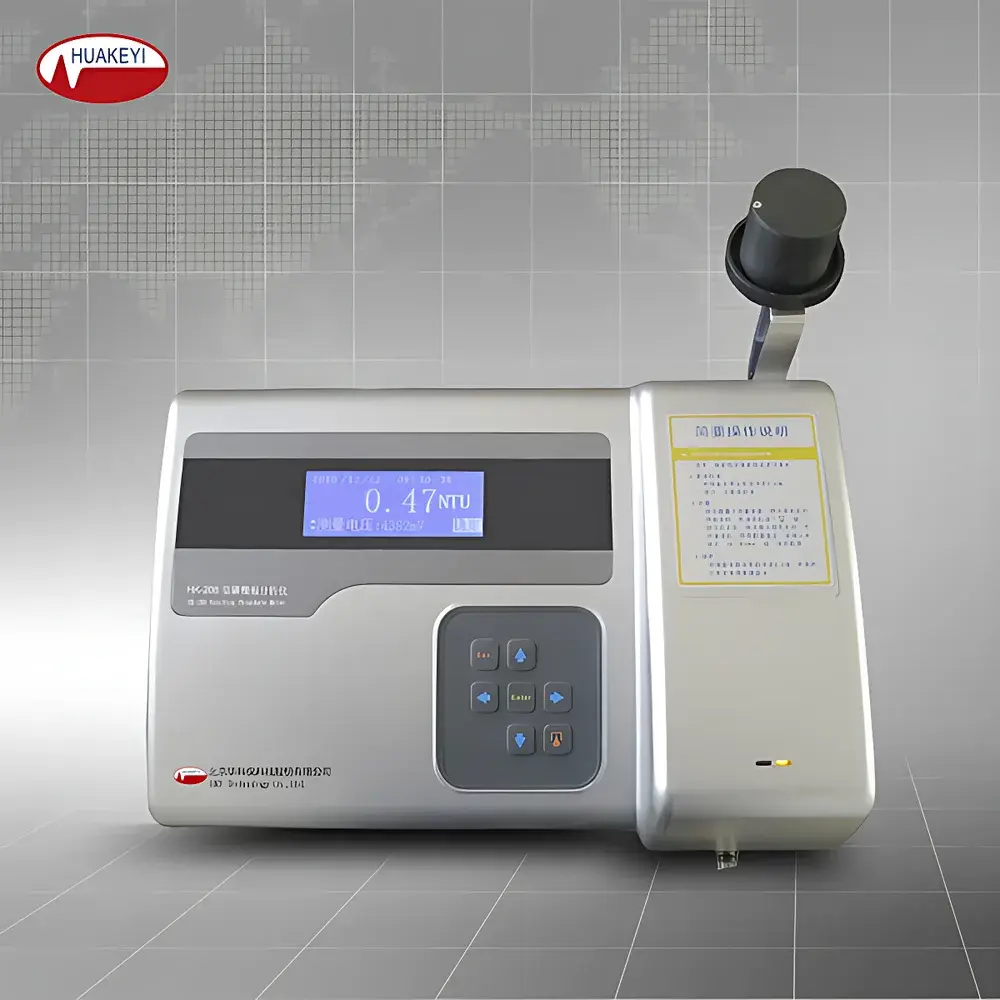
Huake Instrument HK-208 Phosphate Analyzer
| Brand | Huake Instrument |
|---|---|
| Origin | Beijing, China |
| Manufacturer Type | Authorized Distributor |
| Country of Origin | China |
| Model | HK-208 |
| Price | Upon Request |
| Display | 192 × 64 dot-matrix LCD (Chinese/English selectable) |
| Measurement Range | 0–20 mg/L or 0–50 mg/L |
| Resolution | 0.01 mg/L |
| Basic Error | ±2% FS |
| Repeatability | ≤1% |
| Stability | ±1% FS / 4 h |
| Ambient Temperature | 5–45 °C |
| Relative Humidity | ≤90% RH (non-condensing) |
| Power Supply | AC 100–240 V, 50–60 Hz |
| Power Consumption | 40 W |
| Dimensions (L×W×H) | 392 × 260 × 100 mm |
| Weight | 5 kg |
Overview
The Huake Instrument HK-208 Phosphate Analyzer is a benchtop photometric analyzer engineered for continuous or periodic determination of orthophosphate (PO₄³⁻) concentration in aqueous process streams. It operates on the principle of molybdenum blue spectrophotometry—where phosphate reacts with ammonium molybdate and ascorbic acid under acidic conditions to form a stable phosphomolybdenum blue complex, quantified at a fixed wavelength (typically ~880 nm) using a precision single-beam optical system. Designed for industrial water quality monitoring, the instrument delivers high reproducibility in demanding environments including boiler feedwater, condensate, cooling tower systems, pulp & paper effluents, and municipal wastewater treatment influents. Its optical architecture features a temperature-stabilized imported cold-light monochromatic source and a matched high-sensitivity photodiode detector, minimizing drift and enabling long-term unattended operation.
Key Features
- 32-bit embedded microcontroller platform with surface-mount technology (SMT) and fully integrated mechanical-electrical design for enhanced reliability and EMI immunity
- Rugged IP65-rated waterproof enclosure with full silicone membrane keypad—optimized for humid, dusty, or splash-prone industrial settings
- Patented fuzzy PID-based thermostatic control for the colorimetric reaction chamber, maintaining ±0.2 °C stability over extended cycles to ensure consistent chromogenic kinetics
- Zero-reagent calibration protocol: uses only deionized water (blank) for full-scale zero and span verification—eliminating reagent lot variability and reducing consumable dependency
- Multi-point calibration curve selection (up to 5 points): supports user-defined non-linear response mapping per application matrix (e.g., high-turbidity vs. low-conductivity samples)
- Role-based access control with configurable password protection (operator/admin levels) to prevent unauthorized parameter modification or data deletion
- Internal non-volatile memory stores ≥10,000 timestamped measurement records; supports chronological or event-triggered recall with export-ready formatting
Sample Compatibility & Compliance
The HK-208 accepts clarified liquid samples with turbidity <5 NTU and suspended solids <10 mg/L. It is compatible with standard 10-mm pathlength cuvettes and accommodates direct flow-through sampling via optional peristaltic pump interface. The analyzer complies with ISO 6878:2004 (Water quality — Determination of phosphorus — Ammonium molybdate spectrophotometric method) and aligns with ASTM D515-88 (Standard Test Method for Phosphorus in Water). Its firmware architecture supports audit-trail logging required under GLP environments, and configuration parameters are protected against accidental reset per IEC 61508 functional safety guidelines for measurement instrumentation.
Software & Data Management
Data acquisition and system configuration are managed through the onboard LCD interface with bilingual (English/Chinese) menu navigation. All calibration coefficients, alarm thresholds, and sample ID tags are stored with time/date stamps and operator IDs. Measurement logs include raw absorbance values, calculated concentrations, temperature readings, and diagnostic flags (e.g., low signal, heater timeout). Optional RS-485 Modbus RTU output enables integration into SCADA or DCS platforms. No proprietary PC software is required; exported CSV files conform to ASTM E1382-99 standards for analytical data interchange.
Applications
- Power generation: real-time phosphate monitoring in drum boiler feedwater to prevent scale formation and maintain AVT/R/OAT chemistry control
- Petrochemical refining: corrosion inhibitor dosage verification in overhead condensate systems
- Pulp and paper mills: optimization of phosphate-based biocide dosing in white water circuits
- Municipal water treatment: compliance tracking for discharge permits under EPA 40 CFR Part 136
- Pharmaceutical manufacturing: purified water (PW) and water-for-injection (WFI) system surveillance per USP
FAQ
What is the recommended maintenance interval for the optical path?
Optical window cleaning is advised every 30 days in high-dust environments; full photometric validation using NIST-traceable phosphate standards is recommended quarterly.
Can the HK-208 be connected to a central monitoring system?
Yes—via isolated RS-485 interface supporting Modbus RTU protocol (addressable slave mode, baud rates 9600–115200 bps).
Does the analyzer support automatic temperature compensation?
Yes—integrated PT100 sensor continuously monitors reaction block temperature and applies algorithmic correction to absorbance-to-concentration conversion.
Is the instrument suitable for outdoor installation?
It is rated IP65 for indoor or sheltered outdoor use; direct sunlight exposure and ambient temperatures below 5 °C or above 45 °C are not supported.
How is traceability ensured during calibration?
Each calibration event logs operator ID, timestamp, blank/scale reference values, and deviation from prior baseline—enabling full traceability per ISO/IEC 17025 requirements.