
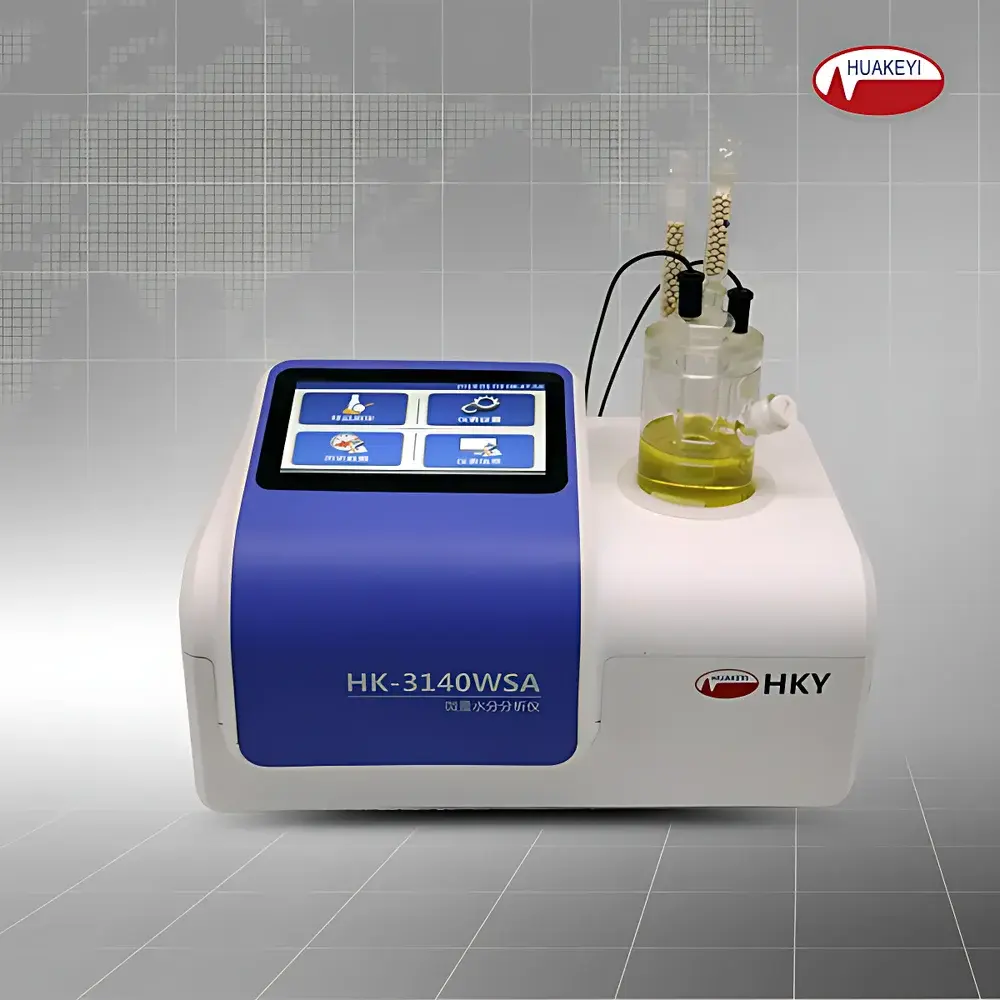
HK-3140WSA Coulometric Karl Fischer Moisture Analyzer by Huake Instrument
| Brand | Huake Instrument |
|---|---|
| Origin | Beijing, China |
| Model | HK-3140WSA |
| Measurement Principle | Coulometric Karl Fischer Titration |
| Detection Range | 1 μg – 200 mg H₂O |
| Resolution | 0.1 μg |
| Accuracy | ±2 μg (3–1000 μg), ±0.3% RSD (>1 mg H₂O) |
| Electrolysis Current | 0–400 mA |
| Electrolysis Rate | 2.2 mg/min (37 μg/s) |
| Display | 800×480 Color TFT Touchscreen (Bilingual: English/Chinese) |
| Data Storage | 500 Time-Stamped Records |
| Connectivity | USB 2.0, RJ-45 Ethernet (LIMS-Compatible), RS-232 (Printer Optional) |
| Power Supply | 100–240 VAC, 50/60 Hz |
| Dimensions | 400 × 260 × 240 mm (L×W×H) |
| Weight | ~2 kg |
| Compliance | Designed for ASTM D6304, ISO 12937, USP <921>, and GLP/GMP-aligned laboratory workflows |
Overview
The HK-3140WSA Coulometric Karl Fischer Moisture Analyzer is a precision laboratory instrument engineered for trace water quantification in liquid, solid, and gaseous samples using the coulometric variant of the Karl Fischer (KF) titration method. Unlike volumetric KF systems, this analyzer generates iodine electrochemically at the anode via controlled constant-current electrolysis—eliminating reagent standardization and enabling superior accuracy at sub-microgram levels. The reaction follows the stoichiometric principle defined by Faraday’s law: one mole of iodine (I₂) reacts with one mole of water (H₂O), requiring 2 × 96,493 C (192,986 C) per mole of water. By integrating real-time current monitoring and precise charge integration over time, the HK-3140WSA calculates absolute water mass directly from total coulombs consumed. Its design emphasizes metrological integrity, low baseline drift, and robust endpoint detection—critical for applications where moisture content below 10 ppm significantly impacts product stability, shelf life, or regulatory compliance.
Key Features
- Coulometric detection with programmable constant-current electrolysis (0–400 mA), optimized for high sensitivity and reproducibility across ultra-low moisture ranges (1 μg–200 mg H₂O)
- High-fidelity dual-platinum electrode system with adaptive endpoint discrimination—resistant to electrical noise, solvent polarity shifts, and sample matrix interferences
- 800 × 480 color TFT touchscreen interface supporting bilingual (English/Chinese) operation, intuitive navigation, and context-sensitive parameter guidance
- Automated blank current subtraction and dynamic drift compensation algorithms to minimize systematic error from reagent aging or ambient humidity ingress
- Five-step adjustable magnetic stirring speed (200–1200 rpm) with optional disposable syringes and sterile needles—enabling rapid sample turnover without cross-contamination
- Comprehensive self-diagnostic suite: real-time monitoring of measuring electrode open/short circuits, electrolysis cell anomalies, and power supply instability
- Integrated data management: 500 timestamped measurement records stored locally with searchable filters by date range, sample ID, or operator name
Sample Compatibility & Compliance
The HK-3140WSA accommodates diverse sample matrices—including hydrocarbons (e.g., transformer oil, jet fuel), polar solvents (acetonitrile, methanol), pharmaceutical excipients (lactose, microcrystalline cellulose), polymers, gases (SF₆, natural gas), and lyophilized biologics—without modification to core hardware. All measurements adhere to internationally recognized standards: ASTM D6304 (coulometric KF for petroleum products), ISO 12937 (water determination in crude oil), and USP (water content in pharmaceuticals). The instrument’s architecture supports audit-trail-ready operation when connected to LIMS via its native RJ-45 Ethernet port, satisfying FDA 21 CFR Part 11 requirements for electronic records and signatures when deployed within validated environments. Environmental operating specifications (5–35 °C, ≤85% RH, non-corrosive atmosphere) align with ISO/IEC 17025 laboratory accreditation criteria.
Software & Data Management
Data handling is performed through embedded firmware—not external PC software—ensuring deterministic response times and eliminating version dependency risks. Measurement logs include full metadata: sample ID, operator ID, start/end timestamps, integrated charge (C), calculated water mass (μg), relative standard deviation (RSD), and raw electrode potential traces. Export is supported via USB mass storage mode (CSV format) or network transfer to centralized LIMS servers using standard TCP/IP protocols. RS-232 serial output enables direct connection to thermal printers for GLP-compliant hard-copy reporting. Firmware updates are delivered via USB stick, preserving configuration integrity and minimizing downtime during calibration or regulatory maintenance cycles.
Applications
This analyzer serves critical quality control and R&D functions across regulated industries. In power generation, it verifies moisture content in insulating oils per IEC 60814 to prevent dielectric breakdown. In petrochemical refining, it monitors hydrotreating catalyst beds and pipeline transport streams for corrosion risk mitigation. Pharmaceutical labs use it to validate lyophilization endpoints and assess excipient dryness prior to tablet compression—directly impacting dissolution kinetics and microbial stability. Chemical manufacturers rely on its repeatability for QC of monomers (e.g., vinyl chloride, epichlorohydrin) where residual water triggers premature polymerization. Additionally, semiconductor-grade solvents and battery electrolyte formulations require sub-10 ppm verification—precisely within the HK-3140WSA’s validated operational envelope.
FAQ
What is the minimum detectable water mass, and how is detection limit verified?
The instrument achieves a resolution of 0.1 μg H₂O, with verified lower limit of quantitation (LLOQ) at 1 μg under ISO 11843-2 conditions using repeated injections of certified 1000 ppm water-in-methanol standard.
Can the analyzer be used for gas-phase moisture analysis?
Yes—when paired with an optional gas sampling kit (including permeation dryer, flow controller, and absorption trap), it complies with ASTM D7443 for moisture in compressed gases.
Is the system compliant with FDA 21 CFR Part 11 for electronic records?
The device supports Part 11 requirements—including user authentication, audit trails, and electronic signatures—when integrated into a validated LIMS environment via its RJ-45 interface and configured with appropriate access controls.
How frequently must the electrolyte be replaced, and what indicators signal degradation?
Typical reagent lifetime is 50–100 coulombs depending on ambient humidity and sample load; the system alerts users when background current exceeds 0.5 μA or endpoint stabilization time increases beyond 60 seconds.
Does the instrument support multi-point calibration or only single-point verification?
It performs single-point verification using certified water standards; multi-point linearity assessment is conducted offline via spreadsheet-based regression of measured vs. theoretical water mass across five concentrations (1–100 μg).
Related Products





