
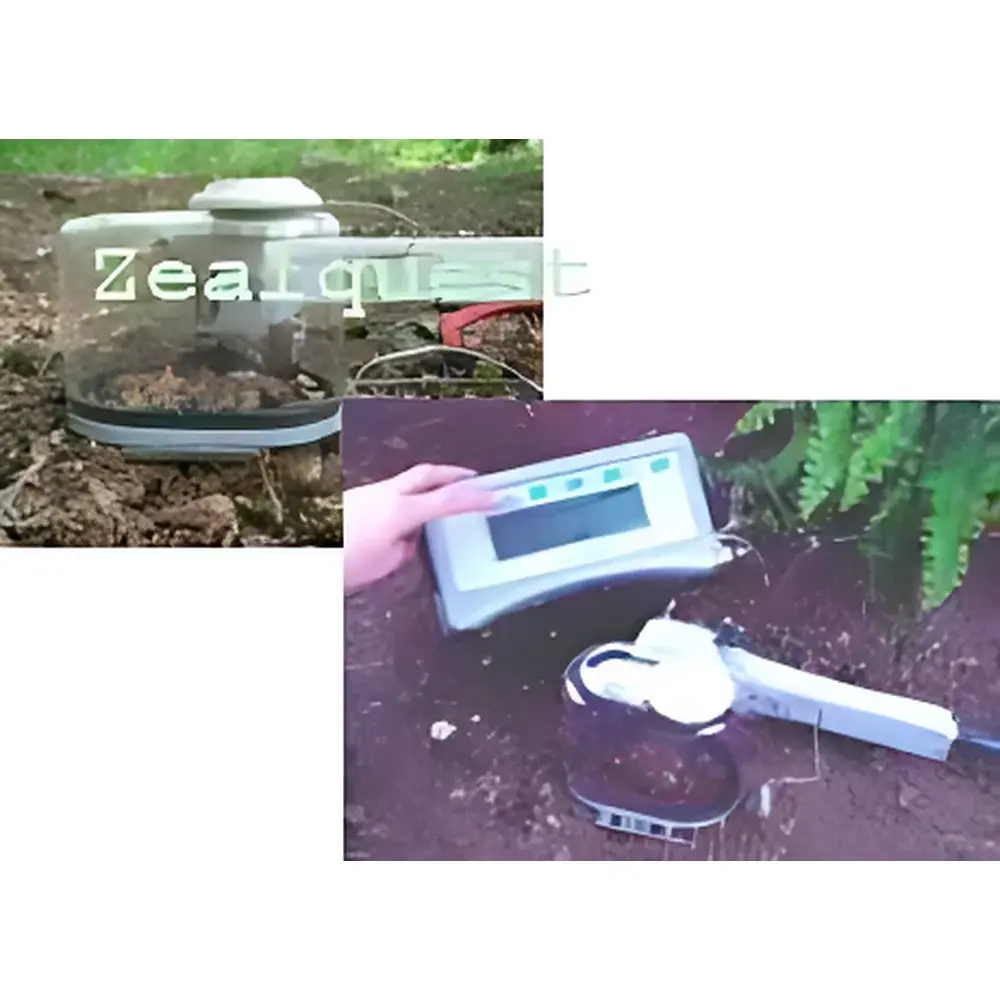
ADC BioScientific SRS2000 Portable Soil Respiration Measurement System
| Origin | United Kingdom |
|---|---|
| Manufacturer Type | Authorized Distributor |
| Import Status | Imported |
| Model | SRS2000 |
| Pricing | Available Upon Request |
Overview
The ADC BioScientific SRS2000 Portable Soil Respiration Measurement System is a field-deployable, closed-path gas exchange instrument engineered for high-temporal-resolution quantification of soil CO2 efflux under natural environmental conditions. It operates on the principle of non-dispersive infrared (NDIR) spectroscopy, with a miniature, integrated CO2 analyzer mounted directly inside a 1 L stainless-steel soil chamber—minimizing gas transport lag and eliminating sampling line artifacts. The system functions in open-loop mode: ambient air is continuously drawn through the chamber at regulated flow rates (100–500 mL/min), ensuring minimal perturbation to in-situ soil microclimate while maintaining atmospheric pressure equilibrium via a calibrated pressure relief valve. This architecture supports robust, reproducible measurements of net soil respiration (Rs) across heterogeneous terrain, with simultaneous acquisition of chamber temperature, soil temperature, photosynthetically active radiation (PAR), and water vapor partial pressure—enabling environmental normalization of flux data per established eddy covariance and chamber-based protocols (e.g., ISO 16634, ASTM D5988-22).
Key Features
- Integrated NDIR CO2 analyzer with 0–2000 ppm range, 1 ppm resolution, and <0.1% RSD at 350 ppm; temperature drift compensation <0.05% FS/°C
- Dual fast-response capacitive humidity sensors (0–75 mbar, 0.1 mbar resolution; ±0.5% RSD)
- Chamber-integrated thermocouples for both chamber air (0–50°C, ±1.5%) and inserted soil temperature (0–50°C, ±1.5%)
- PAR sensor (0–3000 μmol·m−2·s−1) using calibrated silicon photodiode
- Modular chamber design: elliptical 1 L stainless-steel headspace (11 × 85 × 145 mm) with removable metal collar for minimal soil disturbance during insertion
- Onboard graphical LCD (240 × 60 pixel) with real-time CO2 flux curve visualization and automatic calculation of µmol·m−2·s−1 flux rates
- Internal 12 V / 6.8 Ah sealed lead-acid battery supporting >16 h continuous operation; 5 min warm-up time at 20°C
Sample Compatibility & Compliance
The SRS2000 accommodates diverse soil types—including sandy, loamy, clay-rich, and organic-rich substrates—without requiring pre-conditioning or substrate homogenization. Its low-mass chamber (190 g) and shallow-insertion collar minimize mechanical compaction and root zone disruption, preserving biogeochemical integrity during repeated measurements. For multi-point spatial surveys, up to 12 auxiliary collars can be pre-installed across a site, enabling rapid chamber relocation and standardized deployment intervals. Data acquisition complies with GLP-aligned field documentation requirements: timestamped, location-tagged (via optional GPS integration), and traceable to instrument calibration certificates (CO2 and H2O sensors certified annually per ISO/IEC 17025 procedures). All firmware and data logging routines support audit-ready metadata embedding, satisfying foundational elements of FDA 21 CFR Part 11 for environmental monitoring applications requiring regulatory submission.
Software & Data Management
Data are stored onboard in non-volatile 512 KB RAM (expandable to 1 MB), accommodating up to 8,000 complete measurement cycles with full parameter sets (CO2, H2O, Tchamber, Tsoil, PAR, flow rate, flux rate, timestamp). Raw and processed data export via RS-232 serial interface (up to 38,400 baud) to PC-based analysis platforms such as Excel, MATLAB, or custom Python workflows. ADC’s proprietary SRS-Log software (Windows-compatible) enables batch calibration validation, flux curve fitting (linear/non-linear regression), temperature response modeling (Q10 derivation), and automated outlier rejection based on flow stability thresholds. Export formats include CSV and ASCII, facilitating ingestion into long-term ecological research databases (e.g., NEON, LTER) and IPCC Tier 2 soil carbon inventory frameworks.
Applications
- Soil carbon cycling studies: diel and seasonal Rs dynamics, priming effect quantification, and climate-warming response experiments
- Agroecosystem monitoring: pesticide impact assessment on microbial respiration, cover crop decomposition kinetics, and tillage effect evaluation
- Restoration ecology: post-disturbance soil metabolic recovery tracking and mycorrhizal activity screening
- Urban soil science: contaminant bioavailability mapping via respiratory inhibition assays
- Flux network integration: compatibility with multiplexer systems for unattended multi-chamber deployments over 72+ hour periods
- Photosynthesis extension: interchangeable leaf chambers transform the platform into a portable photosynthetic gas exchange system (A/Ci curves, light response, stomatal conductance)
FAQ
What is the minimum detectable CO2 flux resolution under field conditions?
The system achieves effective flux detection limits of ~0.05 µmol·m−2·s−1 when operated at 200 mL/min flow with 60-second measurement intervals, validated against certified permeation sources per ISO 16634 Annex B.
Can the SRS2000 operate in saturated or flooded soils?
Yes—the chamber seal and pressure relief valve prevent water ingress during short-term deployments; however, extended use in standing water requires optional hydrophobic membrane filters on inlet/outlet lines.
Is firmware update capability supported in the field?
Firmware updates are performed via RS-232 connection using ADC-provided utilities; no internet connectivity is required, ensuring secure operation in remote locations.
How is temperature compensation applied to CO2 readings?
Real-time chamber temperature is measured by dual thermocouples; NDIR signal correction uses factory-determined polynomial coefficients embedded in firmware, traceable to NPL (UK) calibration standards.
Does the system meet requirements for peer-reviewed publication data?
Yes—its metrological traceability, documented uncertainty budgets (<±3.2% combined standard uncertainty for Rs), and adherence to chamber methodology best practices (Luo et al., 2013; Janssens et al., 2020) make it suitable for high-impact journal submissions.
Related Products







