
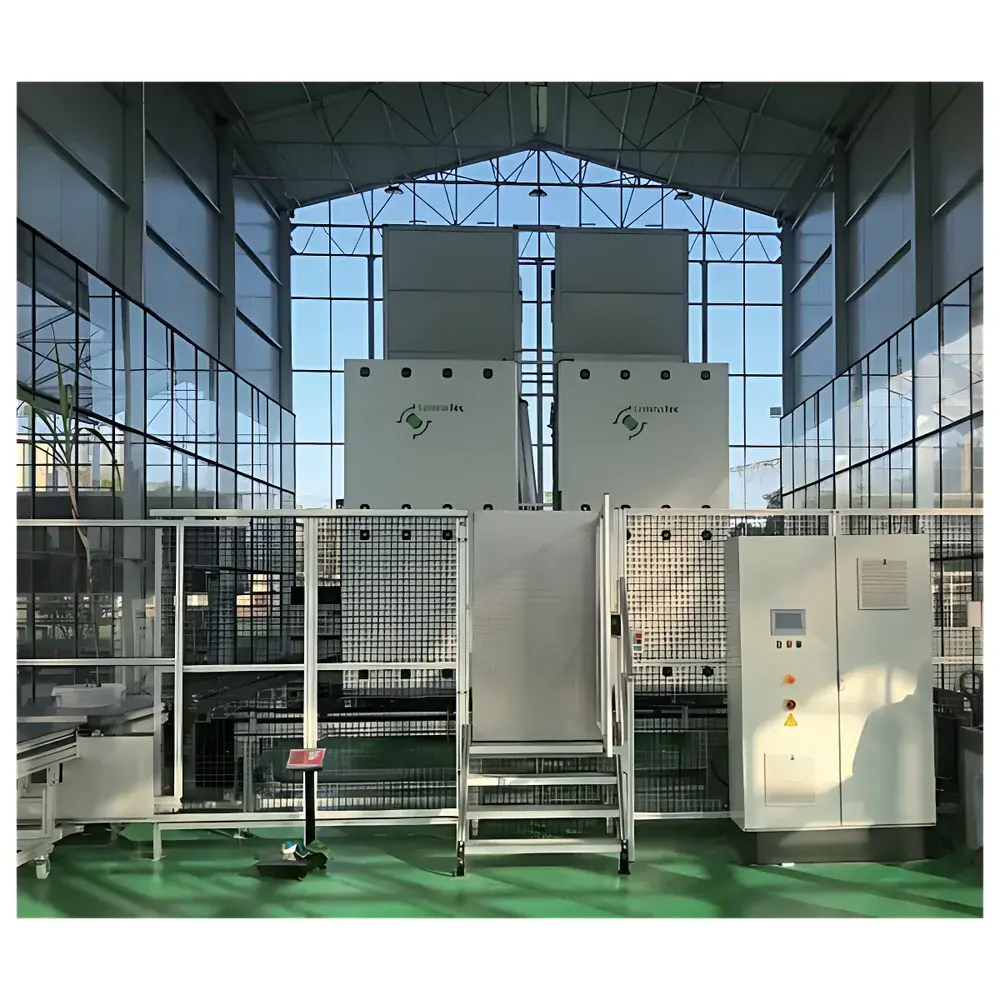
LemnaTec PhenoAIxpert HT Greenhouse-Based High-Throughput Plant Phenotyping Imaging System
| Brand | LemnaTec |
|---|---|
| Origin | Germany |
| Model | PhenoAIxpert HT |
| Imaging Modalities | VIS, NIR, IR, PSII Fluorescence, Autofluorescence, Root VIS, Laser 3D, Hyperspectral (400–1700 nm) |
| Automation | Fully Automated Conveyor Transport System (8–30 kg capacity) |
| Dark Chambers | Dedicated for VIS, Chlorophyll Fluorescence & NIR modules |
| Rotational Sample Stage | 360° motorized pot rotation with software-defined angular resolution |
| Environmental Isolation | Pneumatic airlock doors between cultivation and imaging zones |
| Data Infrastructure | Local server storage with LemnaBase database architecture |
| Software Suite | LemnaControl (hardware orchestration), LemnaGrid (graphical image processing pipeline), LemnaMiner (statistical analysis & export), Remote Management Module (web-based monitoring & protocol adjustment) |
| Compliance Framework | Designed for GLP-aligned experimental workflows |
Overview
The LemnaTec PhenoAIxpert HT is a modular, greenhouse-integrated high-throughput plant phenotyping imaging system engineered for non-invasive, longitudinal, multi-modal characterization of intact plants—from seedling emergence through reproductive maturity. It operates on the principle of spatially resolved, quantitative optical sensing across complementary spectral domains, enabling simultaneous extraction of structural, physiological, biochemical, and thermal traits. Unlike benchtop or field-deployed systems, the PhenoAIxpert HT is purpose-built for controlled-environment agriculture (CEA) and translational plant science, where environmental stability, reproducible sample handling, and temporal consistency are prerequisites for genotype-by-environment (G×E) studies. Its architecture integrates synchronized hardware control, standardized illumination geometries, calibrated spectral acquisition, and traceable metadata capture—ensuring data integrity across thousands of samples per day while maintaining biological relevance under near-natural growth conditions.
Key Features
- Modular imaging suite supporting eight concurrent modalities: visible-light (VIS), near-infrared (NIR), infrared (IR), PSII chlorophyll fluorescence, autofluorescence, root-system visible imaging, laser-based 3D point-cloud acquisition, and hyperspectral reflectance (400–1700 nm).
- Dedicated dark chambers for VIS, chlorophyll fluorescence, and NIR modules—each equipped with precision-controlled LED arrays, programmable exposure timing, and active thermal management to minimize sensor drift.
- Motorized 360° rotational stage integrated into each pot carrier, enabling multi-angle acquisition without manual repositioning; angular increments configurable in 1° steps via LemnaControl.
- Integrated conveyor transport system with RFID-tagged carriers, pneumatic airlock doors, and load-rated options (8–30 kg) to maintain thermal and humidity continuity between cultivation and imaging zones.
- Laser 3D scanner mounted on a robotic arm for circumferential scanning, yielding dense, georeferenced point clouds suitable for volumetric reconstruction, canopy architecture modeling, and dynamic growth quantification.
- Hyperspectral module featuring stabilized halogen illumination, motorized grating spectrometer, and real-time radiometric calibration—enabling calculation of vegetation indices (NDVI, RVI, GVI), pigment ratios (RAnth/RChl), water content proxies, and tissue-level biochemical estimates.
- Root imaging subsystem designed in collaboration with IPK Gatersleben, utilizing angled root boxes and soil-permeable imaging windows for in situ, non-destructive root architecture analysis under native substrate conditions.
Sample Compatibility & Compliance
The PhenoAIxpert HT accommodates standard horticultural containers (e.g., 10–20 cm pots) filled with diverse substrates including peat-perlite mixes, hydroponic media, and field soil analogs. It supports monocots and dicots across developmental stages—from germination trays to mature cereal stands—with optional height-extension kits for tall-stature crops (e.g., maize, sorghum). All imaging protocols adhere to internationally recognized standards for optical measurement repeatability: illumination uniformity is validated per ISO 9001:2015 Annex A.2, spectral response curves are traceable to NIST SRM 2035, and fluorescence kinetics comply with the Minimum Fluorescence Protocol defined in JIP-test guidelines (Strasser et al., 2004). The system’s metadata schema conforms to the MIAPPE v1.1 specification, facilitating FAIR data principles implementation and interoperability with ELIXIR Plant Sciences infrastructure.
Software & Data Management
Data acquisition, storage, and analysis are governed by a tightly coupled software ecosystem. LemnaControl orchestrates hardware sequencing—including conveyor movement, dark-chamber door actuation, illumination ramping, camera triggering, and irrigation/weighting cycles—with millisecond-level synchronization. All raw images and metadata are ingested into LemnaBase, a PostgreSQL-backed relational database supporting ACID transactions, versioned experiment schemas, and role-based access control. LemnaGrid provides a drag-and-drop interface for constructing reproducible image-processing pipelines—supporting segmentation, morphometrics, intensity profiling, and registration across modalities. LemnaMiner delivers statistical summarization, ANOVA-ready output tables, PCA biplots, and exports in CSV, HDF5, and MIAME-compliant formats. Audit trails—including user actions, parameter changes, and instrument calibration logs—are retained for ≥10 years in accordance with FDA 21 CFR Part 11 requirements for electronic records.
Applications
The PhenoAIxpert HT serves as a foundational platform for quantitative plant science across academic, breeding, and agrochemical sectors. In drought physiology research, synchronized IR+NIR acquisition enables direct correlation of leaf temperature gradients with water status maps, supporting mechanistic modeling of stomatal conductance and transpiration efficiency. In photosynthetic phenotyping, PSII fluorescence parameters (Fv/Fm, ΦPSII, NPQ, ETR) are extracted from time-resolved induction curves under controlled light ramps, allowing discrimination of photoprotective capacity across genetic lines. Hyperspectral datasets feed supervised machine learning models trained to predict nitrogen use efficiency or disease susceptibility prior to symptom onset. For root biology, the dedicated root imaging module generates high-resolution trait sets—including lateral root density, branching angle distribution, and gravitropic deviation—under ecologically relevant soil constraints. Longitudinal 3D reconstructions quantify allometric shifts during stress recovery, while autofluorescence kinetics provide early biomarkers of senescence progression.
FAQ
What is the maximum throughput capacity of the PhenoAIxpert HT system?
Throughput is configurable based on greenhouse footprint and experimental design; typical deployment achieves 500–2,000 plants per day depending on imaging modality combinations and dwell times per sample.
Can the system be retrofitted with additional imaging modules after installation?
Yes—the mechanical and software architecture is fully modular; new sensors (e.g., UV fluorescence, thermal IR with higher resolution) can be integrated via standardized mounting interfaces and LemnaControl plugin framework.
Does the system support integration with external environmental control systems?
It includes OPC UA and Modbus TCP interfaces for bidirectional communication with HVAC, irrigation, and lighting controllers, enabling closed-loop environmental perturbation experiments.
How is calibration maintained across long-term deployments?
Each imaging module incorporates automated daily calibration routines using reference targets (e.g., Spectralon panels, ND filters, thermal blackbodies); calibration logs are embedded in every image header and archived in LemnaBase.
Is remote troubleshooting and software update capability available?
Yes—LemnaTec’s Secure Remote Access Gateway permits encrypted, permissioned access for diagnostics, firmware updates, and protocol optimization without compromising local network security policies.





