
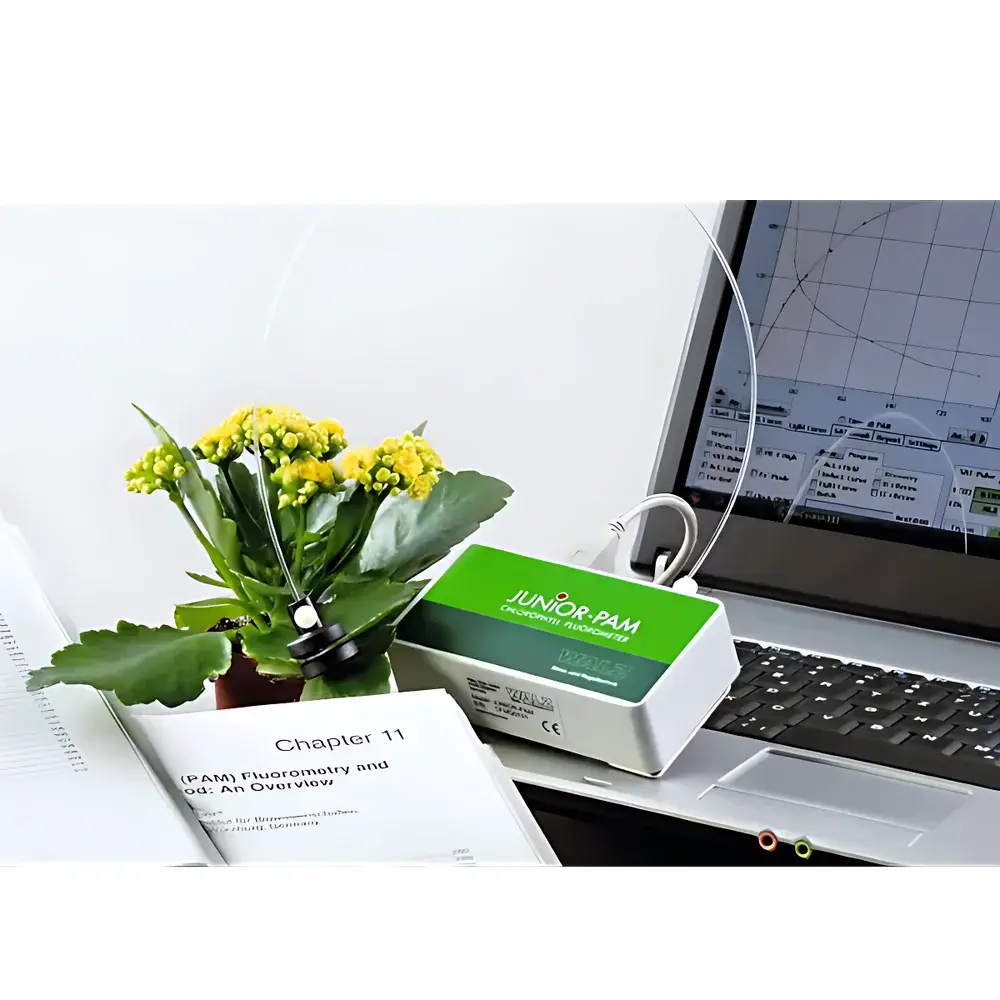
WALZ JUNIOR-PAM Basic Pulse-Amplitude-Modulated Chlorophyll Fluorometer
| Brand | WALZ |
|---|---|
| Origin | Germany |
| Model | JUNIOR-PAM |
| Measurement Light Source | Blue LED (465 nm), modulation frequency 5 or 100 Hz, standard intensity 0.1 µmol·m⁻²·s⁻¹ |
| Actinic Light Source | Blue LED (465 nm), 25–1500 µmol·m⁻²·s⁻¹ |
| Saturation Pulse | Blue LED (465 nm), up to 10,000 µmol·m⁻²·s⁻¹ |
| Far-Red Light | LED (740 nm) |
| Detector | PIN photodiode with long-pass filter (λ > 710 nm), proprietary lock-in amplifier |
| Operating Temperature | −5 to +40 °C |
| Power Supply | USB-powered (5 V DC) |
| Dimensions | 115 × 65 × 30 mm |
| Weight | 200 g |
Overview
The WALZ JUNIOR-PAM is a compact, USB-powered pulse-amplitude-modulated (PAM) chlorophyll fluorometer engineered for quantitative assessment of photosynthetic efficiency in higher plants, algae, and cyanobacteria. Based on the principle of modulated fluorescence detection, it isolates the weak chlorophyll a fluorescence signal from ambient light using a patented lock-in amplifier synchronized with a low-intensity measuring beam (465 nm, 5 or 100 Hz). This enables precise determination of minimal (Fo) and maximal (Fm) fluorescence yields under dark-adapted conditions, as well as steady-state (F) and light-adapted maximal (Fm′) fluorescence during actinic illumination. The instrument supports standardized calculation of quantum yield of PSII photochemistry (Y(II) = ΔF/Fm′), non-photochemical quenching (NPQ), photochemical quenching (qP, qL), and alternative electron flux parameters (Y(NO), Y(NPQ)), all in accordance with established biophysical conventions (Krause & Weis, 1991; Baker, 2008).
Key Features
- Compact, handheld design (115 × 65 × 30 mm, 200 g) optimized for field deployment and classroom use without external power supplies
- Triple-light-source architecture: measuring beam (465 nm, 0.1 µmol·m⁻²·s⁻¹), actinic illumination (465 nm, 25–1500 µmol·m⁻²·s⁻¹), and saturating pulse (up to 10,000 µmol·m⁻²·s⁻¹), all with precise spectral definition
- Far-red LED (740 nm) for rapid dark-state reactivation of Photosystem I, enabling reliable Fo′ determination and qL-based linear electron transport rate (rETR) calculations
- High-sensitivity PIN photodiode detector with optical filtering (λ > 710 nm) and proprietary lock-in amplification, delivering robust signal-to-noise performance even under variable ambient light
- Full compliance with PAM methodology standards: supports Fo, Fm, Fv/Fm, F, Fm′, Fo′, Y(II), qP, qL, qN, NPQ, Y(NO), Y(NPQ), and rETR — all calculated in real time using embedded algorithms aligned with the PAM literature
Sample Compatibility & Compliance
The JUNIOR-PAM is validated for use with intact leaves (dicots, monocots), detached leaf discs, seedlings, mosses, lichens, algal suspensions, and microcosms. Its non-invasive, contact-free optical configuration avoids mechanical stress artifacts. All measurement protocols—including fluorescence induction kinetics, rapid light curves (RLCs), actinic light response curves (LCs), and combined light/dark relaxation sequences—adhere to internationally recognized experimental frameworks (e.g., ISO 10260:2021 for plant stress phenotyping, ASTM E2912-22 for photosynthetic performance assessment). Data output conforms to FAIR principles (Findable, Accessible, Interoperable, Reusable), with timestamped, metadata-rich .csv exports suitable for integration into GLP-compliant lab information management systems (LIMS). While not certified for regulated GxP environments, its traceable calibration and deterministic signal processing support method validation per ISO/IEC 17025 requirements.
Software & Data Management
Controlled via WALZ’s proprietary, Windows-compatible software (free of charge, perpetual license), the JUNIOR-PAM provides an intuitive interface for protocol selection, real-time curve visualization, and parameter annotation. Preconfigured measurement routines include dark-adapted Fv/Fm, light-adapted Y(II) monitoring, RLC acquisition with automatic saturation pulse triggering, and dual-phase LC + dark relaxation protocols. Curve fitting employs two widely adopted models—the hyperbolic tangent (Jassby & Platt, 1976) and the exponential decay function—for deriving α (initial slope), Ek (light saturation index), and rETRmax. Raw data files retain full temporal resolution (10 ms sampling), and software supports batch export, baseline correction, and user-defined parameter derivation. Audit trails, operator login logs, and version-controlled firmware updates are implemented to support academic integrity and reproducibility reporting.
Applications
The JUNIOR-PAM serves as both a pedagogical tool for undergraduate and graduate plant physiology laboratories and a rigorously functional instrument for hypothesis-driven research. It is routinely deployed in studies of abiotic stress responses (drought, heat, salinity, heavy metals), herbicide mode-of-action screening, ecophysiological adaptation across gradients (altitude, latitude, canopy position), crop breeding programs (e.g., high-yield wheat or rice lines), and aquatic primary productivity assessments in mesocosms and phytoplankton cultures. Its compatibility with the WALZ GFS-3000 portable photosynthesis system enables fully synchronized gas exchange and fluorescence measurements—critical for partitioning electron transport demand between CO2 fixation, photorespiration, and alternative sinks (e.g., water-water cycle). Field researchers leverage its USB bus power and rugged enclosure for multi-day deployments in remote ecological sites.
FAQ
Does the JUNIOR-PAM require external power or batteries?
No — it draws 5 V DC exclusively via USB connection to a laptop, desktop, or UMPC. No battery pack or AC adapter is needed.
Can it measure qL and Y(NO) in real time?
Yes — both parameters are computed continuously during actinic illumination using concurrently measured F, Fm′, Fo′, and far-red-induced Fo′, following the Kramer et al. (2004) formalism.
Is software included, and are updates free?
Yes — the full-featured control software is provided at no cost, with lifetime access to minor and major version upgrades via WALZ’s secure download portal.
What sample types are compatible with the microfiber probe?
The 2-mm-diameter microfiber optic allows measurements on small leaves (e.g., Arabidopsis rosettes), cotyledons, epidermal peels, algal biofilms, and submerged macrophyte tissues — with optional holders for standardized positioning.
How does it differ from research-grade PAM systems like the MAXI-PAM or IMAGING-PAM?
While sharing identical core electronics and fluorescence algorithms, the JUNIOR-PAM omits imaging capability, automated stage control, and multi-wavelength actinic options — prioritizing portability, simplicity, and cost-effectiveness without compromising metrological fidelity for single-point measurements.





