
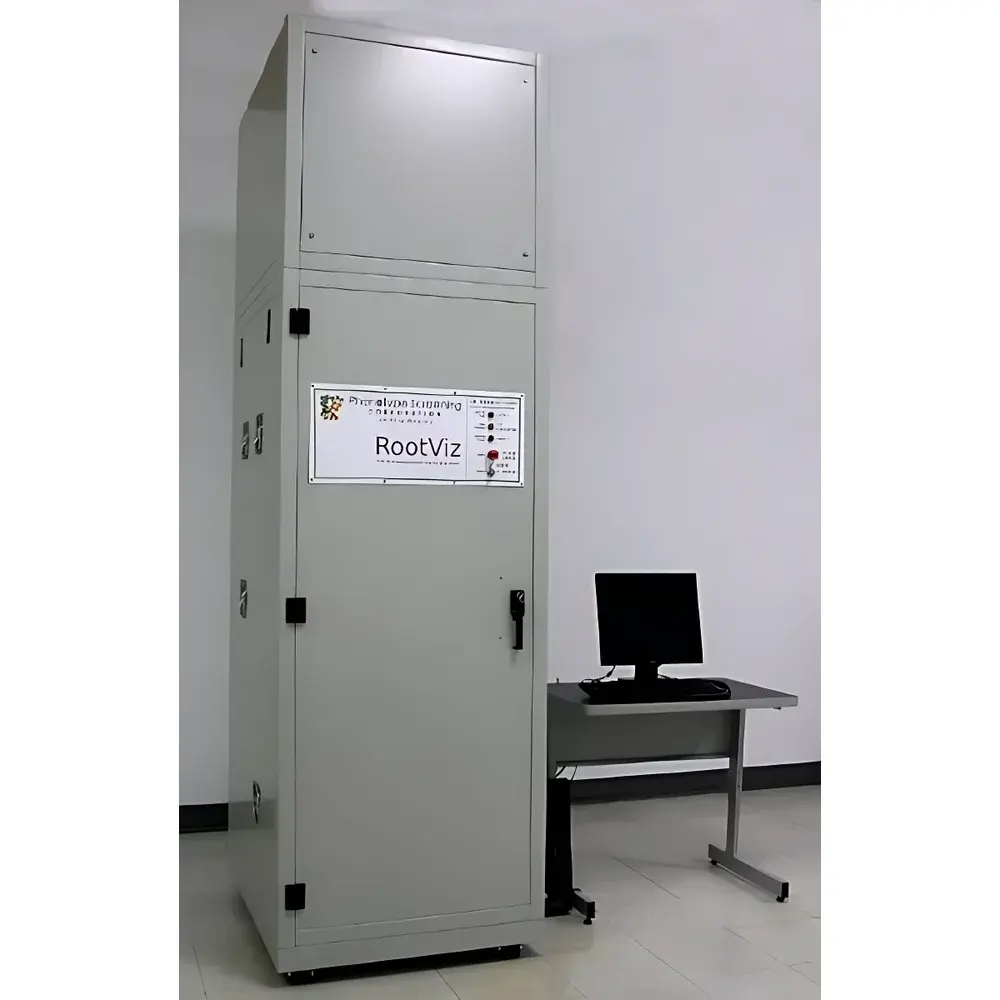
RootViz FS X-ray Root Imaging and Analysis System
| Origin | USA |
|---|---|
| Manufacturer Type | Authorized Distributor |
| Origin Category | Imported |
| Model | ROOTVIZ FS |
| Price | Upon Request |
| X-ray Source | 25 keV @ 800 µA |
| Digital X-ray Camera | 2002 × 2054 pixel CMOS sensor with Gd₂O₂S scintillator |
| Throughput | 25 plants/h (2D), 15 plants/h (3D) |
| Maximum Root Length | 0.6 m |
| Maximum Sample Height | 2.1 m |
| Spatial Resolution | 2002 × 2054 pixels |
Overview
The RootViz FS X-ray Root Imaging and Analysis System is a non-invasive, in situ 3D imaging platform engineered for high-fidelity quantitative analysis of plant root architecture under controlled growth conditions. Developed under U.S. Department of Energy innovation funding and recognized with the 2006 R&D 100 Award—often cited as the “Oscars of Invention”—the system employs low-energy X-ray radiography to generate high-contrast, volumetric projections of intact root systems within soil-filled pots or growth media. Unlike destructive ex situ methods such as WinRHIZO-based scanning, which require root excavation, washing, and flattening—processes that inevitably damage apical meristems and distort spatial relationships—the RootViz FS enables longitudinal, repeated imaging without perturbation. Its core measurement principle relies on differential X-ray attenuation between root tissue and surrounding substrate, captured via a high-sensitivity CMOS detector coupled with a Gd₂O₂S scintillator for optimal signal-to-noise ratio at 25 keV. This physical basis ensures reproducible quantification of root morphology, topology, and developmental dynamics across genotypes, treatments, and timepoints.
Key Features
- Non-destructive, in situ 3D root imaging with sub-millimeter structural fidelity
- Automated, programmable 3D motorized stage enabling precise angular acquisition for tomographic reconstruction
- Dual-mode operation: rapid 2D projection imaging (25 plants/h) and high-content 3D volumetric acquisition (15 plants/h)
- Optimized low-dose X-ray source (25 keV, 800 µA) minimizing radiation-induced physiological artifacts while maintaining contrast
- High-resolution digital detection: 2002 × 2054-pixel CMOS sensor with gadolinium oxysulfide scintillation layer for enhanced quantum efficiency
- Integrated environmental enclosure compatibility for concurrent control of temperature, humidity, CO₂, and light regimes during imaging sessions
Sample Compatibility & Compliance
The RootViz FS accommodates standard pot-based plant growth systems up to 2.1 m in height and supports root systems extending up to 0.6 m in length—suitable for model species (e.g., Arabidopsis thaliana, maize, wheat, soybean) as well as perennial shrubs and small trees in early ontogeny. Its design conforms to ANSI N43.3 and IEC 61000-6-3 electromagnetic compatibility standards. For regulated research environments—including USDA-APHIS-certified containment labs or GLP-compliant phenotyping facilities—the system supports audit-ready metadata logging (timestamp, position, exposure parameters) and can be integrated into ISO/IEC 17025-aligned instrument qualification protocols. While not a medical device, its radiation safety profile meets Class I cabinet X-ray system requirements per 21 CFR §1020.40, with interlocked shielding and dose monitoring.
Software & Data Management
Acquisition and reconstruction are managed via proprietary RootViz Studio software, supporting DICOM-compliant export for third-party analysis (e.g., Avizo, ITK-SNAP, PlantSeg). The software provides automated root segmentation using multi-threshold adaptive algorithms trained on annotated ground-truth datasets, followed by skeletonization and topological graph generation. Quantitative outputs include total root length, surface area, volume, branching density, root diameter distribution, tip count, and gravitropic angle distribution—all georeferenced to the 3D coordinate space. Data provenance is preserved through embedded EXIF-style metadata and optional integration with LIMS platforms. For regulatory workflows, optional 21 CFR Part 11-compliant modules provide electronic signatures, audit trails, and role-based access control.
Applications
- Time-series characterization of root architectural plasticity under abiotic stress (drought, salinity, nutrient heterogeneity)
- In vivo validation of root QTLs and CRISPR-edited mutants in soil-embedded contexts
- Phenotypic screening of root system architecture (RSA) traits for breeding programs
- Quantitative assessment of root–microbe interactions (e.g., mycorrhizal colonization patterns, rhizobacterial biofilm distribution)
- Calibration and ground-truthing of proximal sensing technologies (e.g., ERT, GPR, neutron imaging)
- Developmental biology studies tracking meristematic activity and lateral root emergence dynamics
FAQ
Is the RootViz FS suitable for field-grown plants?
No—it is designed exclusively for controlled-environment studies using potted or rhizobox-grown specimens. Field deployment is precluded by shielding, power, and stability requirements.
Can it image roots in hydroponic or aeroponic systems?
Yes, provided root-containing structures are mechanically stable and X-ray transparent (e.g., acrylic chambers); media must not contain high-Z elements that cause beam hardening.
What is the typical radiation dose per scan?
Effective dose per 3D acquisition is ≤1.2 mGy—well below thresholds shown to alter root cell division rates in peer-reviewed studies (e.g., Plant Physiology, 2021).
Does the system support real-time imaging?
No—it acquires static snapshots; temporal resolution is limited by motorized stage movement and detector integration time (minimum ~90 s per angular view).
Is training and application support included?
Yes—PSC provides on-site installation, operator certification, and annual method validation workshops aligned with ASTM E2922-22 (Standard Guide for X-ray Imaging of Plant Roots).
Related Products





