
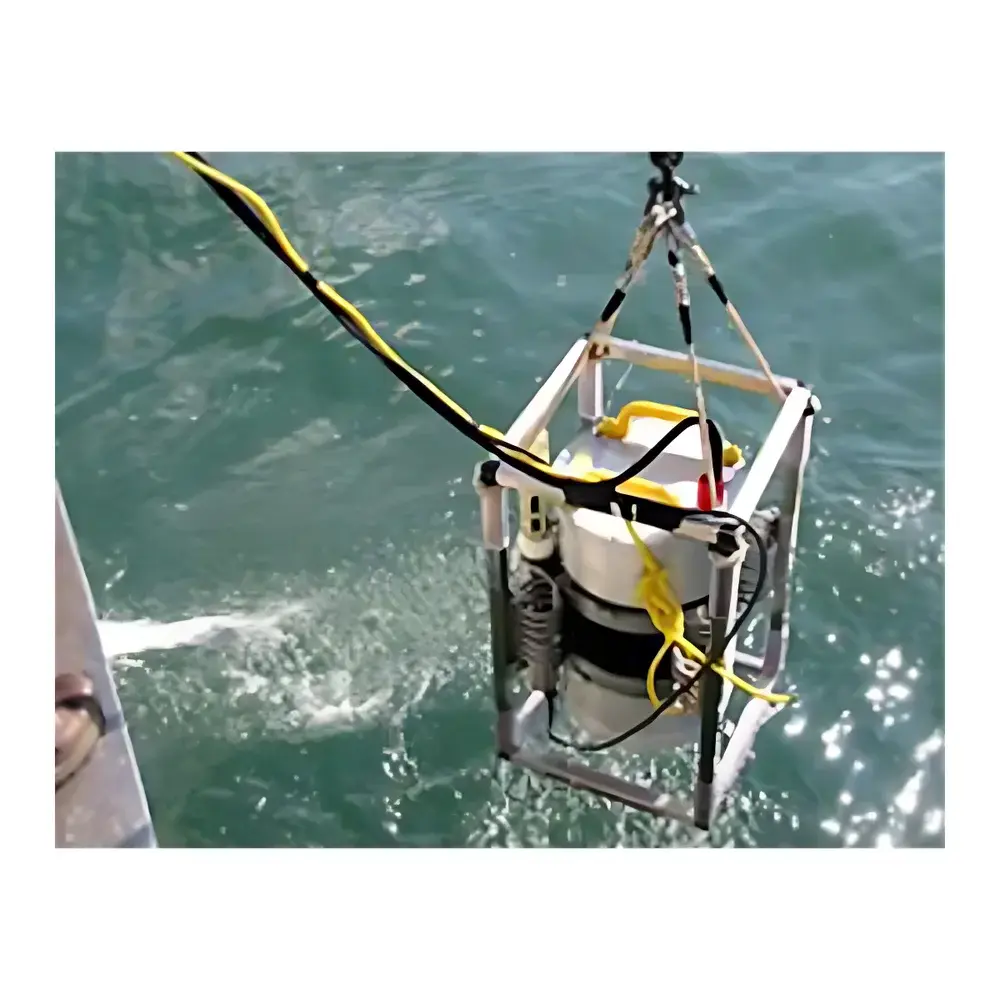
CytoBuoy Buoy-Mounted In Situ Phytoplankton Imaging Flow Cytometer
| Brand | CytoBuoy (Netherlands) |
|---|---|
| Origin | Netherlands |
| Model | CytoBuoy |
| Application Platform | Buoy-Integrated Autonomous Monitoring System |
| Detection Principle | Pulse-Shape Analysis (PSA) + High-Speed Flow Imaging Cytometry |
| Optical Channels | FWS, SWS, FLR, FLY, FLO |
| Depth Rating | Up to 20 m (with CytoSub module) |
| Data Transmission | Wireless (GSM/3G/4G, optional satellite) |
| Compliance | Designed for GLP-aligned environmental monitoring workflows |
| Software | CytoUSB (acquisition), CytoClus & EasyClus (batch clustering & morphometric analysis) |
| Particle Size Range | 1–500 µm |
| Measurement Modes | In situ profiling (with CTD), vertical剖面, remote-controlled unattended operation |
Overview
The CytoBuoy Buoy-Mounted In Situ Phytoplankton Imaging Flow Cytometer is a purpose-engineered autonomous instrument designed for high-frequency, non-invasive, in situ characterization of phytoplankton community structure across marine and freshwater ecosystems. Unlike conventional benchtop flow cytometers, CytoBuoy integrates pulse-shape analysis (PSA) with synchronized high-speed imaging within a pressure-rated, buoy-deployable architecture. Its core measurement principle relies on hydrodynamically focused sample flow through multiple laser interrogation zones (standard 488 nm, optionally 445/635/660 nm), where individual particles generate time-resolved optical signals—including forward scatter (FWS), side scatter (SWS), and multi-spectral fluorescence (FLR, FLY, FLO)—captured at microsecond resolution. These transient pulse signatures encode intrinsic morphological features (e.g., chain length, colony geometry, internal granularity) and physiological states (e.g., pigment composition, photosynthetic activity). Coupled with real-time image capture of gated events, CytoBuoy delivers topologically resolved data across the full algal size spectrum (1–500 µm), enabling quantitative discrimination of colonial cyanobacteria (e.g., Microcystis aggregates), diatom chains, dinoflagellate cysts, and heterotrophic protists—without fixation, staining, or concentration.
Key Features
- Autonomous buoy-integrated deployment: Fully encapsulated electronics, solar-rechargeable power management, and IP68-rated housing engineered for continuous operation in open-water environments.
- Pulse-shape analysis (PSA) engine: Captures temporal signal morphology (rise time, decay profile, peak asymmetry) to distinguish morphologically similar taxa—critical for detecting early-stage Microcystis colony formation or diatom chain fragmentation.
- High-resolution flow imaging module: Enables user-defined gating followed by triggered image acquisition (≥100 fps) of target populations, supporting morphometric validation and cluster verification.
- Multi-parameter optical detection: Simultaneous acquisition of five optical channels (FWS, SWS, FLR, FLY, FLO) permits pigment fingerprinting (e.g., phycocyanin vs. phycoerythrin), chlorophyll-a quantification, and detection of non-photochemical quenching states.
- Adaptive photomultiplier tube (PMT) gain control: Dynamically optimized per channel to maintain linearity across broad particle size and fluorescence intensity ranges—essential for accurate biovolume estimation across mixed assemblages.
- CTD-integrated profiling capability: Synchronized depth-resolved sampling via integrated pressure sensor and programmable peristaltic pump enables true vertical phytoplankton biomass profiling across the euphotic zone.
- Remote command-and-control interface: Secure web-based dashboard supports real-time parameter adjustment, scheduled sampling, diagnostic telemetry, and firmware updates over cellular or satellite links.
Sample Compatibility & Compliance
CytoBuoy operates directly on unfiltered natural water samples, accommodating turbidities up to 100 NTU without clogging. It is validated for use in seawater (salinity 0–40 PSU), freshwater reservoirs, eutrophic lakes, estuarine transition zones, and wastewater-impacted rivers. The system complies with design conventions referenced in ISO 17025-accredited environmental laboratories for instrument qualification and method validation. While not certified to FDA 21 CFR Part 11 out-of-the-box, its audit-trail-enabled software architecture (CytoUSB v4.2+, CytoClus v3.1+) supports implementation of electronic signature protocols required under GLP and GMP-aligned monitoring programs. All optical calibration standards (e.g., NIST-traceable polystyrene beads, fluorescent microspheres) are compatible with ASTM D7687–15 guidelines for flow cytometer performance verification.
Software & Data Management
Data acquisition is managed by CytoUSB, a deterministic real-time operating system ensuring sub-millisecond timestamp accuracy and lossless event buffering during transmission latency. Raw pulse and image datasets are stored in HDF5 format with embedded metadata (GPS, depth, temperature, salinity, battery voltage). Batch processing is performed using CytoClus, which implements hierarchical clustering based on 9 topological descriptors (e.g., pulse width, integrated area, aspect ratio, convexity, solidity) and ≥45 derived biophysical parameters. EasyClus—a MATLAB-dependent extension—enables supervised machine learning classification (SVM, random forest) trained on reference image libraries. Export formats include CSV, NetCDF, and MIAME-compliant XML for integration into LIMS or ecological modeling platforms (e.g., EcoSIM, GOTM). All software modules support automated daily report generation compliant with EU WFD Annex V reporting templates.
Applications
- Harmful algal bloom (HAB) early warning: Detection of pre-bloom Microcystis colony dynamics and toxin-producing strain proxies via phycocyanin:chlorophyll-a ratios and pulse morphology shifts.
- Euphotic zone phenology: High-temporal-resolution vertical profiling of phytoplankton functional groups (diatoms, cryptophytes, prasinophytes) in response to mixing events and nutrient pulses.
- Lake stratification studies: Correlation of taxon-specific abundance maxima with thermocline depth, oxygen gradients, and redox boundaries.
- Ballast water compliance testing: Enumeration of viable phytoplankton propagules >10 µm per IMO G8 guidelines, with morphological verification to exclude abiotic interference.
- Climate-driven phenotypic plasticity research: Long-term observation of chain-length modulation in *Skeletonema* spp. under variable pCO₂ and temperature regimes.
<liReservoir and drinking water source monitoring: Quantitative tracking of colonial cyanobacteria, heterotrophic bacteria (when paired with bacterial staining module), and suspended organic particulates relevant to coagulation efficiency.
FAQ
What depth range is supported for in situ operation?
Standard CytoBuoy deployment is rated for surface to 20 m depth. When configured with the CytoSub pressure housing and subsea connectors, operational depth extends to 200 m.
Can CytoBuoy differentiate between live and dead cells?
Yes—via dual-channel fluorescence ratio analysis (e.g., SYTOX Green viability stain coupled with chlorophyll-a autofluorescence) when used with the optional Bacterial Staining Module and compatible reagent delivery system.
Is calibration traceable to international standards?
All optical calibrations use NIST-traceable reference materials; particle sizing is validated against ISO 22412:2017 (dynamic light scattering) and ISO 13320:2020 (laser diffraction) protocols for equivalent spherical diameter equivalence.
How is data integrity maintained during intermittent connectivity?
Onboard 128 GB industrial-grade SSD stores raw data with cyclic overwrite protection; transmission resumes automatically upon link restoration, with SHA-256 checksum verification for all transferred packets.
Does CytoBuoy support integration with third-party CTD or ADCP systems?
Yes—via RS-232/RS-485 serial interface or Modbus TCP/IP; synchronization is achieved through hardware TTL triggers or NMEA 0183 timestamp alignment.





