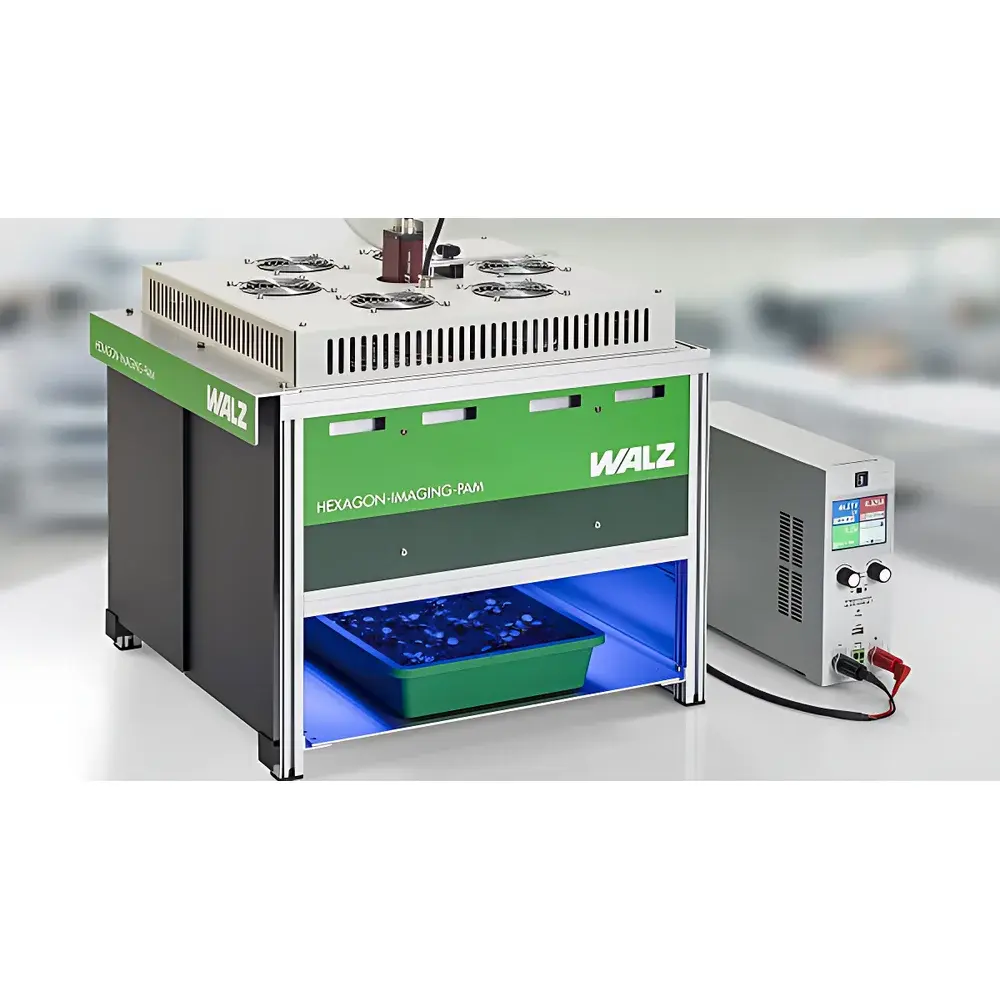
WALZ HEXAGON-IMAGING-PAM Hexagonal Matrix Chlorophyll Fluorescence Imaging System
| Brand | WALZ |
|---|---|
| Origin | Germany |
| Model | HEXAGON-IMAGING-PAM |
| Imaging Area | 20 × 24 cm |
| Resolution | 1.2 MP (1000 × 1200 px with 2×2 binning |
| Pixel Size | 3.45 × 3.45 µm |
| LED Illumination | Pulsed Amplitude Modulation (PAM) with integrated Far-Red (FR) panel for Fo′ measurement |
| Cooling | Active thermal management for high-power LED arrays |
| Safety | Interlocked sliding door with automatic saturation pulse suppression |
| AOI Analysis | Region-of-interest selection pre- or post-acquisition |
| Data Export | Full parameter set exportable to Excel (.xlsx) |
| Compliance | Designed for GLP-compliant plant phenotyping workflows |
Overview
The WALZ HEXAGON-IMAGING-PAM is a high-resolution, large-area chlorophyll fluorescence imaging system engineered for quantitative, non-invasive assessment of photosynthetic performance across diverse plant and algal samples. Based on the well-established principle of Pulse-Amplitude-Modulated (PAM) fluorometry, the system measures variable chlorophyll a fluorescence kinetics to derive biophysically meaningful parameters—including quantum yield of PSII (Y(II)), non-photochemical quenching (NPQ), photochemical quenching (qP, qL), and regulatory/non-regulatory energy dissipation (Y(NPQ), Y(NO))—with spatial resolution across a 20 × 24 cm field of view. Its hexagonal matrix LED architecture ensures exceptional optical uniformity, eliminating vignetting and shadowing artifacts that compromise quantitative comparability in conventional rectangular array systems. This design enables robust, reproducible measurements under controlled laboratory, growth chamber, or greenhouse conditions—critical for longitudinal studies, mutant screening, and stress phenotyping where inter-sample and intra-sample heterogeneity must be resolved at sub-leaf scale.
Key Features
- Hexagonal Matrix Illumination: Modular, tessellated LED panels provide homogeneous actinic and saturating light distribution across the entire imaging area—no edge falloff or hotspot formation—enabling pixel-level quantification without spatial correction.
- High Spatial Fidelity: 1.2 MP sensor (1000 × 1200 px native, 2000 × 2400 px effective via 2×2 binning) with 3.45 µm pixel pitch delivers sub-millimeter resolution over 480 cm², permitting detection of micro-heterogeneities in photosynthetic efficiency (e.g., early pathogen lesions, stomatal patchiness, localized oxidative damage).
- Far-Red (FR) Integration: Dedicated FR LED panel enables accurate determination of Fo′—a prerequisite for calculating Y(II), qP, and qL under actinic illumination—and supports dark-adapted Fo/Fm ratio acquisition without manual repositioning.
- Thermally Stable Operation: Precision-engineered heat-sink and active cooling maintain LED spectral output and intensity stability over extended measurement sessions (>8 h continuous operation), ensuring repeatability across multi-day experiments.
- Integrated Safety Architecture: Motorized sliding door with hardware-level interlock suppresses saturation pulses during access—meeting IEC 62471 photobiological safety requirements for Class 1 LED exposure.
- Automated Kinetic Protocols: Predefined and user-customizable measurement sequences include fluorescence induction curves (OJIP), rapid light curves (RLC), dark relaxation kinetics, and dynamic fluctuating-light simulations—each generating time-resolved parameter maps.
Sample Compatibility & Compliance
The HEXAGON-IMAGING-PAM accommodates a broad spectrum of biological formats without sample reconfiguration: intact potted plants (up to 30 cm height), multi-well plates (including 96-well microtiter plates for algal suspensions), Petri dishes, seedling trays, and detached leaves mounted on standardized holders. Its open-stage geometry permits integration with environmental control modules (e.g., temperature- and CO₂-regulated enclosures). The system is designed to support Good Laboratory Practice (GLP) and research-grade quality assurance protocols: all measurement metadata—including timestamp, LED intensity calibration factors, binning mode, and AOI coordinates—are embedded in raw image headers (TIFF format) and retained in audit-trail logs. While not FDA 21 CFR Part 11-certified out-of-the-box, its data structure and export architecture align with ISO/IEC 17025 and ASTM E2500-17 guidelines for analytical instrument qualification in plant science applications.
Software & Data Management
Imaging and analysis are performed using WALZ ImagingWin software (v5.0+), a Windows-based platform supporting real-time visualization, batch processing, and statistical mapping. All primary fluorescence parameters—Fo, Fm, Fv/Fm, Ft, Fm′, Y(II), Y(NPQ), Y(NO), NPQ, qN, qP, qL, ETR (PS/50), and Inh—are computed pixel-wise and rendered as false-color overlays. The software implements region-of-interest (AOI) analysis with automated temporal trend extraction and comparative statistics (e.g., mean ± SD per AOI across timepoints). Heterogeneity analysis tools permit line-profile extraction between arbitrary points, while histogram-based pixel-counting quantifies the spatial distribution of parameter thresholds (e.g., % leaf area with Y(II) < 0.3). All numerical outputs—including full-parameter matrices and AOI summaries—are exportable in native Excel (.xlsx) format with column headers compliant with MIAPPE (Minimum Information about a Plant Phenotyping Experiment) metadata standards.
Applications
- Photosynthetic Phenotyping: High-throughput screening of crop germplasm for enhanced quantum efficiency, electron transport rate (ETR), or NPQ induction kinetics under controlled abiotic stresses (drought, salinity, heat, low light).
- Early Stress Detection: Identification of subvisual biotic (pathogen, herbivore) and abiotic (heavy metal, nutrient deficiency, UV-B) stress signatures prior to morphological symptom onset.
- Mutant & Transgenic Validation: Spatial validation of photosynthetic phenotypes in Arabidopsis, rice, tomato, or algae—particularly for mutants affecting PSII repair, xanthophyll cycle, or stromal redox signaling.
- Algal Toxicology: Simultaneous quantification of photosynthetic inhibition across 384 wells (four 96-well plates), with automated calculation of relative inhibition (%) versus untreated controls per compound concentration.
- Disease Progression Mapping: Time-lapse imaging of lesion expansion dynamics in host–pathogen interactions, correlating fluorescence heterogeneity with histopathological markers.
- Chloroplast Redox Physiology: Spatiotemporal analysis of Y(NO) and Y(NPQ) ratios to dissect contributions of photoinhibitory damage versus protective energy dissipation in developmental or environmental transitions.
FAQ
What is the maximum sample thickness compatible with the HEXAGON-IMAGING-PAM stage?
The open-top design accommodates samples up to 30 cm tall; optional height-adjustable stage inserts are available for precise Z-axis positioning of low-profile specimens (e.g., microplates, Petri dishes).
Does the system support kinetic measurements under variable light spectra?
Yes—the PAM LED array includes programmable blue (455 nm), red (625 nm), and far-red (740 nm) channels; actinic light spectra can be customized per protocol, and spectral irradiance is calibrated traceably to NIST-standard photodiodes.
Can data from HEXAGON-IMAGING-PAM be imported into third-party analysis platforms like R or Python?
All exported Excel files contain tabular, parameter-labeled data with no proprietary encoding; TIFF image stacks include embedded EXIF tags containing acquisition parameters, enabling direct ingestion into ImageJ/Fiji, MATLAB, or custom Python pipelines using standard libraries (e.g., tifffile, pandas).
Is remote operation supported for unattended overnight measurements?
The system supports scheduled acquisition via Windows Task Scheduler or WALZ ImagingWin’s built-in experiment queue; network-enabled models allow secure remote monitoring and control through authenticated HTTPS endpoints, with logging compliant with institutional IT security policies.
How is calibration maintained across long-term deployments?
WALZ provides annual factory recalibration services; users may perform in-house verification using supplied neutral-density filters and reference cuvettes containing stable fluorescing dyes (e.g., quinine sulfate), with drift correction algorithms embedded in ImagingWin v5.2+.