
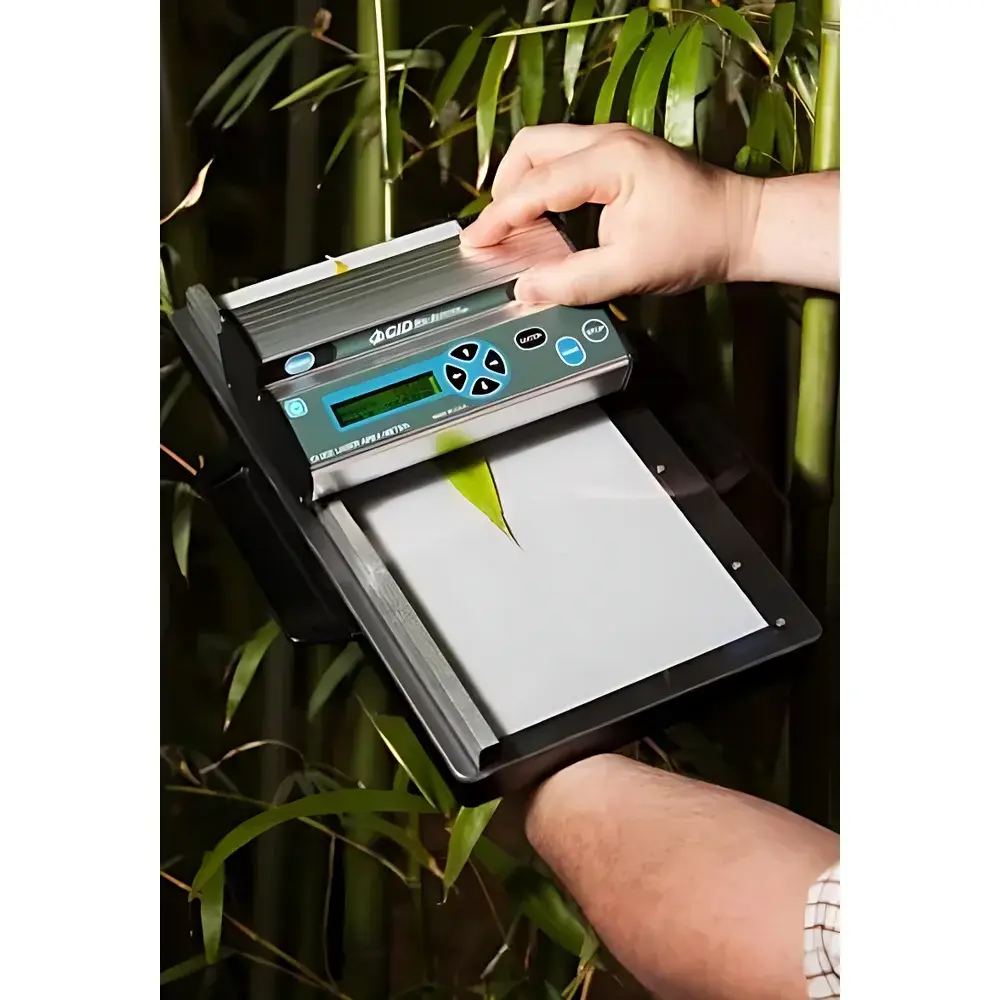
CI-202 Portable Laser Leaf Area Meter
| Brand | CID Bio-Science |
|---|---|
| Origin | USA |
| Model | CI-202 |
| Measurement Principle | Laser-based optical scanning (670 nm diode laser) |
| Max Sample Thickness | 1.5 cm |
| Scan Width | 15 cm |
| Scan Length | 36 cm |
| Optical Resolution | 0.025 mm² |
| Area Resolution | 0.01 cm² |
| Accuracy | ±1% for samples >10 cm² |
| Data Storage Capacity | 8,000 measurements |
| Display | 16-character × 2-line LCD |
| Scan Speed | 200 mm/s |
| Power Supply | 7.2 V Ni-MH rechargeable battery |
| Battery Life | Up to 15 hours per charge |
| Operating Temperature | 0–50 °C |
| Dimensions (L×W×H) | 38.5 × 29 × 12.5 cm |
| Weight | 1.8 kg |
| Interface | USB 2.0 |
| Included Accessories | Scanning plate, host unit, charger, USB cable, proprietary software (CID Bio-Science LeafWorks™), user manual, carrying case |
Overview
The CI-202 Portable Laser Leaf Area Meter is an engineered field-deployable instrument designed for rapid, non-destructive, and contactless quantification of leaf area and derived morphometric parameters in situ or ex situ. It operates on the principle of high-resolution laser line scanning—using a collimated 670 nm red diode laser beam to project a thin planar light sheet across the sample surface. A precision linear CCD array captures reflected/scattered light intensity profiles at 0.025 mm² optical resolution, enabling pixel-level edge detection and binary segmentation of the leaf silhouette. The system computes projected area without requiring leaf detachment, petiole removal, or physical compression—critical for fragile, juvenile, or petiole-less specimens common in early-stage phenotyping, seedling screening, and stress physiology studies. Its compact form factor (1.8 kg), integrated rechargeable power, and robust thermal tolerance (0–50 °C) support extended use across greenhouse, nursery, orchard, forest understory, and remote field sites.
Key Features
- Non-contact, non-destructive measurement—maintains sample integrity and enables longitudinal tracking of individual leaves over time
- Dual-mode operation: real-time in-field scanning and offline batch analysis via USB-transferred datasets
- Optimized gap design: 16 mm clearance between scanning plate and sensor head prevents mechanical deformation of delicate tissues (e.g., cotyledons, moss gametophytes, fern fronds)
- Automated parameter derivation: area (cm²), length (cm), width (cm), perimeter (cm), length-to-width ratio, and shape factor (4π·area/perimeter²)
- On-device statistical computation: real-time cumulative totals and arithmetic means for multi-leaf surveys
- High-capacity onboard memory: stores up to 8,000 complete measurement records with timestamp and sequence ID
- USB 2.0 interface compatible with Windows-based LeafWorks™ software for data export, batch reporting, and GLP-compliant audit trail generation
Sample Compatibility & Compliance
The CI-202 accommodates a broad range of botanical specimens—including monocot and dicot leaves, needles, bracts, petals, and artificial leaf mimics—within its 15 cm × 36 cm scan window and 1.5 cm thickness limit. Its low-intensity Class 1 laser classification complies with IEC 60825-1:2014 and FDA 21 CFR 1040.10 safety standards. While not certified for regulatory submission under ISO/IEC 17025, the instrument meets metrological requirements for research-grade morphometric analysis in academic, agricultural, and environmental laboratories. Data integrity aligns with principles outlined in Good Laboratory Practice (GLP) frameworks when used with LeafWorks™ software’s optional audit logging and electronic signature modules.
Software & Data Management
LeafWorks™ (v4.2+) provides full post-acquisition functionality: import of .csv or native .cid files, visualization of scanned silhouettes, outlier flagging based on shape factor thresholds, export to Excel-compatible formats, and generation of summary reports compliant with institutional data management plans. Raw scan metadata—including ambient temperature, operator ID, GPS coordinates (if externally tagged), and calibration status—is embedded in each record. The software supports version-controlled configuration files and maintains immutable timestamps for all edits, satisfying traceability requirements for peer-reviewed publications and grant-funded projects.
Applications
- Phenotypic screening of crop mutants and breeding lines under controlled or field conditions
- Quantifying drought-, heat-, or nutrient-stress-induced leaf area reduction in real time
- Monitoring canopy development dynamics in agroforestry and urban greening trials
- Calibrating hyperspectral or RGB-based remote sensing algorithms using ground-truth leaf area index (LAI) sub-sampling
- Educational use in plant anatomy and ecophysiology labs due to intuitive workflow and immediate visual feedback
- Comparative morphology studies across taxa where petiole absence or extreme fragility precludes conventional tracing or digital image analysis
FAQ
Can the CI-202 measure leaves with irregular margins or lobes accurately?
Yes—the laser scanning algorithm detects true physical boundaries regardless of serration, incision depth, or marginal undulation, provided contrast between leaf and background exceeds 20% reflectance difference.
Is calibration required before each use?
No routine recalibration is needed; the system employs factory-trimmed geometric scaling and auto-zeroed baseline correction. A single-point verification using the supplied reference standard (10 cm² polycarbonate tile) is recommended weekly for ISO-aligned workflows.
Does the device support external GPS or barcode integration?
GPS tagging is not built-in but can be implemented via third-party Android/iOS apps that log location stamps alongside manual CI-202 dataset IDs; barcode support requires custom scripting in LeafWorks™ using CSV import mapping.
What is the minimum measurable leaf area?
The practical lower limit is ~0.25 cm², constrained by optical resolution and signal-to-noise ratio—not instrument specification—and verified empirically using standardized micro-leaf phantoms.
How is data security ensured during USB transfer?
LeafWorks™ implements AES-128 encryption for exported files containing sensitive experimental metadata; local storage on the CI-202 remains unencrypted but isolated from network exposure by design.





