
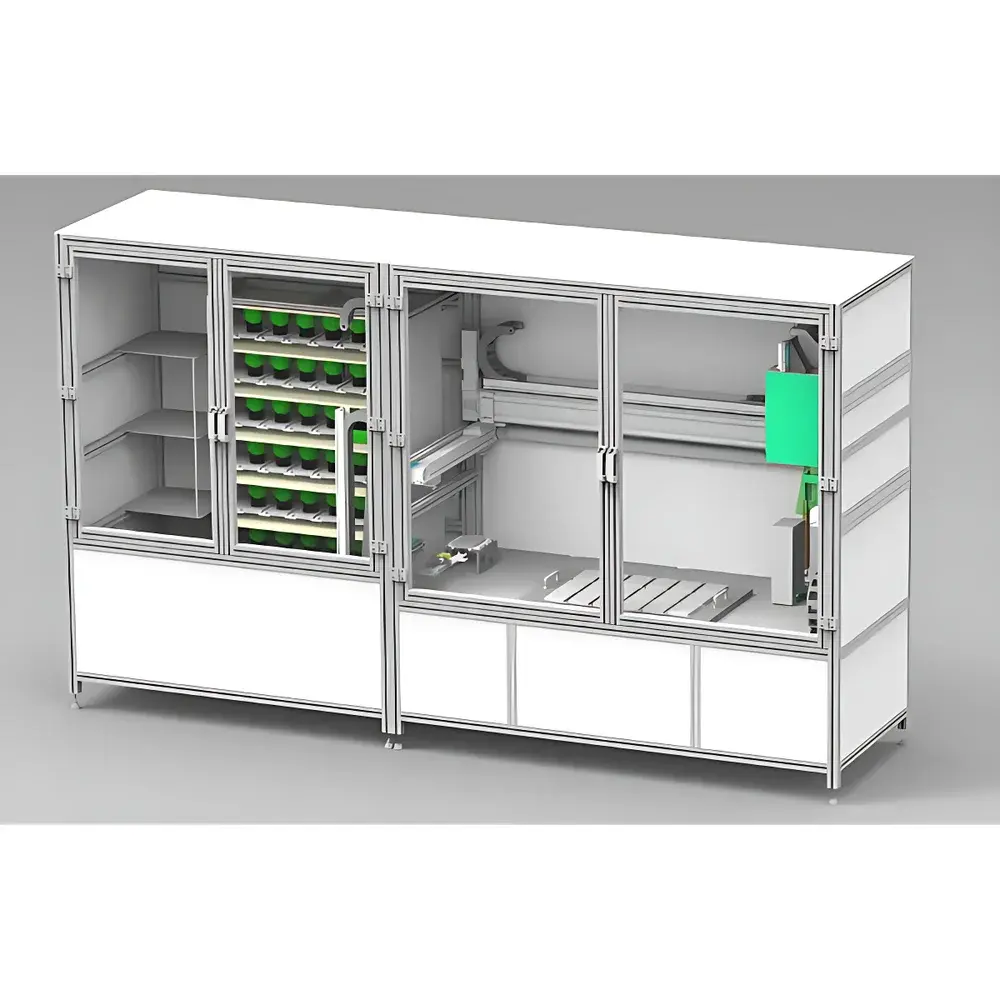
LemnaTec PhenoCenter Laboratory High-Throughput Plant Phenotyping Platform
| Brand | LemnaTec |
|---|---|
| Origin | Germany |
| Model | PhenoCenter |
| Imaging Modules | VIS, NIR, PAM (Maxi-Imaging-PAM), 3D Laser Scanner (optional) |
| Sample Formats | 6–384-well microtiter plates, small pots |
| Max. Throughput | 72 MTPs per run |
| Power Supply | 400 V AC, 16 A, 50 Hz |
| Dimensions (Basic Module) | 1800 × 800 × 1900 mm (W×L×H) |
| Control Console | 1200 × 700 × 1600 mm |
| Optional Extension | 1400 × 800 × 1900 mm |
| Max. Payload per MTP | 300 g |
| VIS FOV | 20° × 15° @ 485 mm WD |
| NIR FOV | 18° × 14° @ 540 mm WD with 1450 nm bandpass filter |
| PAM Imaging Area | 100 × 130 mm @ 185 mm WD |
| Fluorescence Parameters | Ft, Fo, Fm, Fv/Fm, F, Fm′, Y(II), Y(NO), Y(NPQ), NPQ, qN, qP, qL, ETR, Abs., NIR, Red (≥17 parameters) |
| Light Sources | Blue (450 nm) or Red (650 nm) LED arrays for PAM excitation |
| Illumination Homogeneity | ±7% across imaging area |
Overview
The LemnaTec PhenoCenter is a second-generation, laboratory-scale high-throughput plant phenotyping platform engineered for precision, reproducibility, and modularity in controlled-environment research. Built upon the proven architecture of the HTS Lab Scanalyzer series, the PhenoCenter integrates synchronized environmental control, automated sample handling, and multi-spectral imaging into a single robust platform. Its core measurement principle relies on non-invasive, quantitative optical sensing—including visible (VIS), near-infrared (NIR), and pulse-amplitude-modulated (PAM) chlorophyll fluorescence imaging—combined with optional 3D laser scanning. This enables simultaneous acquisition of structural, physiological, and functional phenotypic traits across large cohorts of small plants, seedlings, callus cultures, microalgae, or even motile organisms such as nematodes and insect larvae. Designed for rigorous academic and industrial plant science applications, the system supports longitudinal studies from germination through early vegetative development, delivering spatially resolved, time-series phenotypic data compliant with FAIR (Findable, Accessible, Interoperable, Reusable) data principles.
Key Features
- Modular sensor configuration: Up to three simultaneous imaging modules—VIS, NIR, and PAM—can be installed; 3D laser scanning is available as an add-on or substitution option.
- Integrated environmental control: Programmable LED lighting systems enable precise regulation of spectral composition (e.g., red/blue ratios), photoperiod (day/night cycles), light intensity gradients, and dynamic light ramping protocols tailored to species-specific growth requirements.
- Automated sample logistics: Motorized transport system moves microtiter plates (6–384-well) or small pots between growth zones and the imaging station without manual intervention, minimizing operator bias and experimental variability.
- High-resolution, calibrated imaging: VIS camera (50 mm lens, 20° × 15° FOV at 485 mm working distance) captures morphometric features including leaf area, symmetry, angle, color distribution, lesion quantification, and seed pigmentation—yielding >50 standardized morphological descriptors per image.
- NIR module (50 mm lens, 1450 nm bandpass filter, 18° × 14° FOV at 540 mm WD) enables water status mapping, hydraulic trait inference, and abiotic stress response profiling via reflectance-based hydration indices.
- PAM module incorporates the WALZ Maxi-Imaging-PAM technology, delivering quantitative, spatially resolved photosynthetic efficiency metrics—including quantum yield of PSII (Y(II)), non-photochemical quenching (Y(NPQ)), non-regulated energy dissipation (Y(NO)), electron transport rate (ETR), and photochemical quenching (qP)—across full plates or individual samples.
- Z-axis motorization for both camera and plate stages ensures repeatable focus positioning and accommodates variable sample heights—from petri dishes to shallow pots—without recalibration.
Sample Compatibility & Compliance
The PhenoCenter accommodates diverse biological formats: standard microtiter plates (6-, 12-, 24-, 48-, 96-, and 384-well), custom trays, and small soil or agar-filled pots (≤10 cm diameter). Each plate is rated for ≤300 g total mass, ensuring mechanical stability during transport and imaging. The system’s modular design allows researchers to configure throughput tiers (4-, 24-, 48-, or 72-plate capacity) according to experimental scale and facility constraints. All optical components meet CE marking requirements for laboratory instrumentation. Data acquisition workflows support audit-trail generation and electronic signature capability, aligning with GLP-compliant environments and facilitating compliance with ISO/IEC 17025 for testing laboratories. While not FDA-cleared, the platform’s structured metadata export (CSV, TIFF, HDF5) and traceable parameter logging are routinely adopted in pre-breeding and regulatory toxicology studies adhering to OECD Test Guidelines and ASTM E2929-13 for phenotypic data reporting.
Software & Data Management
PhenoCenter operates exclusively with LemnaTec’s proprietary Phenovision software suite—a validated, scriptable environment supporting batch processing, ROI-based analysis, temporal trend modeling, and statistical outlier detection. Key analytical capabilities include: (1) Automated AOI (Area of Interest) definition pre- or post-acquisition, enabling region-specific parameter extraction and longitudinal comparison; (2) Pixel-level heterogeneity analysis, quantifying spatial variance of fluorescence or reflectance values across defined line profiles or arbitrary polygons; (3) Threshold-based pixel counting for binary classification (e.g., necrotic vs. healthy tissue area); (4) Dynamic radar plot generation (“phenotypic fingerprinting”) using up to 20 normalized descriptors to cluster genotypes or treatments across developmental timepoints; (5) Export of all raw and processed data—including full-parameter fluorescence kinetics, absorbance coefficients, and 3D point clouds—to Excel, MATLAB, or Python-compatible formats. Software validation documentation (IQ/OQ/PQ protocols) is available upon request for GxP-aligned deployments.
Applications
- Mutant screening: High-throughput identification of photosynthetic, drought-tolerant, salt-resistant, pathogen-resistant, or lipid/hydrogen-overproducing mutants in Arabidopsis, rice, barley, and microalgae—validated by industry partners including Bayer CropScience, BASF Agricultural Solutions, and Syngenta.
- Quantitative trait locus (QTL) mapping: Generation of multidimensional phenotypic descriptors for linkage analysis and genome-wide association studies (GWAS), particularly where temporal dynamics (e.g., growth rate inflection points) serve as heritable traits.
- Abiotic and biotic stress physiology: Time-resolved assessment of stomatal conductance proxies (via NIR), photoinhibition onset (via Y(NO) kinetics), and recovery capacity (via qL and NPQ relaxation rates) under controlled drought, salinity, heavy metal, or pathogen challenge.
- Seed and seedling phenomics: Quantification of germination synchrony, coleoptile elongation, pigment accumulation, and early vigor indices under varying light or nutrient regimes.
- Toxicology and ecotoxicology: Parallel assessment of 96-algal cultures exposed to chemical gradients, with automatic calculation of relative inhibition (%) of Fv/Fm or ETR versus controls—supporting OECD 201 and ISO 8692 standards.
- Motility behavior analysis: Frame-difference tracking of C. elegans, Drosophila larvae, or aquatic microfauna under programmable illumination, yielding velocity, turning angle, and pause frequency distributions.
FAQ
What sample formats are supported?
The PhenoCenter accepts standard microtiter plates (6–384-well), custom trays, and small pots (≤10 cm diameter). Plates must not exceed 300 g total mass.
Can NIR and PAM imaging be performed simultaneously?
No—due to optical path constraints, only two of the three core modules (VIS, NIR, PAM) can operate concurrently. A hardware reconfiguration is required to switch between NIR and PAM when both are installed.
Is the system compatible with existing LemnaTec software licenses?
Yes. PhenoCenter uses the same Phenovision v5.x software stack as other LemnaTec platforms, enabling seamless integration into established institutional workflows and shared license pools.
Does the system support remote operation and monitoring?
Yes—Phenovision includes secure web-based remote access (HTTPS/TLS), real-time imaging preview, queue management, and email/SNMP alerting for run completion or error conditions.
What calibration standards are provided for fluorescence measurements?
Each PAM module ships with NIST-traceable neutral density filters and certified reference tiles for daily intensity verification. WALZ-provided factory calibration certificates cover spectral responsivity and irradiance uniformity across the imaging field.
Related Products



