
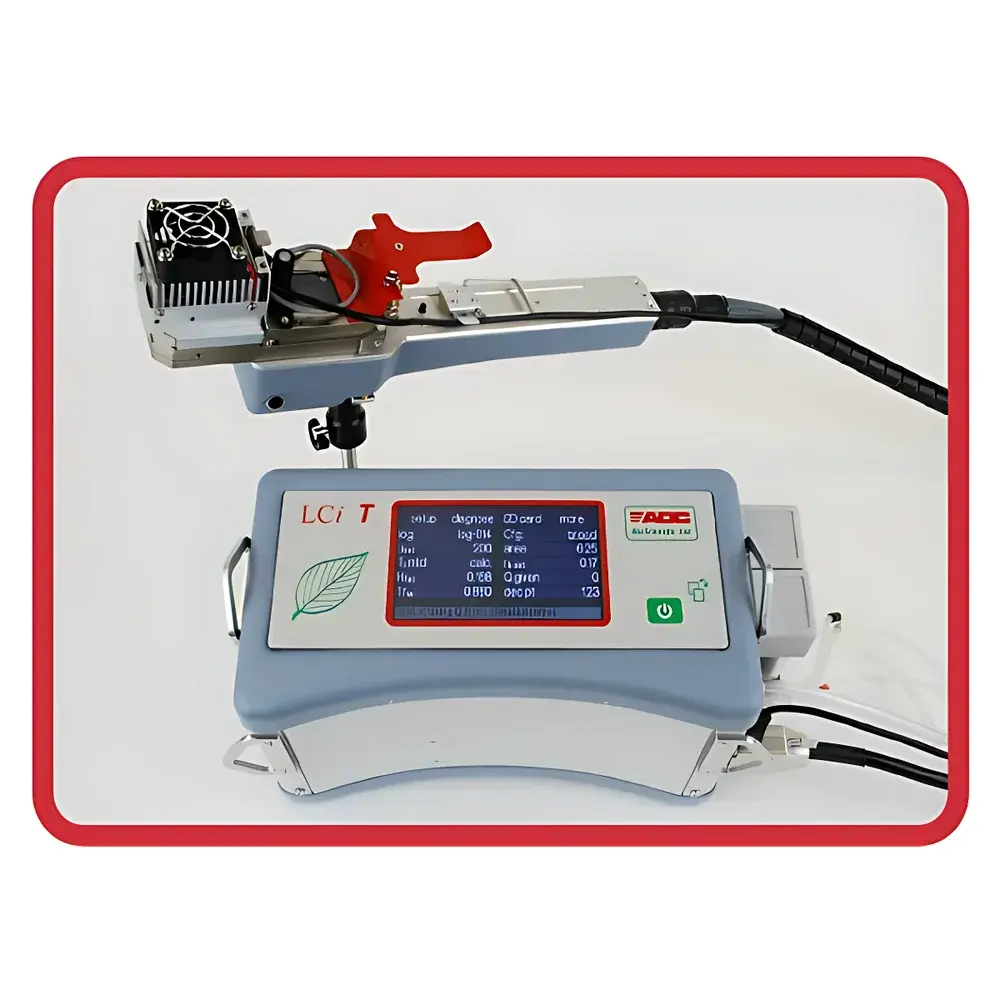
Zealquest LCi T Portable Photosynthesis System
| Brand | Zealquest |
|---|---|
| Origin | UK (ADC BioScientific) |
| Model | LCi T |
| CO₂ Range | 0–2000 ppm (1 ppm res.) |
| H₂O Range | 0–75 mbar (0.1 mbar res.) |
| PAR Range | 0–3000 µmol·m⁻²·s⁻¹ |
| Leaf/Chamber Temp | −5 to 50 °C (±0.2 °C) |
| Flow Control | 68–340 µmol·s⁻¹ |
| Display | WQVGA color touch LCD |
| Data Storage | SD card (up to 32 GB) |
| Battery | 12 V / 2.8 Ah lead-acid (≈10 h operation) |
| Dimensions (main unit) | 240 × 125 × 140 mm |
| Weight (main unit) | 2.4 kg |
| GPS | Integrated |
| Compliance | ASTM E2912, ISO 17025-aligned measurement architecture, GLP-compliant data logging with timestamped audit trail |
Overview
The Zealquest LCi T Portable Photosynthesis System is a field-deployable, open-path infrared gas analyser (IRGA)-based instrument engineered for high-fidelity, real-time quantification of net photosynthetic rate (An), stomatal conductance (gs), transpiration rate (E), and intercellular CO₂ concentration (Ci) in intact plant leaves. Its core measurement principle relies on dual-beam, non-dispersive infrared absorption spectroscopy for CO₂ and a patented dual-laser balanced hygrometer for rapid, drift-free water vapour partial pressure detection—enabling simultaneous, differential analysis of gas exchange across the leaf boundary layer with sub-second temporal resolution. Designed specifically for ecological physiology and agronomic field trials, the LCi T operates reliably under ambient conditions ranging from tropical humidity (>95% RH) to arid, particulate-rich environments—validated per IEC 60529 IP54 ingress protection specifications. All measurements are automatically compensated for ambient barometric pressure, air temperature, and relative humidity using integrated environmental sensors, ensuring metrological consistency across diverse biomes without manual recalibration.
Key Features
- Integrated dual-sensor IRGA platform with auto-zeroing cycle every 16 seconds—eliminating baseline drift and enabling long-duration unattended monitoring.
- Modular leaf chamber system with quick-release mechanism; compatible with species-specific chambers including broadleaf, narrow-leaf, and conifer needle configurations.
- Programmable LED light source with two spectral options: RGB tri-color (450/530/660 nm) output up to 2400 µmol·m⁻²·s⁻¹ or broad-spectrum white LED up to 2500 µmol·m⁻²·s⁻¹—both intensity- and spectrum-tunable via onboard interface.
- High-resolution WQVGA capacitive touch display with intuitive icon-driven workflow navigation and real-time graphical overlay of An, gs, and E curves.
- Built-in GPS module (WAAS-enabled, ±2.5 m CEP) geotags every data point, supporting spatially explicit analysis in landscape-scale phenotyping studies.
- Onboard SD card logging (up to 32 GB) with FAT32 formatting, storing timestamped CSV files compliant with FAIR data principles; USB 2.0 interface for direct PC transfer.
Sample Compatibility & Compliance
The LCi T accommodates leaf samples from herbaceous monocots and dicots, woody shrubs, and coniferous species via interchangeable chamber geometries—including optional add-ons for whole-plant gas exchange (mini-canopy chamber), soil respiration (closed-loop soil collar adapter), and chlorophyll fluorescence integration (via dedicated optical port synchronized with PAM fluorometers). All hardware and firmware comply with ISO/IEC 17025:2017 requirements for testing laboratories, and raw data streams support 21 CFR Part 11–compliant electronic signature workflows when paired with validated third-party LIMS platforms. Measurement uncertainty budgets are traceable to NIST-certified CO₂ and H₂O reference standards, and system-level validation reports are supplied with each unit.
Software & Data Management
Data acquisition and visualization are managed through the embedded LCi Control Suite—firmware v4.2+—which implements automatic outlier rejection, linearized diffusion correction, and Farquhar–von Caemmerer–Berry (FvCB) model parameter export. Exported datasets include full metadata headers (GPS coordinates, atmospheric pressure, chamber flow rate, PAR spectrum ID, user-defined treatment codes) and conform to MIAME/MINQE-compliant annotation schemas. Batch processing tools support normalization to leaf area (cm²), mass (g FW), or nitrogen content (mg·g⁻¹), and time-series alignment across multi-chamber experiments. Audit trails record all parameter changes, calibration events, and user logins with SHA-256 hashing for integrity verification.
Applications
- Field-based drought stress phenotyping across crop germplasm collections.
- In situ assessment of stomatal responsiveness to ozone, NOx, and VOC exposure in urban forest canopies.
- Carbon assimilation kinetics under dynamic light environments (e.g., sunflecks in understory vegetation).
- Validation of remote-sensing-derived GPP (Gross Primary Production) models using ground-truthed An time series.
- Evaluation of CRISPR-edited stomatal density mutants under semi-natural growth conditions.
- Soil–plant–atmosphere continuum (SPAC) modeling using concurrent soil respiration and leaf-level gas exchange data.
FAQ
What is the recommended calibration frequency for field deployments?>
We recommend daily zero/span calibration using certified 0 ppm CO₂ and 350 ppm CO₂ span gas prior to sunrise measurements; factory calibration is valid for 12 months under standard use.
Can the LCi T operate continuously for multi-day unattended logging?>
Yes—when powered via external 12 V DC supply and configured with low-power sampling intervals (e.g., 5-min cycles), it supports >72 h continuous operation with full GPS and SD logging enabled.
Is the system compatible with third-party fluorescence systems?>
Yes—the optical port accepts standard 4-mm fiber couplers and supports TTL synchronization pulses for simultaneous induction–relaxation kinetics acquisition with commercial PAM fluorometers.
How does the dual-laser hygrometer improve water vapour measurement stability?>
By actively balancing laser intensities across two independent absorption paths, the sensor cancels common-mode thermal and mechanical drift—achieving <0.05 mbar RMS noise over 8-hour field sessions.
Does the device meet GLP documentation requirements for regulatory submissions?>
Yes—audit logs, calibration certificates, and raw data files include immutable timestamps, operator IDs, and instrument serial numbers, satisfying OECD GLP Principles Section 5.2.2 for analytical instrumentation records.




