
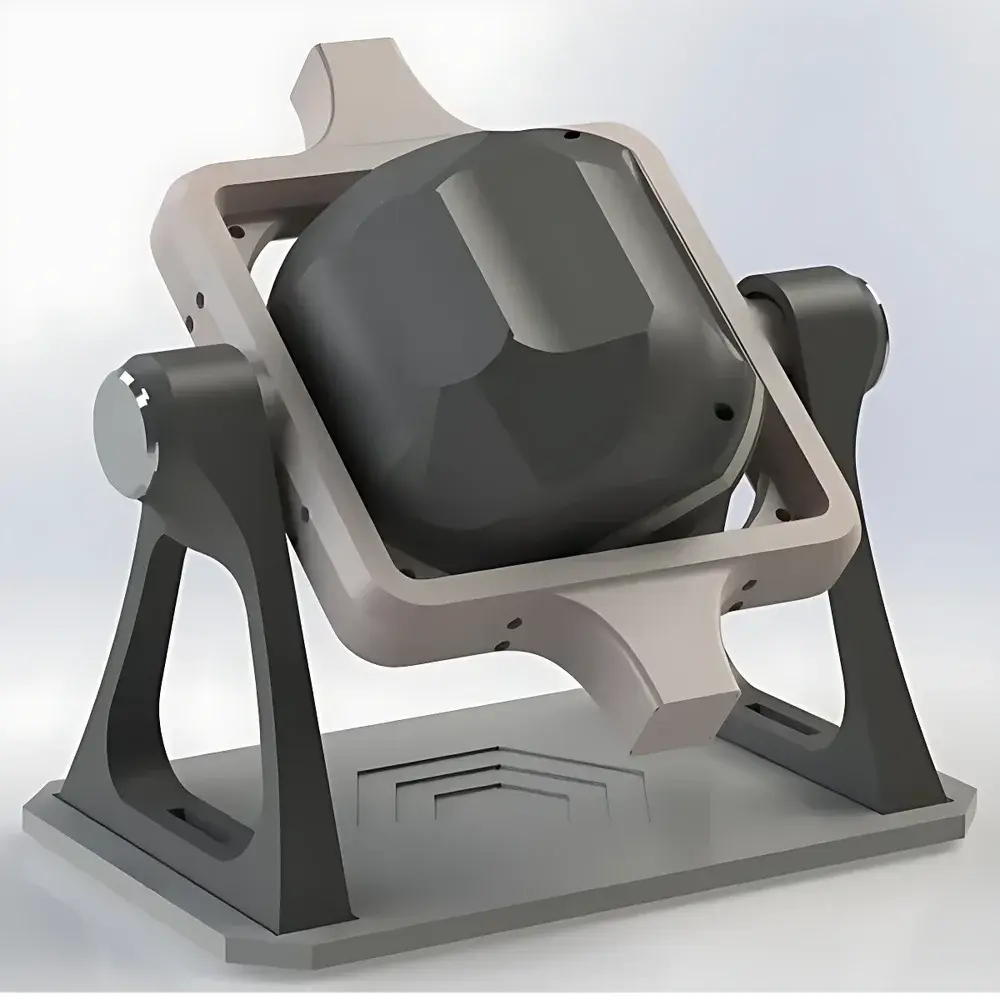
CoSE SciSpinner Max 3D Dual-Axis Clinostat
| Brand | CoSE Instruments |
|---|---|
| Origin | USA |
| Model | SciSpinner Max 3D |
| Rotation Range | 0.05–10 rpm |
| Resolution | 0.001 rpm |
| Imaging | 11.9 MP, 120° FOV, IR-sensitive, autofocus, 1080p/60fps video |
| Illumination | 850 nm IR LED + addressable RGBWW LED array |
| Sensor | 9-axis IMU (gravity, angular velocity, linear acceleration) |
| Power | Dual 5 V / 12 V DC |
| Sample Compatibility | 60 mm & 120 mm Petri dishes, 96-well plates, T25/T75 flasks, 25/50 mL Falcon tubes, plant seedling modules |
| Enclosure Materials | PETG & TPU (biocompatible 3D-printed structural components) |
| Operating Environment | 15–40 °C, 20–95% RH (non-condensing) |
| Acoustic Noise | <40 dB(A) |
| Safety | 12 V DC low-voltage operation with overcurrent and thermal protection |
Overview
The CoSE SciSpinner Max 3D is a precision-engineered dual-axis clinostat designed to simulate microgravity conditions for terrestrial life science research. Unlike single-axis rotation devices, the SciSpinner Max 3D employs independent, programmable rotation of two orthogonal axes—horizontal and vertical—to continuously randomize the gravity vector relative to biological samples. This dynamic reorientation effectively averages gravitational acceleration over time, achieving a high-fidelity ground-based analogue to orbital microgravity (≤10−3 g residual). The system operates on well-established clinorotation principles validated across decades of space biology studies, including NASA’s KC-135 parabolic flight comparisons and ESA’s ground-based validation campaigns. Its core architecture supports rigorous experimental reproducibility in cell suspension culture, plant gravitropism assays, microbial metabolic profiling, and biomaterial development—making it suitable for both academic discovery and bioprocess optimization under GLP-aligned workflows.
Key Features
- Dual-axis independent control: Synchronous or asynchronous rotation modes enable precise tuning of gravity vector cancellation dynamics; each axis driven by closed-loop stepper motors with real-time feedback from integrated 9-axis inertial measurement units (IMUs).
- Ultra-low-speed precision: Stable operation down to 0.05 rpm (±0.001 rpm resolution) minimizes hydrodynamic shear stress—critical for maintaining viability and phenotype integrity in sensitive mammalian cells (e.g., CHO, iPSCs, organoids) during long-term suspension culture.
- Modular optical integration: Standardized mounting interfaces support optional 4K imaging modules, IR-transparent viewing ports, and spectrally tunable RGBWW LED arrays (380–780 nm + 850 nm IR), enabling time-lapse morphological analysis under controlled photobiological conditions.
- Low-noise mechanical design: Fully enclosed, vibration-damped housing with balanced rotor assemblies ensures acoustic emissions remain below 40 dB(A)—preventing mechanical perturbation of delicate structures such as root apices, embryoid bodies, or biofilm matrices.
- Biocompatible construction: Structural components fabricated from medical-grade PETG and flexible TPU via ISO 13485-aligned additive manufacturing processes; non-outgassing, autoclavable sample carriers compliant with USP Class VI standards.
- Secure low-voltage operation: 12 V DC power architecture eliminates electrical hazards in humid incubator environments; embedded protection circuits provide automatic shutdown during thermal excursion (>55 °C) or current overload (>3 A).
Sample Compatibility & Compliance
The SciSpinner Max 3D accommodates standard laboratory consumables without modification—including Corning® 60 mm and 120 mm Petri dishes, Thermo Fisher Nunc™ 96-well plates, Greiner Bio-One T25/T75 flasks, and Falcon™ 25/50 mL conical tubes. A dedicated plant seedling module enables upright growth orientation while permitting full 3D reorientation—validated for Arabidopsis thaliana, wheat, soybean, and maize seedlings under controlled photoperiods. All configurations maintain sterility when used inside Class II biosafety cabinets or CO2 incubators (15–40 °C, 20–95% RH). The system meets IEC 61000-6-3 (EMC emissions) and IEC 61010-1 (lab equipment safety) requirements. Data acquisition logs—including timestamped RPM, IMU vectors, and environmental metadata—are structured to support ALCOA+ data integrity principles and are compatible with FDA 21 CFR Part 11-compliant electronic record systems when deployed with validated LIMS integration.
Software & Data Management
Control is executed via a cross-platform graphical user interface (GUI) accessible through Wi-Fi or Ethernet. The software provides granular parameter configuration: individual axis speed setpoints, rotation profile sequencing (ramp-up/down, dwell intervals), delay-triggered image capture, and real-time IMU telemetry visualization. All operational parameters and sensor outputs are logged in HDF5 format with embedded metadata (MIAME/MINSEQ-compliant headers), ensuring traceability for publication or regulatory submission. Export options include CSV for statistical analysis in R or Python, and DICOM-compatible stacks for 3D reconstruction pipelines. Firmware updates are delivered via signed OTA packages with SHA-256 verification, supporting audit-ready change control per ISO/IEC 17025 requirements.
Applications
- Cell physiology & biomanufacturing: Suspension culture of recombinant protein-producing CHO cells under reduced shear stress; comparative transcriptomics of stem cell differentiation pathways under simulated microgravity vs. static controls.
- Plant gravitropic signaling: High-resolution tracking of Arabidopsis root cap amyloplast redistribution and auxin transporter polarization using synchronized IR-lit time-lapse imaging.
- Microbial secondary metabolism: Modulation of antibiotic synthesis in Streptomyces coelicolor and pigment production in Cryptococcus neoformans under variable clinorotation regimes.
- Biomaterial development: In situ monitoring of collagen-Mg alloy composite mineralization kinetics and endothelial cell adhesion dynamics on aerospace-grade scaffolds.
- Space biology validation: Pre-flight assay standardization for ISS experiments; correlation of clinostat-derived phenotypes with actual microgravity data from JAXA’s Kibo module or NASA’s Rodent Research Hardware.
FAQ
What distinguishes the SciSpinner Max 3D from a random positioning machine (RPM)?
The SciSpinner Max 3D uses deterministic dual-axis clinorotation—not stochastic reorientation—enabling repeatable, programmable gravity vector modulation ideal for mechanistic studies requiring temporal consistency. RPMs prioritize randomness over reproducibility; this system prioritizes experimental control.
Can the device operate inside a CO2 incubator?
Yes—its sealed enclosure, wide operating temperature/humidity range (15–40 °C, 20–95% RH), and 12 V DC power input are explicitly validated for continuous use in standard humidified incubators.
Is the imaging system suitable for fluorescence detection?
While the base configuration includes IR and broad-spectrum white light, optional bandpass filter wheels and cooled sCMOS modules are available for quantitative fluorescence time-lapse (e.g., GFP-tagged PIN proteins in root tips).
How is calibration performed for gravity vector accuracy?
Factory calibration leverages NIST-traceable angular encoders and triaxial gravimetric reference sensors; end-user verification protocols are provided in the SOP manual, including static tilt validation and dynamic g-residual mapping using onboard IMU fusion algorithms.
Does the system comply with FDA or EMA regulatory expectations for GMP process development?
The hardware and firmware architecture supports 21 CFR Part 11 compliance when deployed with validated third-party e-signature and audit trail modules; IQ/OQ documentation packages are available upon request for qualification in regulated bioprocess environments.





